


 from an article 'Palestinian Official Criticizes U.S.', Palestinian Foreign Minister Mahmoud Zahar says:
"Is the Canadian state willing to starve the Palestinian people while the Israelis are committing major crimes against Palestinian industry, Palestinian society, the Palestinian economy, occupying their land?" he said. "Is this is a moral principle according to which Israel should be blessed and supported by the Canadian government and people?"
Palestinian Official Criticizes U.S.
Mar 30, SARAH EL DEEB, Associated Press Writer
GAZA CITY, Gaza Strip
Newly installed Palestinian Foreign Minister Mahmoud Zahar said the United States is biased toward Israel, guilty of crimes against Muslims and Arabs and is widening the rift with the Middle East.
Zahar, considered one of the more hard-line officials in the Palestinians' new Hamas-led government, also said his group would not cave in to international pressure to change its ways and had no plans to negotiate with Israel.
Zahar, responding to a statement by President Bush that Washington would not give aid to a Hamas-led government unless it changed its extremist policies, said those comments were in line with American support for Israel in the United Nations, and its massive aid to Israel.
"America is committing big crimes against the Arab and Islamic countries," Zahar told The Associated Press late Wednesday at his Gaza home. "This new decision will intensify the gap between the American people, American interests and the Middle East in general."
He also said the United States is spending $3 billion a year "to expand settlements and to confiscate our rights and our land," he said, referring to U.S. aid to Israel.
The United States lists Hamas as a terrorist organization and is by law forbidden to deal with such groups.
The United States and Israel have said they will not deal with Hamas unless it recognizes Israel's right to exist, renounces terrorism and respects all past commitments by the Palestinian Authority.
On Thursday, the United States, United Nations, European Union and Russia warned that a Hamas-led Palestinian government could lose aid unless it recognizes Israel.
Canada cut off aid to the Palestinians' new Hamas government shortly after it was sworn in Wednesday, an action Zahar condemned as immoral.
"Is the Canadian state willing to starve the Palestinian people while the Israelis are committing major crimes against Palestinian industry, Palestinian society, the Palestinian economy, occupying their land?" he said. "Is this is a moral principle according to which Israel should be blessed and supported by the Canadian government and people?"
Zahar said Hamas would welcome aid from those wishing to help Palestinians overcome the Israeli occupation, "but if they are going to give this money to twist the neck of our national interests, we are not going to accept that."
He said his group could have contacts with Israel and the United States on day-to-day issues such as health and the environment, but "we have no intentions to make any meeting with any country at the expense of our national interests."
Zahar said Hamas, which swept Jan. 25 Palestinian parliamentary elections, would seek new international alliances beyond its traditional Arab friends.
"The new channels will be Africa, Asian countries, including China, and the South American continent, for assistance politically and also financially," he said.
Despite his job title, it is unclear how much real influence Zahar will have on Palestinian foreign policy. A 2003 amendment to the Palestinian constitution gives the president sole power to appoint or dismiss foreign service officers and to accredit foreign envoys.
Incumbent President Mahmoud Abbas, whose Fatah Party opposes Hamas, favors negotiations with Israel and has declared his acceptance of the U.S.-backed "road map" for Middle East peace, which envisages an independent Palestinian state, coexisting in peace with Israel.
In Jerusalem on Thursday, top U.S. envoys and Israeli officials met to discuss the new Hamas-led government.
White House official Elliot Abrams and Assistant Secretary of State David Welch met with Israeli Foreign Minister Tzipi Livni and were to meet later Thursday with acting Prime Minister Ehud Olmert and Defense Minister Shaul Mofaz, U.S. Embassy spokesman Stewart Tuttle said.
The talks were expected to focus on the repercussions of the new Hamas government and issues related to the peace plan, Tuttle said.
Thursday, March 30, 2006
a determined people, fighting for what they believe
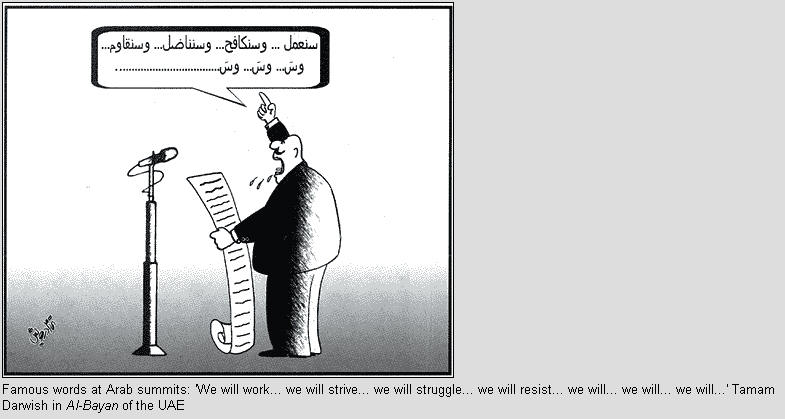
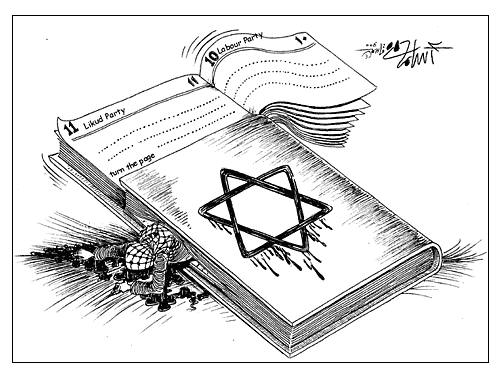
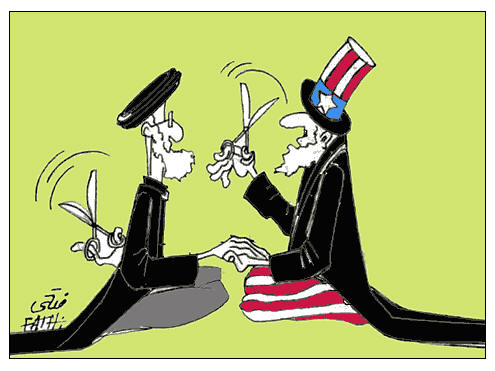
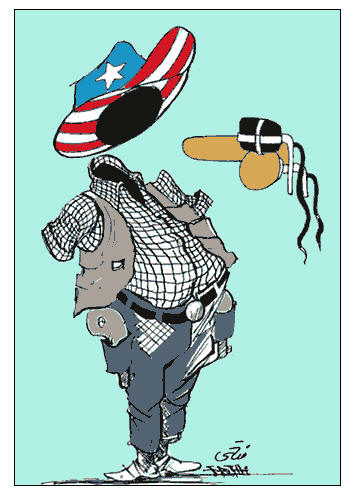
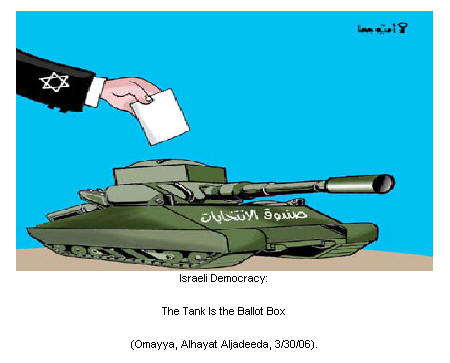
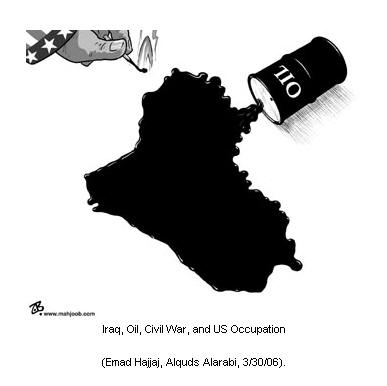
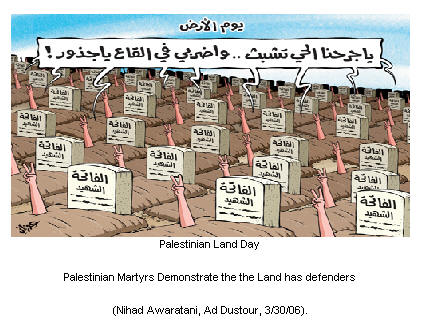
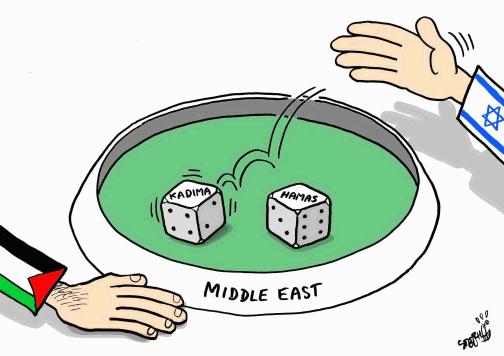
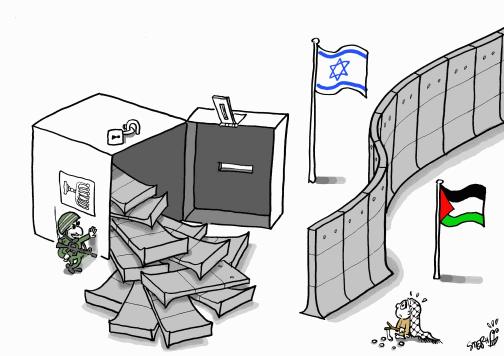

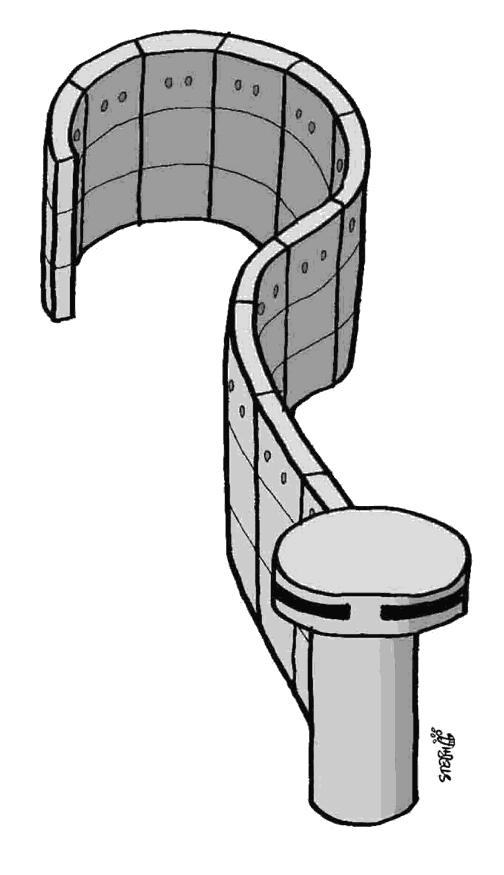
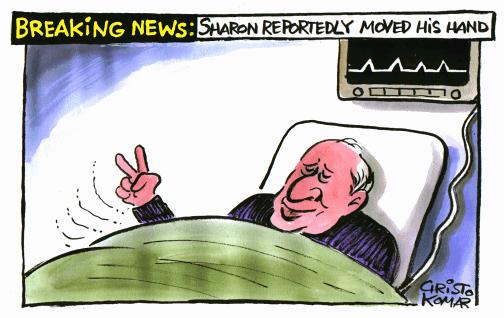
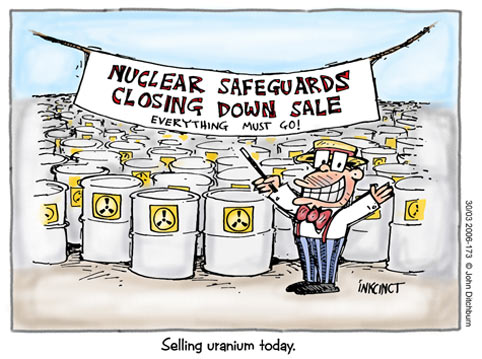
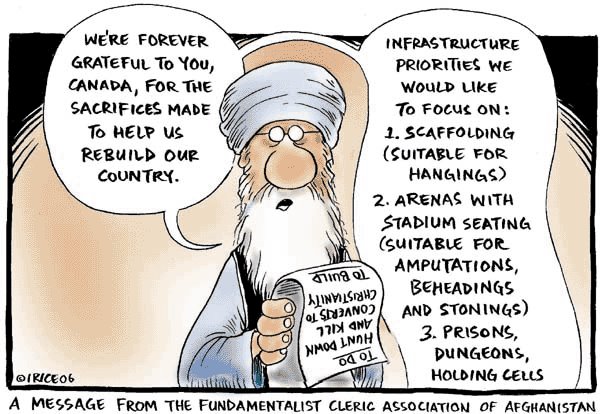
it isn't april 1st, so who are these fools?
 Tory support on rise: Poll
March 30, 2006
CP, OTTAWA -- A new poll suggests Conservative support may be edging upward as Parliament prepares to resume under a new Tory government.
The survey by Decima Research put support for Stephen Harper's Conservatives at 39% nationally, up almost three points from their popular vote in the Jan. 23 election.
Although the Conservative rise remains within the poll's margin of error, the results indicate a widening gap with the second-place Liberals.
Grit support was at 28%, down two percentage points from election day. The NDP was at 19% and the Bloc Quebecois at 11%. The poll of 1,012 respondents was conducted over four days, through Sunday.
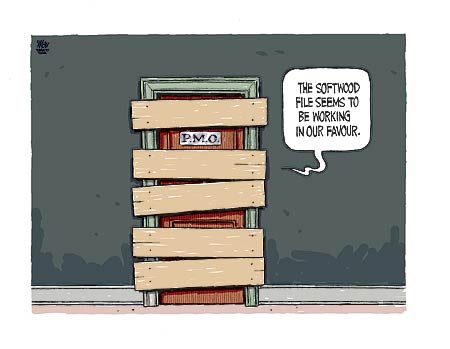
who wins, who loses?
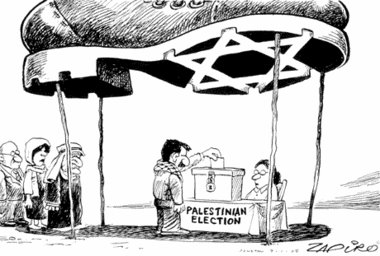 Canada suspends PA aid
30 March 2006, Aljazeera
Defenders of Israel hope that the Conservatives - who took power early last month - will be more pro-Israel than the former Liberal government. ...
The National Council on Canada-Arab Relations said the aid freeze could harm Ottawa's reputation as an honest broker. ...
so far only canada has suspended aid, and the u.s. cuts off contracts .
suspending aid is one thing, but make sure systems are working, before a people have to endure a continual food shortage. or is this the new canadian approach?
An EU delegation
has visited Gaza to get a fresh perspective on food shortages following the Israeli closure of a critical checkpoint ... Gaza's 1.5 million Palestinians suffered food shortages this month because of the closures.
Canada suspends PA aid
Canada has become the first donor to suspend aid to the Palestinian Authority, saying the new Hamas-led government had failed to give assurances that it would recognise Israel's right to exist.
Canada's Conservative government said last month that for funding to continue, Hamas would also have to renounce violence against Israel and agree to stick to the terms of previous peace deals between the two sides. Hamas rejects such demands.
Peter MacKay, the foreign minister, said in a statement on Wednesday: "Canada will have no contact with the members of the Hamas cabinet and is suspending assistance to the Palestinian Authority.
"A clear commitment by the Hamas government to the principles that we and the international community have outlined remains an essential precondition for Canada to resume any assistance to the Palestinian Authority."
Canada gives C$25 million ($21 million) a year to the Palestinian Authority to fund aid projects.
'Collective punishment'
Although the United States, the European Union and other donors say they are also concerned about the Hamas government, they have yet to cut assistance.
Mushir al-Masri, a Gaza-based legislator in the new Palestinian parliament, said the freeze showed that Canada was biased towards Israel.
"This hasty decision represents a collective punishment on the Palestinian people who practiced their democratic choice [in electing Hamas]," he told Reuters.
MacKay's announcement came hours after Washington ordered its diplomats and contractors not to have any contacts with Palestinian ministries once the government had been sworn in on Wednesday.
Josee Verner, the International Co-operation Minister, said Ottawa would continue to "support and respond to the humanitarian needs of the Palestinian people" by working through the United Nations, its agencies and other organisations. She gave no further details.
Pro-Israel
Defenders of Israel hope that the Conservatives - who took power early last month - will be more pro-Israel than the former Liberal government.
The Israeli embassy in Ottawa welcomed MacKay's statement.
"The Canadian decision reaffirms the international community's demand ... to the new Palestinian government to stop terrorism against Israel, to recognise Israel and to abide by the previously signed agreements between the two parties," it said in a statement.
The National Council on Canada-Arab Relations said the aid freeze could harm Ottawa's reputation as an honest broker.
Hussein Amery, the council president, said: "We're disappointed and perplexed that Canada would be the first to decide to make this move."

Wednesday, March 29, 2006


oh really; bush says iraq instability is of hussein, not invasion
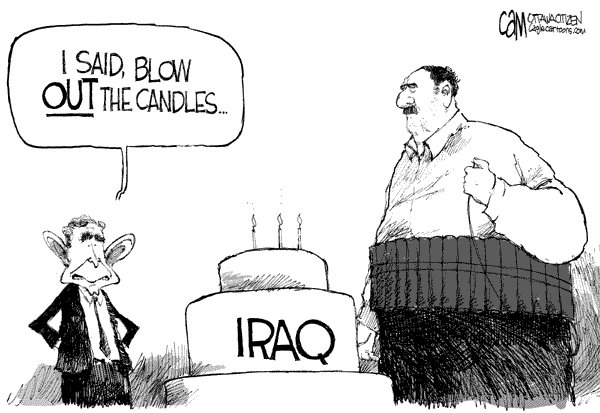 Bush Says Iraq's Sectarian Divide a Legacy of Hussein
March 29 (Bloomberg)
President George W. Bush said the instability in Iraq today is a legacy of Saddam Hussein's regime and not the result of the U.S. invasion that toppled his government.
The sectarian violence that has enveloped Iraq is boiling over now because Hussein left the nation ``physically and emotionally scarred'' by purposely dividing ethnic and religious groups to prevent them from challenging him, Bush said.
``He sought to establish himself as the only force that could keep Iraqis together,'' Bush said today in Washington in an address to the Freedom House, a non-profit organization that promotes the spread of democracy. ``It is no wonder deep divisions and scars exist.''
One of the key ways to heal those divisions, he said, is by training an army loyal to the central government and ridding police forces of the influence of sectarian militias.
Bush's speech on Iraq is his third in as many weeks as he continues attempts to reassure the American people that the conflict is worthwhile and that Iraq is on the path to democracy. The president said he wanted to address the ``legitimate questions'' being raised in the U.S., including why are Iraqis so divided and ``did America cause the instability'' that is being seen now?
`Determined to Succeed'
Bush said Iraqis are ``determined to succeed'' in building a democracy, as shown by wide participation in three elections. After the terrorist bombing of a mosque last month, Iraqi troops took the lead in confronting the sectarian violence that broke out, he said.
Helping the Iraqis is vital to U.S. security, Bush said, because a failure of the military mission will mean a victory for terrorists trying to establish a base in Iraq.
``Pulling our troops out prematurely would be a disaster,'' he said. ``America will leave Iraq, but we won't retreat from Iraq.''
Democratic Representative John Murtha of Pennsylvania last year sparked a debate about the U.S. presence in Iraq, saying the U.S. should begin immediately withdrawing from most of the country. Murtha argues that the U.S. presence is driving much of the insurgency.
Murtha's call for a withdrawal has divided congressional Democrats and only House Minority Leader Nancy Pelosi of California among the party's leaders has endorsed it.
Democratic Criticism
Democrats today offered their own plan for national security today, which calls for making 2006 a ``year of significant transition to full Iraqi sovereignty'' and for a ``responsible'' redeployment of U.S. troops. Their agenda doesn't address when to withdraw U.S. forces. Senate Minority Leader Harry Reid used the opportunity to criticize Bush for sending ``mixed messages'' on Iraq.
``The president can give all the speeches he wants, but nothing will change the fact that his Iraq policy is wrong,'' the Nevada Democrat said in Washington.
The U.S. has about 133,000 military personnel in Iraq and the Defense Department previously has said it was making plans to decrease that number to less than 100,000 by year's end if the Iraqis continue to make progress.
Republican Senator John McCain of Arizona, who was in Iraq last week, said yesterday that while Iraqi troops are ``doing better'' at leading the battle with insurgents, ``It's going to be a slower process than some anticipate.''
Bush's job approval rating has been less than 40 percent in most national polls over the past month as an increasing number of Americans say they believe the war is going poorly. At the same time, members of Congress, including some lawmakers from Bush's Republican Party, are urging the president to put more pressure on Iraqi political leaders to form a unity government and set benchmarks for progress.
During a question-and-answer session after the speech, Bush said the U.S. is worried about Iran's influence in the formation of an Iraqi government and remains ``deeply concerned'' about whether the Iranians have the ability to build a nuclear weapon.

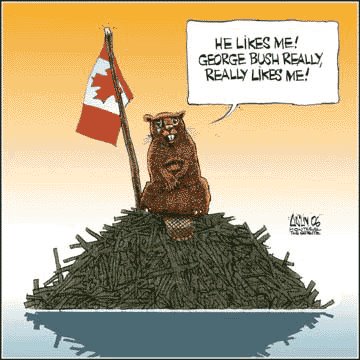
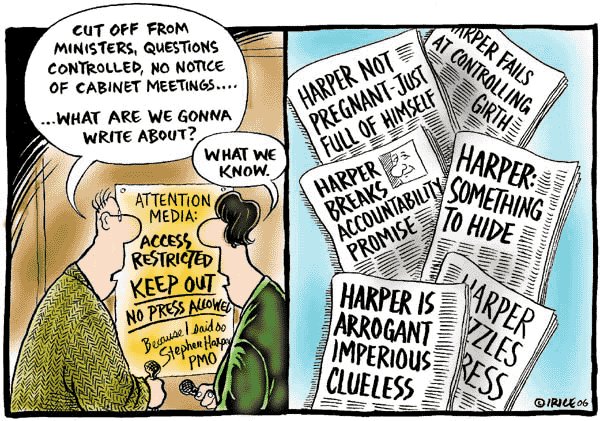
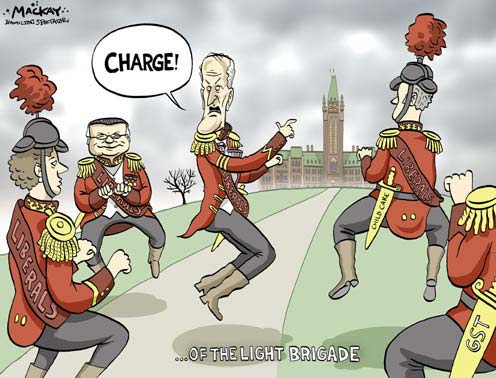
wake up mackay ...

as canada cuts aid; "Foreign Affairs Minister Peter MacKay announced the news Wednesday after the Palestinian Legislative Council approved the formation of a Hamas-led government" .... "Canada also makes an important distinction between assistance to the Palestinian Authority and to Palestinians," International Co-operation Minister Josee Verner says in the same article "Working with our partners and through the United Nations, its agencies and other organizations, Canada will continue to support and respond to the humanitarian needs of the Palestinian people." [ Canada cuts aid to Palestinians - Hamas formally takes power March 29, 2006 OTTAWA (CP) ] ....
and coincidently on the same day:
US cuts off contacts with Hamas-led government (Reuters)
The United States ordered its diplomats and contractors on Wednesday to cut off contacts with Palestinian ministries after a Hamas-led government was sworn in, the State Department said.
UN food aid agency calls for permanent opening of crossing from Israel to Gaza Report
UN News, 24 March 2006
With the humanitarian crisis in the Gaza Strip deteriorating and food and other supplies running short due to Israeli closures, the United Nations World Food Programme (WFP) warned today that it was crucial for this week a 48-hour opening of the Karni crossing point to become permanent.
WFP, which provides food aid to some 160,000 Palestinians in Gaza, was able to bring in 16 containers, containing 300 tons of food, mainly beans and vegetable oil, but this was a very limited amount, agency spokesperson Christiane Berthiaume told a news briefing in Geneva.
A further problem was that the Israeli authorities were not allowing WFP to bring out the empty containers, and the agency needed to fill them again and bring them back in. Israel closed the crossing earlier this month, citing security concerns.
A second crossing, Kerem-Shalom on the Egyptian side, had been opened and WFP would try to bring food in from there, but it was a new checkpoint and was not yet organized sufficiently to bring in the amount of food required, Ms. Berthiaume said.
Five trucks, containing 260 tons of food donated by Egypt, had gone through, mainly with wheat flour.
It was very important for the two checkpoints to stay open, and crucial in the case of Karni not only for food relief but also for commercial transactions.
There was currently very little wheat flour in the Gaza Strip, which required 450 tons per day. The 300 tons of other foods that had been brought in would not feed many people for very long and WFP was currently investigating how it could buy wheat flour outside Gaza and bring it in, Ms. Berthiaume said.
Earlier this week, WFP appealed to the Israeli authorities to allow consignments to reach the tens of thousands of people who depend on outside assistance to survive, warning that the extended closures of Karni could have had a devastating effect.
and the heavy hand comes down
 Olmert builds Israeli coalition
March 29, 2006
JERUSALEM (Reuters) - Interim Prime Minister Ehud Olmert began building a coalition on Wednesday after winning an election on plans to set Israel's final borders within four years with or without agreement of its Palestinian neighbor.
In Gaza, Palestinian President Mahmoud Abbas swore in a Hamas government, handing the militants an administration on the brink of financial collapse and fighting Western isolation.
The United States in response ordered its diplomats and contractors not to have contacts with any Palestinian ministries, U.S. officials said. Hamas is committed to Israel's destruction.
Appealing to Abbas, Olmert, head of the centrist Kadima party, said Israel favored peace negotiations to end decades of conflict.
But in the continued absence of talks -- a remote prospect with Hamas now in power -- Olmert has vowed to draw Israel's frontier by 2010 by removing isolated settlements in the occupied West Bank and expanding bigger ones.
Palestinians say such a move would annex land and deny the viable state they seek in the West Bank and Gaza Strip. Abbas told reporters in Gaza the Palestinians "will not accept, at any price" unilateral Israeli moves.
Kadima fared worse than expected in Tuesday's poll, signaling Olmert might struggle to sustain support for his plan. The party's showing of 28 seats in the 120-member parliament was among the lowest for an election winner.
But some political analysts said Olmert should be able to stitch together a coalition that would avoid the need to negotiate with right-wing parties opposed to any withdrawal from West Bank land that settlers see as a biblical birthright.
"I think we can run a government with 28 seats. It will be difficult, but possible," elder statesman and senior Kadima politician Shimon Peres said on Army Radio.
In separate comments to Channel 2 television, Peres said it would be "at least a year" before Olmert's West Bank plan is put into effect.
The sweeping measures would uproot tens of thousands of settlers, far more than the 8,500 evacuated from Gaza last year, while tracing a border along a fortified barrier Israel is building inside the West Bank, where some 240,000 Israelis live among 2.4 million Palestinians.
COOPERATION
After the Hamas cabinet members took the oath of office, Palestinian Prime Minister Ismail Haniyeh pledged "coordination and cooperation" with Abbas, whose Fatah movement had refused, along with all other factions, to join a governing coalition.
The president coaxed Hamas to accept a ceasefire with Israel last year but the group insists it will not abandon what it calls a right of armed resistance against occupation.
Asked by reporters if Abbas could seek to revive talks with Israel on his own, Haniyeh said: "As the elected president, he can move politically in any direction he wants. We have no problem at all."
Olmert's foreign minister, Tzipi Livni, has publicly dismissed Abbas as "irrelevant."
In a telephone call to Olmert, U.S. President George W. Bush invited him to the White House after he forms a government. Olmert has said he would seek support from the United States and other countries before taking unilateral steps.
The new U.S. directives on dealings with the Palestinian government will limit a wide range of U.S. programs, including security coordination through the Palestinian Ministry of Interior.
Contacts will be permitted with Abbas, his personal office and non-Hamas legislators.
The Israeli election came two months after Hamas's shock win in parliamentary polls, prompting the Jewish state to halt tax revenue transfers and threats from Western countries to cut aid unless the group recognized Israel and disarmed.
Opinion polls had originally predicted Kadima would win 44 seats. Election results showed that second place went to center-left Labour, with 20 seats, while other parties netted between four and 13 seats.
Kadima, founded just four months ago, was expected to seek a coalition with Labour and small parties, in talks that could last weeks. Some religious parties and one representing pensioners could back Olmert's West Bank plan.
The World Court has ruled all 145 settlements Israel has built on occupied territory illegal. Israel disputes this.
President Moshe Katsav is expected to formally assign the task of putting together a government after consultations with parties on Sunday.
(Additional reporting by Adam Entous and Allyn Fisher-Ilan in Jerusalem and Nidal al-Mughrabi in Gaza)
israeli way or no way
Arabs Offer Peace, Warn Against Punishing Palestinians
March 29, 2006, The Palestine Chronicle
The Arab leaders urged the international community not to punish the Palestinians for democratically voting Hamas into power. KHARTOUM - As Israelis voted to elect a parliament that could give the new government a mandate to impose permanent borders with the Palestinians, Arab leaders meeting in Sudan on Tuesday, March 28, reaffirmed peace commitment and renewed a land-for-peace offer to Israel.
"I call on the ... Quartet (of international mediators) to double its efforts so that Israel responds to repeated Arab calls for peace, especially the Beirut resolutions," said host Sudanese President Omar Hassan al-Bashir, reported Reuters.
Algerian President Abdelaziz Bouteflika and King Mohammed of Morocco, in a speech read by his prime minister, urged the Quartet, which groups the US, the EU, Russia and the UN, to help revive Middle East peace talks.
At the 2002 Beirut summit, all Arab states offered Israel peace in return for withdrawal from Arab lands occupied by Israel in the 1967 war.
Israel rejects the offer as unrealistic and interim prime minister, Ehud Olmert, has campaigned in elections on a plan to set Israel's borders by 2010 by retaining big Jewish settlement blocs in the occupied West Bank, while dismantling smaller ones.
Palestinian President Mahmoud Abbas asked for more financial aid "to reinforce the steadfastness of our people."
The Arab leaders also urged the international community not to punish the Palestinians for democratically voting Hamas into power.
"All calls to distort the political meaning of the Palestinian choice by threatening to boycott it and cut aid cannot be justified," Bouteflika told the gathering.
"This can only be seen as an unfair punishment to a whole people on a choice they made freely," he added, referring to the stunning win of the resistance movement Hamas in January's legislative election.
Beshir also condemned "punishing the Palestinian people for practicing their right to choose who rules them."
A draft resolution agreed to during a two-day meeting of Arab foreign ministers ahead of Tuesday's summit demanded the international community not suspend funding to the Palestinian Authority and to "respect the democratic choice of the Palestinian people."
The EU and the United States have threatened to sever all aid to the Palestinian Authority once Hamas, which they both list as a terrorist organization, takes power.
The 24-member Hamas-led government on Tuesday the overwhelming backing of Palestinian lawmakers after a long and fiery debate on the government's political platform presented by Prime Minister Ismail Haniya.
The Arab leaders also rallied behind Sudan in its refusal to replace African Union peacekeepers with UN ones in the troubled region of Darfur.
"The African Union forces are capable of accomplishing their mission in Darfur without any foreign intervention," Beshir told the summit.
He called on "Arab countries and the international community to support financially the AU forces," which are cash strapped and undermanned.
Arab League officials say the pan-Arab body has already given about $200,000 to the AU mission in Darfur and another $50,000 to the Abuja peace process, a minor amount considering the AU mission needs $17 million a month.
"They are unlikely to get a significant amount of money," one Arab diplomat, who declined to be named, told Reuters.
The UN Security Council voted on Friday, March 25, to speed up plans to deploy peacekeepers to replace the African Union mission in Darfur.
An Arab League official told AFP only Egypt and Arab League Secretary General Amr Moussa are backing full implementation of the UN Security Council resolution on Darfur, while other members are lining up behind Sudan.
A number of key regional heavyweights, including President Hosni Mubarak of Egypt and Saudi King Abdullah Bin Abdel Aziz, missed the annual summit, which was cut down to one day instead of two.
Only twelve Arab heads of state, from 22 Arab League members, attended the opening session -- a disappointing turnout for the Sudanese hosts.
Jordan's King Abdullah II became the latest Arab leader to announce he will be skipping the summit in Sudan.
Also absent are Bahrain's King Hamad bin Issa Al-Khalifa, United Arab Emirates President Khalifa bin Zayed Al-Nahayan, Morocco's King Mohammed VI, Sultan Qaboos of Oman, Iraqi President Jalal Talabani and his Tunisian counterpart Zine El-Abidine bin Ali.
Syrian President Bashar Al-Assad and Lebanese Prime Minister Fuad Siniora shook hands on the summit sidelines despite simmering tensions between the two neighbors.
Siniora, who is attending the summit despite the presence of President Emile Lahoud, told Assad hat he wished to visit Damascus, a member of Siniora's delegation said.
Syrian-Lebanese relations have been strained since the assassination of Lebanon's former premier Rafiq Hariri in February last year.
canada cuts palestinians
 Canada suspends funding to Palestinian Authority
Reuters - Canada became the first donor to suspend aid to the Palestinian Authority on Wednesday, saying the new Hamas-led government had failed to give assurances that it would recognize Israel's right to exist.
Canada halts diplomatic ties, aid to Hamas-led government
AFP - Canada has suspended all contact and financial aid to the new Hamas-led government in the Palestinian territories, Foreign Minister Peter MacKay announced.
Canada cuts aid to Palestinians
Hamas formally takes power
March 29, 2006
OTTAWA (CP) - Canada is cutting assistance and diplomatic ties to the Palestinian Authority because the new Hamas government has not renounced violence.
However, Ottawa will still provide humanitarian aid to the Palestinian people through the United Nations and other organizations.
Foreign Affairs Minister Peter MacKay announced the news Wednesday after the Palestinian Legislative Council approved the formation of a Hamas-led government.
"The stated platform of this government has not addressed the concerns raised by Canada and others concerning non-violence, the recognition of Israel, and acceptance of previous agreements and obligations, including the Roadmap for Peace," MacKay said in a statement.
"As a result, Canada will have no contact with the members of the Hamas cabinet and is suspending assistance to the Palestinian Authority."
MacKay added that the new government must make a "clear commitment" to peace before Canada will resume assistance.
International Co-operation Minister Josee Verner said Canada remains committed to a negotiated solution to the Israeli-Palestinian conflict.
"Canada also makes an important distinction between assistance to the Palestinian Authority and to Palestinians," she said.
"Working with our partners and through the United Nations, its agencies and other organizations, Canada will continue to support and respond to the humanitarian needs of the Palestinian people.
"Canada will also continue to work with the voices of moderation within Palestinian society."
roles media plays in politics
 It’s the Media, Stupid
Ramzy Baroud, 29, March, 2006
There is little disagreement on the indispensable role of the media in influencing political debate and narrative, thus shaping public discourse.
Among progressives, liberals and most political minorities in the United States and Europe, there is also consensus regarding the troubling alliance that is bringing warmongering politicians, ideologues, religious zealots and media moguls together. They alone possess the capabilities to sway the public in any way they wish, or so it seems; they stack a nation’s priorities in the way they find most fit; they concoct wars and justify them when they go awry. In short, they manipulate democracy by manipulating the public, using whatever means necessary: Fear, misinformation and all the familiar rest.
No other issue has been the victim of such treachery as the Middle East discourse in the West, and particularly that concerning Palestine and Israel. This is a subject that is as old as the conflict itself. Even before the establishment of the State of Israel upon the hundreds of conquered and mostly destroyed Palestinian towns and villages in 1947-48, the founders of Israel seemed utterly aware of the destructive impact of their action on Western public opinion. Israeli historian Benny Morris’ commanding book, The Birth of the Palestinian Refugee Problem is dotted with instances where “in their secretive dealings” Zionist politicians bickered over the massacring of Palestinians or their overt ethnic cleansing particularly because of how such blatant actions could damage Israel’s image in the West, not because of the immorality of the acts themselves.
This “image” problem has indeed irked Israel since day one and continues to do so; this is why the term “PR disaster” has always constituted a nightmarish scenario for Israeli politicians throughout the years, and subsequently turned Israel into a master in media spins and crisis management. Israel understood well that in order for its habitually indefensible policies, so evident in the illegal confiscation of land, the oppression of people and the defiance of international law, and so on, to be justified, facts have to be spun, truths hidden and a new discourse, one that defies reality altogether, would have to be woven, as it has.
Thus, despite the fact that the Arab-Israeli conflict is the most reported media story on earth, it is the least understood, seemingly the least rational, and most certainly one with the least potential to be resolved. The media’s skewed narrative makes the conflict an end in itself; it creates a status quo that is most suitable for Israel’s colonial policies and least desirable for Palestinians, who are silently — or so it seems — losing their land, their livelihood and any prospect of freedom, let alone their refugees’ right of return.
Israel’s impact on the media, however, has metamorphosed throughout the years, from that seeking to influence to the one doing its own molding of public opinion. Israel’s dedicated media friends, from the New York Times to the British Telegraph are perhaps the largest and by far the most influential interest groups in the media anywhere around the world, a fact that they often rebuff. But the facts are too apparent to deny. According to the findings of a recent study conducted by two top American scholars — Professor John Mearsheimer at the University of Chicago and Professor Stephen Walt of the Kennedy School of Government at Harvard University — the single largest influence on US foreign policy in the Middle East is Israel’s interest, even when it is at odds with the United States own interests. The study cited the Israeli lobby AIPAC as chiefly responsible for hijacking US foreign policy in the Middle East and has based its apparently thorough research on diverse sources, including uncountable media reports.
Many are already familiar with the “special” ties between the United States and Israel, which arguably allowed the latter to steer the foreign policy of the “greatest democracy on earth” into the Middle East political abyss. But most might not be aware of the fact that the media is largely responsible for manufacturing that “special relationship”. In fact, US interests in the Middle East — be they political, economic, i.e. strategic — have been greatly hampered, thanks to the perpetual, albeit misguided advocacy by Israel’s allies in the administration, Congress, media and “independent” think tanks and endless lists of “experts” unleashed whenever Israel’s image is at risk.
But what has in fact magnified the impact of the Israeli lobby and its influence in the media whose work on behalf of Israel goes well beyond the Middle East to cover Africa, Asia, Latin America, and of course, Washington itself, also described as “the other occupied territory” by a former US congressman was the pitiable and most disorganized response of Palestinians, Muslims and Arabs. Some out of fear, perhaps, chose to disown the matter altogether using whatever injudicious logic they could drum up. Others tried to develop their own media alternatives, which is commendable. However, such mediums have failed — unlike the Israeli media machine — to carry any depth, strategy or sense of unity toward a fixed goal. In fact, it reflected Arab factionalism and brought into question the actual motives behind these “alternative” ventures.
The result has been catastrophic. Israel’s decades-long quest to bolster its media image has done wonders as American public opinion either sees Israel as a lone defender of democracy amid uncivilized Arab polities or not at all aware of the facts, basing its inane understanding of Middle East politics on half-truths that see Arabs as irrational, lazy and inherently violent.
I am afraid that many Palestinians, Arabs and Muslims are themselves content with the status quo and are the least interested in reversing their misfortune or appreciating the immense impact of the media on politics, wars and indeed peace. There is an overall inclination that associates media bias with racial categorization — always the easy answer to all enigmas — which is usually followed by a shoulder shrug and the defeatist impression that “all is lost”, an echo of the same defeatist sentiment that has accompanied the Arab-Israeli conflict since its inception.
However all is not lost, for even the most focused misinformation can be reversed, no matter how humble the initiative, how modest the resources. I have said so for many years and many have said it before me and many will continue to echo the same idea: With all due respect “it’s the media, stupid.” And if one is foolish enough to neglect its import, then maybe one deserves to be burned by its fire.
— Ramzy Baroud is the author of The Second Palestinian Intifada: A Chronicle of a People’s Struggle.
was the trial rigged?
Two Nut Jobs and a Boeing 747
Kurt Nimmo, March 28, 2006 One of the most obvious lies in the show trial of Zacarias Moussaoui came when a court-appointed physician, Dr. Raymond Patterson, declared Moussaoui was not suffering from mental illness. Patterson made the assertion after Moussaoui said he wanted to fire his lawyers and represent himself. Moussaoui’s lawyers “became convinced that their client’s mental condition, already precarious, was deteriorating under the stress of solitary confinement, and that he was becoming increasingly paranoid,” writes Seymour Hersh for the New Yorker. In response to Patterson’s assertion that Moussaoui was sane enough to present his own defense, two “mental-health experts retained by the defense, Dr. Xavier Amador, of Columbia University, and Dr. William Stejskal, of the University of Virginia, argued that Patterson’s conclusions were unfounded and that Moussaoui needed further evaluation.” Judge Brinkema did not agree and ruled from the bench on June 13th, 2002, without hearing testimony, “that the defendant met the legal standard of competency.”
In fact, Zacarias Moussaoui is a stark raving lunatic, given to paranoid outbursts in the courtroom, and he was deemed sane for the simple reason that the government needs a conviction to prop up its ludicrous whitewash commission fairy tale about “al-Qaeda” cave dwellers attacking America on September 11, 2001.
Zacarias Moussaoui “is the only person charged in relation to the events of Sept. 11,” writes Stephanie Mencimer, a Washington Monthly contributing editor. “He was arrested after a flight-school instructor tipped off the FBI that he had asked to learn only how to fly, but not to take off or land. The government is working very hard to persuade people that this is a serious prosecution of a man who was supposed to join 19 other terrorists in hijacking four passenger planes on Sept. 11. They would like the world to believe that Moussaoui is a dangerous threat to national security and a calculating operative of al Qaeda who should be executed. But Moussaoui’s behavior has made that an uphill battle. His filings in federal court led lawyers interviewed by Legal Times to dub him ‘crazy as a loon.’”
For some reason we are expected to believe this loon was capable of crashing a 747 into the White House.
“Zacarias Moussaoui testified that he and would-be shoe bomber Richard Reid planned to hijack a jetliner and fly it into the White House on the day of the Sept. 11 attacks,” reports Bloomberg. “Moussaoui said al-Qaeda leaders asked him in 1999 if he wanted to be a suicide pilot and he declined. He said that later, when he was in al-Qaeda leader Osama bin Laden’s compound in Afghanistan, he told bin Laden he had dreamed of making plans to fly a plane into the White House. After that he decided to become a suicide pilot, Moussaoui said.”
If you believe any of this there is a proverbial bridge in Brooklyn I’d like to sell you.
Moussaoui “couldn’t maintain basic aircraft control,” his flight instructor at Airman Flight School in Norman, Oklahoma, Shohaib Nazir Kassam, told the Los Angeles Times. “He was a not a very good student. Just below average.” Average flight students solo after 15 hours of practice with an instructor, but Moussaoui wasn’t up to the task after nearly 60 hours of training. As an example of how out of touch he was with reality, Moussaoui told another flight school “My dream is to fly one of these big birds” and “After all we are in America and everything is possible.” Clarence “Clancy” Prevost, a flight instructor at the Pan Am International Flight Academy in Eagan, Minnesota, told the court there was something “odd” about Moussaoui. “For instance, he asked absurd questions: Could the cabin doors be opened after they were pressurized and the plane was aloft?”
But the paramount absurdity is Moussaoui’s claim he plotted to hijack an airplane with Richard Reid (aka Abdul Raheem or Abu Ibrahim), a certifiable mental case and not the sharpest knife in the drawer now serving three life sentences in the ADX Florence, a Supermax prison in Florence, Colorado. Reid of course attempted to blow up his shoes (containing plastic explosive with a triacetone triperoxide detonator) on American Airlines Flight 63 going from Paris’ Charles De Gaulle International Airport to Miami International Airport.
It is said Reid reported directly to alleged nine eleven “mastermind” Khalid Shaikh Mohammed, the “al-Qaeda” operative who had no problem obtaining a visa to enter the United States a mere six weeks before nine eleven, even though the CIA and FBI knew Mohammed was involved in Oplan Bojinka, also known as Operation Bojinka, a foiled attempt to assassinate the Pope and crash a plane into the CIA headquarters in Langley, Virginia and other buildings. It is well known that Mohammed also worked with the ISI, Pakistan’s notorious intelligence agency and partner with the CIA in creating the dire threat we now call “al-Qaeda.”
Reid was a follower of Syed Mubarik Ali Gilani, the Pakistani clerical leader of Tanzeem ul Fuqra or al-Faqra, an "Islamic sect that seeks to purify Islam through violence," according to the http://www.uruknet.info/
Simply put, both Zacarias Moussaoui and Richard Reid are patsies, two doltish fall guys provided to put a sinister (if pathetic) face on the beast our government and corporate media call "al-Qaeda." It was never intended that Moussaoui see the cockpit of a commercial airliner and if indeed "al-Qaeda" had wanted to blow up American Airlines Flight 63 over the Atlantic Ocean, they would not have selected a bumbling petty criminal such as Richard Reid to accomplish the task.
Stunning Zacarias Moussaoui into Submission?
Kurt Nimmo, March 28, 2006 NBC news reporter Pete Williams speculates that the feds have rigged a defiant Zacarias Moussaoui with a stun belt, an "electro-shock" device, apparently part of a growing "shock technology" arsenal used by torturers in South Africa, China, and Lebanon. "Amnesty International is extremely concerned about the introduction by the prison authorities in the United States of America of a remote controlled electro-shock stun belt for use on prisoners in chain gangs, judicial hearings and transportation," the human rights organization declared in 1996. "Officers can use it to psychologically threaten a prisoner, and it appears designed to humiliate and degrade a prisoner… Data from other electro-shock weapons indicate that the high pulse 50,000 volt shocks lasting eight seconds at a time could result in longer term physical and mental injuries."
Is it possible Moussaoui is now admitting he was involved in a plot to crash an airliner into the White House with the shoe bomber mental case Richard Reid in a Pavlovian response to 50,000 volts of electricity? If the feds are using electro-shock against the alleged wanna-be "al-Qaeda" operative, is it possible they are also drugging him? Aicha el-Wafi, Moussaoui’s mother, believes her son "must have been drugged" when she saw him in court, according to Yahoo News. "That is not Zachary," she declared.
It should be remembered that Moussaoui previously denied any involvement in the nine eleven attacks and his sudden if not electrifying (pun intended) eleventh hour conversion during the penalty phase of his trial is highly suspicious. Moreover, according to nine eleven "mastermind" Khalid Shaikh Mohammed (supposedly in custody), Moussaoui was to take part in a second wave of attacks and was not part of the September 11, 2001, attack. Of course, this contradiction is not worth consideration, either by the jury or the corporate news media. It appears the patsy Zacarias Moussaoui is indeed a dead man walking—with a little help from a 50,000 volt shock belt.
Addendum
As an example of Moussaoui’s precarious mental state, Daniel McGrory, billed as a Times Online "al-Qaeda expert," cites several examples of his unusual behavior. "Asked why he signed a guilty plea as 'the twentieth hijacker’, Moussaoui smirked and said: 'Because everybody used to refer to me as the 20th hijacker and it was a bit of fun,’" McGrory writes. "Prosecutors have no interest in demolishing Moussaoui’s extraordinary confession as the self- proclaimed al-Qaeda terrorist seems to have done their job for them. It does not appear to matter to them that Moussaoui’s testimony contradicts their own evidence."
It appears Moussaoui made things up as he went along. "Defense lawyers argue he has repeatedly changed his story about his supposed role in a deliberate attempt to confuse US authorities…. First he claimed he was to be used in a plot to free a blind Egyptian cleric, Sheikh Omar Abdel-Rahman, jailed in the US in 1996 for an earlier attempt to blow up the World Trade Centre. Moussaoui told how he was to pilot a plane carrying the freed sheikh to Afghanistan…. Then he changed his mind and said that he was to take part in a second wave of aerial attacks in the US. He did not give a date, but claimed he was to crash his aircraft into the White House."
Moreover, Moussaoui’s claim he plotted with the demented shoe bomber Richard Reid is at odds with the facts. "The question to be asked about his latest confession is, why would he implicate Richard Reid, his friend from their days at Finsbury Park mosque? Both men were at training camps in Afghanistan at the same time but, as evidence has shown, Reid, and another young Briton, Saajid Badat, were being groomed for an entirely different role…. Investigators know that Reid’s path never crossed that of the 9/11 cell. Before he was ordered to carry a bomb onto a plane, Reid had other uses for al-Qaeda. Using his British passport, he was sent on reconnaissance missions across Europe and the Middle East at the time the 9/11 hijackers were finalizing their plans…. There is no mention of anything remotely connected to 9/11."
Moussaoui is a textbook example of a patsy. "The patsies ultimately have three vital functions," explains Webster Griffin Tarpley. "The first is that they have to be noticed. They must attract lots and lots of attention. They may issue raving statements on videotape, or doubles can be used to issue these statements for them if they are not up to it. They need to get in to fights with passersby, as Mohammed Atta is said to have done concerning a parking space at the airport in Maine early in the morning on September 11."
"Those who remember Moussaoui from his loudmouth displays at London mosques, and who trained with him in Afghanistan, describe him as a man who enjoyed exaggerating his own importance," McGrory continues. "He claimed to be a particular favorite of Osama bin Laden, which none of the al-Qaeda captives verify…. He liked the idea that London had provided al-Qaeda with a small army of would-be suicide bombers, and that he would be the first to die. He continually boasted about wanting to be a martyr for al-Qaeda…. After his testimony yesterday he may yet get his wish."
Tuesday, March 28, 2006
understanding the seal hunt
Nunavut premier defends seal hunt as way of life for Arctic aboriginals
March 27, 2006 BRUSSELS, Belgium (AP) - A top Canadian Inuit official defended his country's seal hunt Monday, saying it was vital to the survival of aboriginal peoples in the Arctic and provided an economic lifeline for an area desperate for jobs and growth.
Paul Okalik, premier of Canada's northern Nunavut territory, said the majority of the 30,000 people in his region were dependent on seals and other native species like polar bear and fish for their everyday food.
"This is our daily basic diet - we can't grow potatoes. . . . It's something we require to continue to survive and its far more nutritious than what is imported from southern Canada," Okalik told reporters.
"So we will continue to eat it, and assist our diets in living healthy. . . . You do your thing and we will continue to do ours."
Canada's annual seal hunt off its Atlantic eastern coast got underway last week amid renewed criticism from environmentalists and conservationists that the hunt is cruel.
Okalik said, however, that unlike the East Coast sea hunt, the killing of seals in the North is year-round and is heavily relied on.
"The species that we harvest is the ring seal, and it's primarily adult ring seals," said Okalik. "It's not those fluffy, cute things that you see on TV all the time, that these (conservation) groups use to try and kill the sealskin market."
He said his government hopes to boost the trade in seal pelts, which would just be thrown away if there was no market for them.
"At least with trade it allows us to use the whole seal, as opposed to just discarding the hide, which is a lot more valuable than cow hide," said Okalik.
Okalik was in Brussels to speak with European Union officials to boost the profile of the problems of the Arctic region. He said the Inuit way of life is threatened by global warming
"We are seeing the effects of global climate change more predominantly in our territory," said Okalik. "We're getting shorter winters, longer summers and it's creating a bit of a real challenge. We have a strong hunting and fishing society and each spring and fall we see quite a bit of tragedies where people fall through the ice or lose their equipment. . . ."
He said the rise in temperatures is also having major effects on wildlife like the polar bear, which relies on sea ice to hunt its prey.
"We require an international action to tackle it," Okalik said. He called on the EU, Canada and other Arctic countries to focus on practical measures to reduce emissions of carbon dioxide, blamed for global warming.
He said his territorial government was already investing in alternative energy sources, away from fossil fuels, like more environmentally friendly sources like hydroelectricity and wind power generation.
palestinians, will be worse off
full apartheid
IMEMC & Agencies - Wednesday, 29 March 2006 Ehud Olmert declared himself the new Israeli Prime Minister in the early morning hours of Wednesday, adding that he would go forward with a plan for full apartheid with the Palestinians, with the Israeli Annexation Wall separating the two peoples along a border unilaterally declared by Israel.
Olmert, who has been the acting Israeli prime minister since Ariel Sharon suffered a stroke in January, earlier outlined the plan as part of his election campaign, saying, "We will take the Jordan Valley, the Ma'ale Adumim bloc, and of course Ariel will always remain a part of Israel" -- referring to the names of large Israeli settlements built illegally (according to international law) on occupied Palestinian land over the last 40 years. Israel captured the West Bank and Jerusalem, home to about 2.5 million Palestinians, in the 1967 Mideast War, and has occupied it, and transferred 450,000 Israeli citizens to live there (in the West Bank and East Jerusalem), in the 40 years since.
The choice was painful, Olmert said, but if Israel did not act quickly and divide themselves completely from the Palestinians, the Arab population would soon outnumber the Jewish population in Israel. "It would lead to the loss of Israel as a Jewish state," he said.
Tuesday's vote marked the first time the leading candidate has laid out a concrete vision for the future of the West Bank. After last summer's so-called "disengagement" from the Gaza Strip, in which 6,000 Israeli settlers were paid to leave their homes built illegally on occupied Palestinian land, much of the Israeli military force that had been stationed in the Gaza Strip moved to the West Bank, where 250,000 Israeli settlers live illegally on occupied Palestinian land. The number of settlers in the West Bank increased by 8,000 last year, so that, despite the 'disengagement' of Israeli settlers from the Gaza Strip, the net number of settlers living on Palestinian land actually increased last year, according to the Israeli human rights group B'tselem.
Tuesday's Israeli election, which had record low turnouts, particularly among Arab-Israelis, who expressed an overwhelming sentiment that there was no one for them to vote for among the candidates presented, became almost a referendum for Olmert's platform of apartheid after he presented his plan so openly last month.
"This is perhaps the most important election in all of Israel's life," said Mordechai Aviv, 76, of Jerusalem. "We are going to separate between us and the Arabs.
With most of the votes counted, Olmert's Kadima Party appears set to win, but with a much smaller lead than expected. Olmert has said he would only invite parties that back his plan to join his government, but he might be forced to seek other allies if Kadima wins fewer seats than expected. Labor, which favors territorial concessions, was expected to win about 20 seats, and Likud, which favors a full takeover of the Palestinian land and expulsion of the Palestinian residents, was polling at 14.
Under Olmert's plan, Israel's partially completed Annexation Wall, which annexes 20% of the West Bank, including all of East Jerusalem, for Israel, will become the new border within four years. Israeli settlers would be moved from some settlements into other settlements on the 'Israeli side' of the Wall, and the Palestinian areas would be divided into enclaves completely controlled by Israeli military forces.
"We will determine the line of the security fence, and we will make sure that no Jewish settlements will be left on the other side of the fence. Drawing the final borders is our obligation as leaders and as a society," Olmert wrote Tuesday in an op-ed piece published in the Yediot Ahronot daily.
China, Russia, and a number of other countries have criticized Israel for acting unilaterally to set their border and continuing settlement expansion, even while Hamas has held to its end of a ceasefire declared last February. During the 'ceasefire' period, Hamas claimed responsibility for killing one Israeli, while Israeli forces have killed over 220 Palestinians, including 44 children.
Since the state of Israel was created in 1947, the state has never declared its borders, and has continued to expand throughout Palestinian land, expelling the Palestinian residents and allowing Israeli settlers to live there. As a result of the 1948 and subsequent expulsions, Palestinians are now the largest refugee population in the world.
extends deep into the u.s. political system
Harvard to Remove Its Logo and Distance Itself From Pro-Israel Lobby
Barbara Ferguson, Arab News WASHINGTON, 29 March 2006 — Following the fury detonated by two eminent professors who challenged the value of the pro-Israel lobby’s impact on American foreign policy, Harvard University said it will remove its logo from the study in order to distance itself from the paper’s conclusions.
Professor Stephen Walt, the academic dean of Harvard University’s John F. Kennedy School of Government, and Professor John Mearsheimer, a top international relations theorist at the University of Chicago, the authors of the controversial study, kicked up a storm in academic and political circles with their 83-page paper, called “The Israel Lobby and US Foreign Policy,” published last week.
They argue that the “unwavering support” of the US for Israel cannot be justified on strategic or moral grounds and is a result of a powerful and pernicious “lobby.” Both men charge that American foreign policy has been subordinate to Israeli interests and accused the pro-Israel lobby of responsibility for America’s invasion of Iraq.
Part of that lobbying influence, they claim, extends deep into the US political system, namely Washington think tanks – not only the neoconservative and right-wing institutions, but also liberal ones.
The head of the liberal Brookings Institute forcefully rejected their claims that his prestigious Washington think-tank was part of the “pro-Israel chorus.” Officials at Jewish organizations are said to be furious.
The report — versions of which appear on the Kennedy School Web site and in the March 26 issue of the London Review of Books — describes “the Israel lobby” as a “loose coalition” of politicians, media outlets, research institutions, Jewish groups and Evangelical Christians that steers America’s Middle East policy in directions beneficial to Israel, even if it requires harming American interests.
The report appears to have caused little mention in the mainstream press. “Several editors, foreign affairs reporters and columnists for major American newspapers contacted by The Forward did not know about the study.
They didn’t sound especially interested when told about the report’s findings,” noted the New York Jewish newspaper, The Forward.
The Forward said Jewish organizations are holding fire in order to avoid generating publicity for their critics.
But behind the scenes, pro-Israel activists are planning a briefing for congressional staffers to be held Thursday. Lawmakers on Capitol Hill are also considering releasing a letter in response to the new paper, congressional staffers said.
“The truth is that this really wouldn’t be worth spending any time discussing if not for the fact of where these people are located and what their reputations are,” said Ken Jacobson, associate national director of the Anti-Defamation League told reporters.
He said the paper contains no new revelations or insights, is riddled with factual errors and makes arguments that the ADL is accustomed to dealing with from extremists on the margins of America’s political arena.
Jacobson said that he had prepared a rebuttal to the study, but for the time being it is only being used for internal ADL purposes.
“In these kinds of things you’re always trying to debate how important will it be in terms of the impact, if you give it more attention,” he said. “The amount of attention we will give it will depend on how it plays out” in the public domain.
additional information: Israel Lobby driving US foreign policy
when one destroys a culture
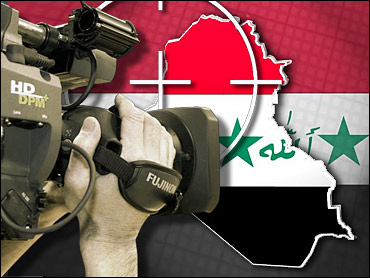 The Iraq War is Going Very Well - for Israel
Genevieve Cora Fraser, March 29, 2006
Though I agree with Jeff Blankfort in his critique of Noam Chomsky as well-intentioned but basically a functioning Zionist, there is one point Jeff makes in the Chomsky/Blankfort Polemic on which I differ.
Jeff believes as I do that the USA got into Iraq because of Israel. Where we differ is that Jeff states as most people do that the war is going very badly. As an individual sympathetic with the people of Iraq, concerned for our troops and the trillions of dollars of debt America is liable for as a result of our misadventure, I agree. But from the position of the Bush-NeoCon-Israeli perspective, I disagree.
When George Bush is upbeat about the war, he should be. George works on behalf of Israeli not American interests and from an Israeli perspective, the war is going extremely well and as planned. The NeoCon lies and games to get us on board (flowers in the streets - celebrating Iraqis etc) was a honey trap. Israel always thrives on chaos and bloodshed. It is when and how they work best. Look at Palestine. Horror/chaos destabilizes people and it takes generations to restabilize and build back a civilization. Meanwhile, you can pull anything you want using the chaos as a smokescreen - such as securing resources for yourself.
By suppressing and/or killing academics and looting museums and destroying and desecrating sites that the people of the region consider holy you take away a people's history and heritage. The purpose is to create a "blank page" on which the victor can create "historic myths" from which the new country will be built and manipulated. These are long-range plans. Big destruction, big lies, big fear so later when Israel (America) is in complete charge "stabilizing" the country, a whole new reality for the people can be created.
Big Brother is here. His handmaiden is AIPAC and its brother organizations. He will tell you who you are, what you may think, what you may do and not do. Dissidents will be targeted for financial ruin, discredited, incarcerated and if need be killed - as terrorists - an enemy of The New People. The American myths are being changed too - Israel is sacred - our new Mecca - our hope for a just future. This morning I was listening to an NPR commentator using the analogy of Joshua's triumphant entry into Canaan - bizarre and somewhat off-topic, but a perfect message to drum up Israel's take-over of the fertile lands and water resources of Palestine.
Israel also believed that in terms of its security Sadaam had to go. He was paying families of suicide bombers in Palestine, so in many ways he was an arm of the resistance movement, in their eyes. This might be considered a legitimate concern, except for the fact that Israel had created the illegal Occupation which Palestinians under international law have a right to resist. In addition, Israel believes that Iraq is part of Greater Israel (from the Tigris to the Euphrates) and where they failed in Egypt in 1967 (except for the Occupation of Palestine) they have succeeded in Iraq and plan ultimately for the complete subjugation of the people of the region.
If you follow this logic, though taking on Iran would be stupid from an American perspective, it would help Israel's "securing of the realm," by taking out a country which not only has a wealth of resources but is in open defiance of the Zionist agenda.
what fate will come to the palestinian's
The Meaning of Provisional Withdrawal
Many scholars continue to recommend the need for Israeli-Palestinian negotiations while overlooking the harsh reality that Israel is on a predetermined course.
Issa Khalaf, Ph.D Short of ideologically realizing the vision of the Land of Israel free of Palestinians, Zionism is singularly preoccupied with how to permanently keep the land without ruling over, or incorporating, the Palestinians who inhabit it. Given the reality of Palestinian presence, the non-security related “solution” pursued for the past five years by Ariel Sharon and now by his successor, Ehud Olmert, is a “long term interim agreement” or “provisional agreement”—more properly, a unilateral decision rather than an agreement, hopefully with US-EU backing. This essentially means further annexations and unilateral demarcation of borders, no real negotiation with the Palestinian Authority, that is, Mahmoud Abbas’ Fatah and now Hamas, and repudiation of final status issues (Jerusalem, borders, refugees). Commitments to the road map or previous agreements have already been canceled, though Israeli officials claim their planned withdrawals, annexations, and unilateral border setting are being done through the road map. (1)
Many scholars continue to recommend the need for Israeli-Palestinian negotiations while overlooking the harsh reality that Israel is on a predetermined course. Negotiations are the preferred route, for not only do they offer hope for both peoples, but also the alternative is not pretty, particularly for the Palestinians. However, nothing and no one, not the US, the EU, or the UN are prepared to put the brakes on Israel’s destructive path. As long as Israel has unwavering US support and protection, and the EU puts the Atlantic alliance above justice in Palestine and stability in the Middle East, little can be done. Below I’ll look at the meaning of interim and provisional agreements and review at length what several well-known scholars and observers are saying. I argue that the occupation has become so deeply entrenched that the possibility of its reversal based on “performance” frameworks is irrelevant.
The self-proclaimed Israeli intention to conduct a provisional withdrawal also referred to as disengagement, from the West Bank neither clarifies what the Israelis mean by “withdrawal” nor what the implications are for Israeli-Palestinian peace. The essential question is this: is Israel’s planned withdrawals a series of steps that eventually lead to relinquishing of the West Bank based on a just and realistic peace or are they a step toward separating from major Palestinian population centers, giving continuity to Jewish settlement, and annexing major portions of the West Bank?
The characterization of the Israeli moves as interim or provisional that will lead to permanent withdrawal and peace at some unspecified future time is fraught with ambiguity and contradiction. The public Israeli contention is that, in the absence of negotiating partners, “withdrawal” (whose eventual extent and scope is unclear) may de facto lead to two states that may eventually live in peace. Certainly, this is what many Israelis who support the “centrist consensus” hope for. Viewed optimistically, this implies, or can imply, negotiations after the interim withdrawal that may lead to complete and final withdrawals based on UNSC 242 and 338, land for peace, an end of conflict based on a permanent and comprehensive peace. Israeli policy is portrayed, including by the US, as an intermediate or transitional measure in terms of time and final terms. In principle and practice, ending an occupation does not require negotiating partners or recognition as a precondition, and negotiations can be conducted after the occupying power has withdrawn—in this case, only from some parts of the West Bank.
Rami G. Khouri of The Daily Star is optimistic that Israel’s actions are a “historic reversal” of policies since 1967, that Sharon’s “long term interim agreement” and Hamas’ “long term truce” will lead to coincidental interests. He notes:
Kadima members have said that if elected, they would continue withdrawing unilaterally from parts of the West Bank, while completely leaving Gaza's affairs in the hands of the Palestinians. The first step, revealed this week by former Shin Beth [sic] security service director Avi Dichter, would be to dismantle more isolated settlements in the West Bank, while consolidating the large settlement blocs near the 1967 border. Disengagement from the Palestinians is now seen as more conducive to Israeli interests than colonization and military occupation…. A Hamas-led government is poised to manage those areas vacated by Israel, move quickly on building a more secure, stable, law-governed society, and enforce an extended truce that probably has already started. Hamas will quietly watch Israel withdraw from more occupied lands, and focus on building a well-governed polity in Gaza and much of the West Bank (my italics). (2)
It’s unclear how much of the West Bank will be incorporated into Israel through annexation and unilateral demarcation of borders. Most suggest close to half. It’s safe to say, however, that these plans are not based on the principles of withdrawing to the 1967 borders with minor adjustments for security and defensive purposes, evacuating most of the settlers, completely dismantling the control regime, and sharing sovereignty over Jerusalem.
In practice, Israelis are pursuing the following outcomes: a) permanent incorporation into Israel of Greater Jerusalem, the “settlement blocs” (one of which, Ma’aleh Adumim, cuts the West Bank in two), lands both west and east of the “separation barrier,” and the recently annexed strip (“security zone”) along the West Bank’s border with Jordan; b) geographic, economic, and political atomization of Palestine (West Bank) whose people’s movement, trade and contact with each other are through bridges, tunnels, and isolated roads; c) “border” passages or crossings (gates and checkpoints) along the separation barrier, including around (East) Jerusalem, controlling Palestinian movement into and out of the west and east sides of the wall/barrier; d) demographic and geographic continuity of a Jewish majority from Israel to the West Bank.
The Israeli “disengagement” or withdrawal is, in its final form, an attempt at permanent colonization, though without extensive military occupation and obligations. Israeli colonization and annexation, including the wall’s completion, are devised to preclude the creation of a geographically contiguous, viable Palestinian state. Permanent disengagement may mean eventual removal of military presence from the remaining Palestinian enclaves, with or without Palestinian agreement. Obviously, gaining Palestinian acceptance of such a withdrawal, which means acceptance of Israeli unilateral border setting, is preferable and will depend, in the next four years, on whether they deem they have a negotiating partner who would sanctify Israeli unilateralism in a final peace agreement, that is, after they’ve solidified their annexations. However, even if they enter into negotiations with Hamas before further large-scale rearrangement of the West Bank, they will not be deterred from their plan, which obviously means that negotiations, as Hamas itself understands, would be hollow.
The logical outcome is that “peace” will be dictated to the Palestinians, whether or not they enter into a final peace treaty with the Israelis. Hence, the insistence that Hamas must meet certain conditions is a public relations maneuver. In the short term, the initial step is the evacuation of isolated settlement outposts (really, mostly those east of the wall/barrier) and their relocation in larger and denser colonies that are to be part of the annexed lands while maintaining a military presence in the evacuated areas. Neither short-term dismantlement of small, peripheral colonies nor final withdrawal, or more precisely, reconstitution and redeployment of the military presence outside of what is to be the Palestinian areas, constitutes an end to the occupation of the West Bank. If Israel fails to gain Palestinian acceptance through a final negotiated peace on its own terms, the provisional or interim withdrawal can last indefinitely. The Israelis are interested in ending conflict and violence but not their occupation. Colonization and annexation of Palestine by force, even as its people live in the midst, is still occupation.
Hamas, which understands clearly that there’s been no peace process in recent years, including Israeli intentions behind provisional withdrawal, apparently welcomes Israeli retrenchment, interpreting this as an opportunity to get on with the business of orderly governing and social and economic development and rebuilding of Palestinian society while maintaining a long-term truce that will eventually lead to full Israeli withdrawal. The movement is subject to different interpretations and pressures from different leaders but its pragmatism and adaptation to changing circumstances are not in doubt, including its unilateral adherence to the cease-fire. In a March 6 interview with Helena Cobban, Mahmud Zahhar, named foreign minister in Hamas’ cabinet, said that he expects:
[T]hat after the Israeli election there will be a further Israeli withdrawal in the West Bank...You know, when Israel undertakes unilateral withdrawals, they are costless to us, because they do not tie us up in negotiations. They are a big victory for us!
And that, in two years,
I see a further Israeli withdrawal in the West Bank. There will be a flourishing in our economy and in our society. We'll be represented in the international community, and people around the world will see a good example of how a people without resources can build strong industries.
This led Cobban to observe that
Nearly all the Hamas leaders and activists whom I interviewed viewed the prospect of negotiations with Israel with considerable wariness, referring to Fateh's record in such negotiations and concluding that those negotiations had just been a very damaging trap. But Zahhar was the most outspoken on this issue of any of them. “The conflict should not (Cobban’s emphasis) be solved in our age, because the power equation here is not yet balanced,” he said at one point. “... If the Israelis leave us alone a while, and want to come to talk to us later, then okay.” (3)
Zahhar apparently is awaiting a future age in which the balance of (regional) power will eventually change and force Israel to talk real peace. Since Israel has no interest in making peace, he assumes that there is nothing to lose in letting them withdraw. Indeed, every Israeli retrenchment locally translates to proportionate relief for Palestinians, meaning relative peace and quiet, daily life conducted at a lower threshold of repression or harassment. However, the Palestinian’s economic hardship, impoverishment, and national frustration will continue, and worsen, under a revised Israeli occupation. Zahhar is eager for Hamas to replace the military occupation in the areas the Israelis vacate, and therefore to form Palestinian self-governance and self-determination, though the vast majority of Palestinians support peace with Israel and Hamas negotiations with it based on a two-state solution whose context is complete withdrawal. This Hamas understands well and accepts.
Premier-designate Ismail Haniyah, in a Gaza press conference on 26 March made clear that Hamas will not accept, that is, confer legitimacy, to unilateral Israeli withdrawal without Palestinian agreement and that they do not wish continuous conflict and violence for the region. “We want rights and dignity for this [Palestinian] people, and to put an end to this decades-long complicated situation…We will not hang onto the tails of the occupation. But this doesn’t mean that we consider the borders they decide on to be those of the Palestinian state.” (4)
No one really understands the full consequences of “withdrawal” for Israel and the Palestinians. The intimate, contorted, serpentine-like embrace of Jewish colonial settlements and fragmented Palestinian communities not only is inimical to Palestinian political and economic viability, but also to the colonies’ sustainable territorial and geographic integration into Israel. According to Richard Falk, unilateral solutions of this sort lay the foundation for further violence and
[N]ever had any chance of resolving the conflict in a sustainable way. It completely ignores Palestinian rights, including the duty of Israel to withdraw from all territory occupied since the 1967 war, as well as those issues on which international law supports Palestinian claims—refugees, Jerusalem, settlements, water rights and the barrier.
What is necessary, Falk continues, is that the US, EU and Israel encourage the “pragmatists” over the “maximalists” in Hamas. They need to:
[P]rovisionally respect the election results, establish normal diplomatic relations and maintain desperately needed external aid flows, an important source of Western credibility and leverage. As of now, they are all pushing in the opposite direction…The US and Europe insist that there will be no contact with Hamas and no economic assistance unless its leaders explicitly renounce terrorism, recognize Israel, accept all prior agreements between the Palestinians and Israel, and annul that part of the Hamas charter that calls for Israel's destruction.
The chance of Hamas meeting these political conditions all at once is essentially nil since they amount to a renunciation of struggle and almost a declaration of surrender.
It is only through diplomacy based on respective rights that a durable peace can be achieved. Hamas must be persuaded to abandon terrorist tactics and rely on political moves to achieve Palestinian self-determination. For this to work, Hamas must be assured there will be real gains towards statehood. However, first Washington will need to learn two lessons—promoting democracy involves accepting the outcome of elections and Israeli unilateralism will not solve the conflict. (5)
Joel Beinin argues along similar lines as Falk. After showing that Hamas’ victory was not just due to corruption but also to the Israeli occupation with its repressive measures, economic hardships, destruction of PA infrastructure, unilateral measures, including the Gaza withdrawal, and refusal to negotiate, including abandonment of the Taba agreement in 2001 and the Saudi proposal in 2002, he maintains that:
Neither the Bush administration nor Israel appears to recognize its own responsibility for strengthening Hamas and weakening secular and more moderate Palestinian political forces. Will Hamas recognize Israel and abandon armed struggle when it assumes political responsibility for the Palestinian people? If this happens at all, it is unlikely to come as a single dramatic declaration. A long transition comparable to the torturous negotiations among the Irish Republic Army, the British government and the other Irish political forces would probably be required.
Israel and the Bush administration have two options—to stonewall the new P.A. government on the grounds that Hamas is a terrorist organization, or to engage cautiously and encourage the adoption of pragmatic policies by offering real progress toward a viable and independent Palestinian state in exchange. (6)
Rashid Khalidi correctly maintains that the Palestinians want peace with Israel, a two state solution, a secular state, and that Hamas-head Ismail Haniya may accept this if Israel withdraws. He demonstrates that Israel’s occupation is responsible for breeding Islamic extremism. Khalidi arrives at a conclusion similar to those of Beinin and Falk by arguing that the US and Israel will be responsible for the “disastrous consequences” that follow from their decisions. He strikes a note of pessimism, reflective of current conditions, when he states that the US and Israel “seem prepared to try to starve the Palestinians financially, to refuse to engage constructively with a PA run jointly by a Fatah president and a Hamas-led cabinet, and to refuse to explore whether a just and lasting settlement is possible between Israelis and Palestinians.” (7)
But what does exploring a just and lasting settlement—and that Hamas may accept a two state solution if Israel withdraws—mean? Withdraws before negotiations? Commits itself to a comprehensive settlement? And how, as Beinin frames it, is “real progress toward a viable and independent Palestinian state” to be realized? The complex, almost exasperated ambiguity of these statements is emblematic of the impossible situation Israel has created. Stopping Israeli unilateralism requires forcing Israel to immediately implement a series of concrete steps and to reverse ongoing actions before any negotiations can take place, though even such steps, confidence building measures, are uncertain to produce the desired outcome, certainly without forceful monitoring and pressure. A settlement freeze at this time or the dismantling of the isolated, thinly populated outposts, for example, will have little effect because no viable Palestinian state can emerge without the abandonment of the colonies and the expropriated lands surrounding them, either as part of a withdrawal or subsequent to withdrawal, as part of a peace settlement that follows. More important, Israel under the current regime must want peace. I am not convinced this is so.
In the present conditions, not only have principles for a peace settlement, including UNSC 242 and 338 and international law been ejected, it is also difficult to see clearly how any of the previously agreed frameworks could be implemented. Israel has gone too far in changing the face of the West Bank. Sara Roy, after surveying the dismal record of Israeli repression, mutual violence, terrorist suicide bombings, impoverishment, deteriorating conditions, and expansion since Oslo, prophetically stated as early as June 2003 that
Any attempt by the US and Israel to impose a political settlement on Palestinians while maintaining the occupation and Israel’s matrix of control will fail. This is what doomed Oslo and will doom the road map. The violence insures the continuation of the conflict and fundamentally jeopardizes the interests of the US in resolving it. The end of occupation is a necessary condition for ending the bloodshed. Without it, nothing is possible. (8)
She asserted that: “A complete end to Israeli occupation [that is, to the June 4, 1967 lines] must be the first step. Only when occupation ends can one talk about what it entails, and what must follow from it.” She recommended that this be followed by a sequence of steps, including Palestinian unilateral ceasefire, a settlement freeze, and interjection of an “international buffer” between the two peoples, suggesting that the “rest” (peace settlement) can then be concluded.
This forceful clarity is even more relevant today, nearly three years later, because the occupation has become ideologically, politically, economically, legally, socially, infrastructurally, and physically entrenched and, perhaps, irreversible. This conclusion is not new. Israelis, such as Meron Benvenisti, Haim Hanegbi, Ilan Pappe, and especially Jeff Halper have seen this ineluctable trend for the last several years. A radical framework requiring complete withdrawal, in the context of a blue print for peace supported by the international community, in my mind is the most effective response to current conditions and will lead to Hamas making peace with Israel. However, a framework based on full withdrawal first is politically unattainable given America’s unconditional support of Israeli policies—regardless of how adverse these policies are to US interests and to Israel’s long-term peace and security.
Israel has rendered a negotiated settlement based on a two state solution all but unrealizable. At the same time, it will never contemplate a unitary state. By its own actions, it is endangering the very thing it presumes to safeguard: a democratic Jewish state. The result is the cruelly apartheid state in the process of being implemented and a future of violence and instability in the Middle East. Ilan Pappe expresses it plainly:
Israel nowadays is like a plane flying on autopilot. The course is preplanned, the speed predetermined. The destination is the creation of a Greater Israel which will include half of the West Bank and a small part of the Gaza Strip (almost 90 per cent of historical Palestine): this will be a Greater Israel without a Palestinian presence, with high walls separating it from the indigenous population of Palestine, who will be crammed into two huge prison camps in Gaza and what's left of the West Bank. Palestinians inside Israel can either leave and join the millions of refugees languishing in the camps or submit to an apartheid system of discrimination and abuse. In many parts of the Western world the media still describe this as the only safe route to peace and stability. The discourse of peace employed by the Quartet—the US, the EU, Russia and the UN—since the Road Map came into being seems to blind many reasonable observers, who still seem to believe that this course makes sense. But it should have long been clear that Israel is heading for disaster. (9)
The failure to achieve a negotiated Palestinian-Israeli peace after four decades of occupation is not due to a lack of imaginative and realistic frameworks and principles or to changing political events and leaders. Failure is due, first and foremost, to ideological obstacles, to Zionist ethno-religious nationalism that has not yet accepted coexisting with another people. The situation is bleak short of concerted international action to force Israel to adhere to international law.
-Issa Khalaf holds a Ph.D. in political science and Middle East Studies from Oxford University.
Notes
1. “Kadima Planning West Bank Pullout,” Washington Post, 3/6/06.
2. “Accord that dares not to speak its name,” The Daily Star, 3/8/06.
3. “Interview with Zahhar,” posted on Cobban’s website March 18, ‘Just World News’, http://justworldnews. org/).
4. “Hamas tells Israeli voters it wants to end deadlock,” by the Associated Press, in Haaretz, 3/26/06.
5. Richard Falk, “Respect Democracy, Engage Hamas,” Topeka Capital-Journal, 3/11/06, found in Middle East Report.
6. Joel Beinin, “Why Hamas Won and Why Negotiations Must Resume,” San Francisco Chronicle, 2/8/06, found in Middle East Report.
7. “Maybe too far to go back for Hamas, Financial Times, 3/7/06.
8. “How to stop Hamas: first, end the occupation,” The Daily Star, 6/20/03.
9. Ilan Pappe, “As long as the plan contains the magic word ‘withdrawal’, it is seen as a good thing,” London Review of Books, Vol. 26, No. 9, 6 May 2004.