
Troops lower flag at Cdn camps
February 28, 2006
KANDAHAR, Afghanistan (CP) - The Maple Leaf is coming down at Canadian military installations in Afghanistan.
Commanders of Operation Enduring Freedom have asked coalition troops to lower their national flags and fly only the black-red-green of Afghanistan in an effort to put Afghan colours on forces bolstering the national government.
Canada has decided to comply with the request, citing "cultural sensitivity."
"This is not Canada, this is the Islamic Republic of Afghanistan," said Brig.-Gen. David Fraser, head of the Canadian contingent and the multinational brigade in southern Afghanistan.
"We've got to respect their cultures and traditions and be respectful that they invited us here. I think it's only fitting we fly their flag."
Fraser, officially made head of the multinational brigade for southern Afghanistan on Tuesday in a ceremony at the main air base outside Kandahar, said there is one team behind international efforts to pacify Afghanistan and that it should unite under one flag.
As Fraser was installed, soldiers at the small camp housing the Canadian provincial reconstruction team in downtown Kandahar a few kilometres away lowered the Maple Leaf in a dignified ceremony.
"It goes back to the cultural sensitivity training we did back in Canada," Fraser said. "We're in support of the Afghans. They're leading this mission."
Fraser said small Canadian flags on the side of vehicles and the tiny ones on soldiers' shoulders can remain.
For years, coalition and NATO military leaders have tried to polish the image of the Afghan government by insisting local authorities regularly lead operations with only the backup of international troops.
Despite improvements in training and equipment, the reality on the ground is often far different. International soldiers often pick up the slack for under-paid and poorly trained Afghan police and troops, although Afghans take the bulk of the casualties from insurgent attacks.
U.S. Maj.-Gen. Benjamin Freakley, the coalition operational commander who asked contributing countries to lower their flags, said the international community needs to build institutions like the Afghan National Army and Afghan National Police. Raising the Afghan flag as frequently as possible can only help the effort.
"We're trying to make subtle transitional moves to help the people of Afghanistan fend for themselves," he said.
Freakley said some U.S.-run compounds hosting international troops fly a dozen flags from various coalition countries.
He said the U.S. has a tradition of flying only one flag at military installations.
Contributing nations will understand, according to Freakley. "In no way is it intended to suppress any nationalistic pride, commitment or investment in the nation of Afghanistan," he said.
source
The Current Flag of Afghanistan
The flag of Afghanistan is composed of three equal vertical bars of black, red, and green, with the yellow coat of arms of Afghanistan in the center; this flag is known as the "King's flag." Each bar is twice as long as it is wide. The coat of arms depicts part of a mosque, sheaves of wheat, two banners, the date 1371 (A.D. 1992), which is the date of the Mujahideen victory, and an Arabic inscription that reads, "There is no God but Allah and Muhammed is his messenger."
This black, red, and green flag was flown in Afghanistan from 1930 until 1973. It was again flown over the presidential palace in Kabul on February 5, 2002, in a ceremony led by interim Afghan leader Hamid Karzai. This flag replaced the flag of the overthrown Taliban.

The Old Flag of Afghanistan
Afghanistan's old flag was adopted on December 2, 1992, after the Mujahideen (fundamentalist Muslim fighters) won a civil war against the government that formed after the Soviet Union had pulled out of Afghanistan in 1989.
The old flag of Afghanistan is composed of three equal horizontal bars of green, white, and black. Green symbolizes Islam. In the center is the coat of arms of Afghanistan, pictured in yellow. The arms depict two curved swords, part of a mosque, wheat, two banners, the date 1371 (A.D. 1992), which is the date of the mujahideen victory, and an Arabic inscription that reads, "There is no God but Allah and Muhammed is his messenger."
source
Tuesday, February 28, 2006
the flag of the country!

Posted by audacious at 28.2.06 0 comments
interesting press release
Attention Business Editors:
Heritage Oil signs second agreement for Kurdistan, Iraq field studies
/THIS PRESS RELEASE IS NOT FOR DISTRIBUTION TO UNITED STATES NEWSWIRE
SERVICES OR FOR DISSEMINATION IN THE UNITED STATES/

CALGARY, Feb. 28 /CNW/ - Heritage Oil Corporation (TSX: HOC) today announced that the Oil, Gas and Petrochemical Establishment (OGE) of the Government of the Autonomous Region of Kurdistan, Iraq has entered into a second exclusive Memorandum of Understanding (MOU) with K Petroleum Company (KPC) to undertake integrated reservoir field studies over several fields located south of the Erbil Mosul main road.
KPC is a wholly-owned subsidiary of Heritage Erbil Oil Limited, which is a joint venture company co-owned with a major economic and industrial entity within the Autonomous Region of Kurdistan, Iraq.
Micael Gulbenkian, Chairman and CEO of Heritage, said: "This second MOU demonstrates KPC is well-positioned in the Autonomous Region of Kurdistan, Iraq. We are delighted that KPC has been selected to undertake these studies.
KPC's two MOUs cover an area of approximately 1,300 km(2). Preliminary negotiations to convert both MOUs into Production Sharing Agreements (PSA) have begun and we anticipate they will be completed within the next three months."
Fieldwork in the first MOU area commenced in January. The planned 120-day field program includes undertaking magnetic and gravity studies as well as geological fieldwork. This work is being undertaken without any prevailing operational issues.
KPC plans to commence studies in the second MOU shortly. The scope of work includes regional studies, geological field mapping, magnetic and gravity surveys and satellite data interpretation. Additionally, the scope of work shall include the determination of hydrocarbon in place volumes and reserves from interpretation of all available data, utilising the latest reservoir characterisation and modelling technology.
Iraq's new constitution, entered into in 2005, gives the Kurdistan Regional Government the exclusive authority to enter into oil and gas licences over exploration areas and non-producing fields within its territory. KPC and Heritage have kept the Ministry of Oil in Baghdad fully informed of all developments.
Heritage is an international oil and gas corporation with producing properties in the Republic of Congo and Sultanate of Oman, a development property in Russia and exploration projects in the Republic of Uganda. Heritage Middle East, which is focusing on Iraq, has established an office in Amman, Jordan, which it intends to re-locate to Baghdad when the security situation permits.
The Company's Common Shares trade on the Toronto Stock Exchange under the symbol HOC.
FORWARD-LOOKING STATEMENTS: Except for statements of historical fact, all statements in this news release - including, without limitation, statements regarding production estimates and future plans and objectives of Heritage - are forward-looking statements that involve various risks and uncertainties.
There can be no assurance that such statements will prove to be accurate; actual results and future events could differ materially from those anticipated in such statements. Factors that could cause actual results to differ materially from anticipated results include risks and uncertainties such as: risks relating to estimates of reserves and recoveries; production and operating cost assumptions; development risks and costs; the risk of commodity price fluctuations: political and regulatory risks; and other risks and uncertainties as disclosed under the heading "Risk Factors" and elsewhere in Heritage documents filed from time-to-time with the Toronto Stock Exchange and other regulatory authorities. The Company disclaims any intention or obligation to update or revise any forward-looking statements, whether as a result of new information, future events or otherwise. %SEDAR: 00010129E
For further information: please contact: Investors Relations Contacts:
CHF Investor Relations - Cathy Hume, Tel (416) 868-1079 x231, Email: cathy@chfir.com; Heather Colpitts, Tel (416) 868-1079 x223, Email: heather@chfir.com; Heritage Oil Corporation - Swiss, European Contact Details: Micael Gulbenkian or Paul Atherton, Tel +41 91 973 1800 or
+44 870 011 5555, Fax +41 91 973 1808 or +44 20 7629 3863, Email: info@heritageoilcorp.com; Canadian Contact Details: John McLeod, Tel (403) 234-9974, Fax (403) 261-1941; If you would prefer to receive press releases via email contact Heather Colpitts (heather@chfir.com) and specify "Heritage press releases" in the subject line.
CNW Group

Heritage Oil Corporation is a Canadian-based independent, international oil and gas exploration, development and production company.
The Company’s principal producing properties are in the Republic of Congo and Oman. Heritage acquired a 95% interest in a development project in Russia in December 2005, which has proven and probable reserves of 69 million barrels net to Heritage, before deduction of royalty and income tax. Heritage has an exploration project in Uganda.
K Petroleum Company, a subsidiary of Heritage, has entered into a Memorandum of Understanding with the Oil, Gas and Petrochemical Establishment of the Government of the Autonomous Region of Kurdistan, Iraq to undertake field studies over an area exceeding 300 square kilometers. This area is adjacent to an existing oil field.
Heritage Middle East Limited, a wholly owned subsidiary of Heritage, continues to enter into negotiations with the Ministry of Oil in Baghdad to obtain MOUs to undertake exclusive detailed field studies and to prepare development plans over a number of oil fields.
Heritage is looking to expand its recently-acquired operations in Russia through the acquisition of a number of similar-sized development licences in Russia and Kazakhstan.
The Company’s producing, development and exploration projects, together with potential opportunities, provide a combination of early cash flow and longer term value creation opportunities.
The Company’s shares trade on The Toronto Stock Exchange, or TSX, under the symbol HOC.
source
Posted by audacious at 28.2.06 1 comments
surprising, not ...
U.S. Opposes U.N.'s Planned Rights Panel, Exclusion of Abusive Nations Sought
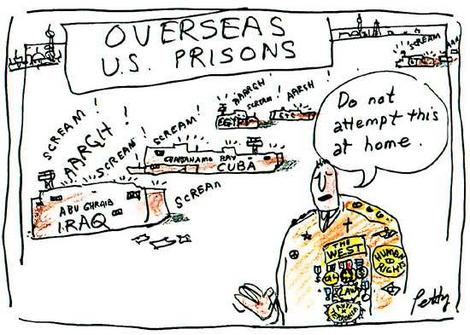
UNITED NATIONS, Feb. 27 -- The Bush administration will oppose a U.N.-backed resolution calling for the creation of a council to expose the world's worst human rights abusers, John R. Bolton, the U.S. ambassador to the United Nations, said Monday.
Bolton said that a draft charter presented Thursday by the U.N. General Assembly president, Jan Eliasson, was not tough enough to ensure that nations that abuse human rights would be barred from joining the council. He said he was under instructions from Washington to reopen negotiations on the text or postpone deliberations on a new rights body for several months.
U.N. Secretary General Kofi Annan and other supporters of the compromise warned that there is no better deal to be struck and that the U.S. strategy could undermine their efforts to create an improved, though imperfect, human rights body. "I think we should not let the better be the enemy of the good," Annan told reporters Monday in Geneva.
The United States and the United Nations have been pressing for nearly a year to create a strengthened human rights council to replace the 53-member Human Rights Commission. The reputation of the Geneva-based panel, which helped draft the landmark Universal Declaration of Human Rights, has recently been tainted by the frequent election of members with dismal human rights records, such as Sudan and Zimbabwe.
Senior U.S. and U.N. officials had sought to prevent countries with poor rights records from joining the new organization by raising the membership standards and requiring a two-thirds vote of the 191-member General Assembly for any nation's admittance. But the proposal met stiff resistance, and the current draft resolution would require members to be elected by an absolute majority -- at least 96 countries.
"I say this really more in sorrow than in anger, but we're very disappointed with the draft that was produced last Thursday. We don't think it's acceptable," Bolton told reporters. "My understanding is that the president of the General Assembly intends to bring this matter to the General Assembly within a day or two for a vote. If he continues on that course, we will call for a vote and vote no."
Annan, U.N. Human Rights Commissioner Louise Arbour and two leading human rights organizations (Human Rights Watch and Amnesty International) say the compromise proposal is still worth supporting. They have been joined by former president Jimmy Carter and several other Nobel Prize winners, who issued a joint letter calling on the United States and other governments to back the deal.
Annan, who discussed the human rights council Sunday with Secretary of State Condoleezza Rice, appealed Monday for the United States to "join the vast majority of governments who seem ready to accept" Eliasson's proposal. He and other supporters said the proposal constituted a serious improvement on the existing Human Rights Commission.
They noted that provisions to subject all council members to scrutiny of their human rights record would discourage countries with poor records from joining. They also said that council members suspected of abusive behavior can be suspended by a vote of two-thirds of the U.N. membership present.
"We are a country that puts high value on human rights. We wouldn't vote in favor if we weren't sure it was going to be an improvement," said Chile's U.N. ambassador, Heraldo Muñoz, a former dissident who was jailed under former Chilean ruler Augusto Pinochet.
The new council would consist of 47 members selected by secret ballot on the basis of "geographical distribution" and committed to "uphold the highest standards in the promotion and protection of human rights." Members would be elected for as many as two three-year terms at a time and would meet for at least 10 weeks throughout the year.
source
Posted by audacious at 28.2.06 0 comments
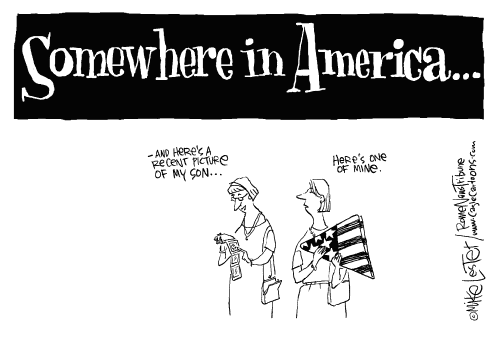
far too many iraq casualties

estimates of iraq casualties between 28535 and 32153 as of feb 20, 2006
source
Iraq attack kills two UK soldiers
Two British soldiers have been killed and another injured by a roadside bomb in Amara, southern Iraq, the Ministry of Defence has said. ... which take the number of UK troops killed in Iraq to 103. ...
source
and 54 U.S. so far in febuary 2006 source
Posted by audacious at 28.2.06 0 comments
can this avoid a bush war?
IAEA: Iran Not Seeking to Produce Nukes, Iran Says U.N. Agency's Report Shows Tehran Not Seeking to Produce Nuclear Weapons
KAORI HITOMI
TOKYO Feb 28, 2006 (AP)— A report by the U.N. nuclear watchdog agency shows there is no proof Iran's nuclear program is aimed at producing nuclear weapons, Iran's foreign minister said Tuesday in Japan.
"They could not find evidence which shows that Iran has diverted from its peaceful purposes of nuclear activities in Iran," said Manouchehr Mottaki, who was in Tokyo to meet with Japanese Prime Minister Junichiro Koizumi.
A confidential International Atomic Energy Agency report made available to The Associated Press Monday said that a more than three-year probe has not revealed "any diversion of nuclear material to nuclear weapons or other nuclear explosive devices."
But it also said that because of lack of sufficient cooperation from the Iranian side, the agency remains unable "to conclude that there are no undeclared nuclear materials or activities in Iran." The report suggested that unless Iran drastically increases its cooperation, the IAEA would not be able to establish whether past clandestine activities were focused on making nuclear arms.
The report, prepared by IAEA head Mohamed ElBaradei for a March 6 meeting of the agency's 35-nation board of governors, could help determine what action the U.N. Security Council will take against Iran, which says its nuclear program is intended solely for peaceful purposes.
The IAEA decided at a Feb. 4 meeting to report Tehran to the council over concerns it might be seeking nuclear arms. But further action was deferred until the end of next week's meeting at the insistence of veto-wielding council members Russia and China, which have close economic and political ties with Iran.
Mottaki said Iran had a right to nuclear technology for peaceful purposes and is committed not to build nuclear weapons.
"Iran also, like Japan, enjoys its right to have nuclear technology for peaceful purposes," Mottaki told reporters after talks with Koizumi. "We are against nuclear weapons."
However, the IAEA report said Iran plans to start setting up thousands of uranium enriching centrifuges this year even as it negotiates with Russia on scrapping such domestic activity a possible pathway to nuclear arms.
Russia dampened hopes of a deal with Iran on Monday, saying Tehran must first freeze its domestic uranium enrichment, something Iran has refused to do. Russian Foreign Ministry spokesman Mikhail Kamynin told the Interfax news agency he expected talks with Iran to resume in the coming days.
The Russian offer to host Iran's uranium enrichment program has been backed by the United States and the European Union as a way to provide more guarantees that Tehran's atomic program cannot be diverted to build weapons.
But the IAEA report showed Iran pressing ahead with enrichment at home by going from testing a lone centrifuge a machine that spins uranium gas into enriched uranium to introducing the gas into 10 centrifuges and beginning enrichment between Feb. 11 and Feb 15.
Furthermore, said the report, Iran began final maintenance of an additional 20 centrifuges a week ago, reflecting determination to further expand enrichment.
That would leave Iran still far short of the thousands of centrifuges it needs to enrich substantial amounts of uranium. Still, it reflected the country's plans to forge ahead with domestic enrichment even as it talks with Moscow.
And just a few months down the road, "commencement of the installation of the first 3,000 … (centrifuges) is planned for the fourth quarter of 2006," said the report.
Experts estimate that Iran already has enough black-market components in storage to build the 1,500 operating centrifuges it would need to make the 45 pounds of highly enriched uranium needed for one crude weapon.
source
Posted by audacious at 28.2.06 3 comments
no accident
A bomb badly damaged the tomb of Saddam Hussein's father
Saddam trial resumes amid sectarian violence
Tue Feb 28, 2006
BAGHDAD (Reuters) - A bomb badly damaged the tomb of Saddam Hussein's father at dawn on Tuesday, hours before the ousted leader was due back in court for the first time since a week of sectarian violence pitched Iraq toward civil war.
A Sunni mosque in Baghdad was also damaged by a bomb, police said, and police discovered nine bodies near the religiously mixed city of Baquba, scene of several sectarian attacks since a suspected al Qaeda bomb destroyed a Shi'ite shine on Wednesday. ...
The dome of the shrine Saddam had erected over his father's originally modest grave in the cemetery of his Sunni home town of Tikrit was damaged, local residents said, and windows and doors blown out. Police and local government officials said explosives planted at the tomb had gone off around 6 a.m. (0300 GMT). ...
source
Posted by audacious at 28.2.06 0 comments
blogger reveals ...
Blogger bares Rumsfeld's post-9/11 orders
24 February 2006
Hours after a commercial plane struck the Pentagon on September 11 2001 the United States Defence Secretary, Donald Rumsfeld, was issuing rapid orders to his aides to look for evidence of Iraqi involvement, according to notes taken by one of them.
"Hard to get good case. Need to move swiftly," the notes say. "Near term target needs -- go massive -- sweep it all up, things related and not."
The handwritten notes, with some parts blanked out, were declassified this month in response to a request by a law student and blogger, Thad Anderson, under the US Freedom of Information Act. Anderson has posted them on his blog at outragedmoderates.org.
The Pentagon confirmed the notes had been taken by Stephen Cambone, now undersecretary of defence for intelligence and then a senior policy official. "His notes were fulfilling his role as a plans guy," said a spokesperson, Greg Hicks.
"He was responsible for crisis planning, and he was with the secretary in that role that afternoon."
The report said: "On the afternoon of 9/11, according to contemporaneous notes, Secretary Rumsfeld instructed General Myers [the chairperson of the joint chiefs of staff] to obtain quickly as much information as possible. The notes indicate that he also told Myers that he was not simply interested in striking empty training sites. He thought the US response should consider a wide range of options.
"The secretary said his instinct was to hit Saddam Hussein at the same time, not only Bin Laden. Secretary Rumsfeld later explained that at the time he had been considering either one of them, or perhaps someone else, as the responsible party."
The actual notes suggest a focus on Saddam. "Best info fast. Judge whether good enough [to] hit SH at same time -- not only UBL [Pentagon shorthand for Usama/Osama bin Laden]," the notes say. "Tasks. Jim Haynes [Pentagon lawyer] to talk with PW [probably Paul Wolfowitz, then Mr Rumsfeld's deputy] for additional support ... connection with UBL."
Wolfowitz, now the head of the World Bank, advocated regime change in Iraq before 2001. But, according to an account of the days after September 11 in Bob Woodward's book Plan of Attack, a decision was taken to put off consideration of an attack on Iraq until after the Taliban had been toppled in Afghanistan.
But these notes confirm that Baghdad was in the Pentagon's sights almost as soon as the hijackers struck. - Guardian Unlimited
source
Posted by audacious at 28.2.06 0 comments
trial or farce?
Soldier acquitted in Afghan prisoner abuse
(AP), 2006-02-24
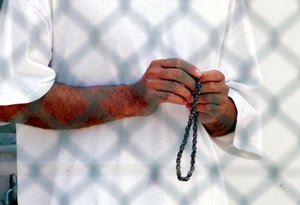
A military jury deliberated for only 15 minutes Thursday before acquitting the last of 11 Army reservists from an Ohio unit who had been charged with abusing prisoners at Bagram Air Base in Afghanistan.
Sgt. Alan J. Driver kissed a photo album with pictures of his children after the verdict was read. He was the fifth of 11 soldiers from the Cincinnati-based 377th MP Company to be cleared of abusing detainees.
Driver was accused of being one of several soldiers who beat a detainee known as Habibullah, who the Army says died of his injuries. Driver was also accused of throwing a shackled and handcuffed prisoner, Omar al-Farouq, against a wall.
"I just did my job," Driver said after hugging his wife and parents. "We were put in a difficult situation with minimal training and did the best with what we had."
Driver's attorney, Capt. Michael Waddington, had argued that prosecution witnesses had no credibility.
He showed jurors a receipt indicating that al-Farouq, a former al-Qaida operative, was released from the jail in good condition on Sept. 20, before the time prosecutors alleged Driver threw him against a wall.
"All we have is clouded memories, completely differing accounts of what happened," Waddington told the jury.
Capt. John B. Parker, the prosecutor, stressed that the case was about abuse of authority.
"It's not a question of confusion. It's not a question of fog of war. It's two specific incidents where a soldier went over the line," Parker said.
Prosecutors struggled with wobbly witnesses and little evidence. During the only day of testimony, one member of the 377th MP Company said it was not uncommon for MPs to forcefully wake sleeping detainees, and another testified he never saw Driver mistreat anyone.
***The investigation was launched shortly after Habibullah and another man known as Dilawar died within days of each other in Bagram in December 2002. No one has been prosecuted for the detainees' deaths, though both cases were ruled homicides and the Army claims the men were beaten to death at the jail. ***
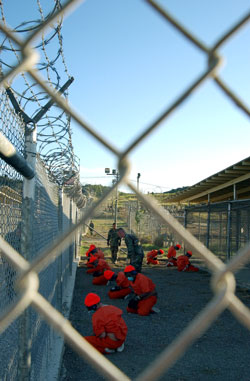
Only one soldier from Driver's unit was convicted by an Army jury, and he was spared jail time. Two pleaded guilty to assault and went to prison before being kicked out of the Army. Charges against three others were dropped in part because investigators in some pretrial hearings found no evidence of wrongdoing.
Driver's mother, Lori Marsh, was relieved by Thursday's verdict but still astonished that her son was prosecuted.
"You just never expect to have to fight for your son against your government," Marsh said with tears in her eyes.
Parker and other prosecutors declined to comment after the verdict.
source
Posted by audacious at 28.2.06 0 comments
Monday, February 27, 2006
x cnd olympian, sports to jail?
Olympian found guilty of smuggling
Feb. 27, 2006.

ROUSES POINT, N.Y. (CP) — A former Canadian Olympian has been convicted on two counts of heroin smuggling.
Kofi Yevakpor, a sprinter and member of the Canadian Olympic team in the 2000 Summer Games in Sydney, Australia, was convicted by a federal jury in Albany, N.Y., U.S. Immigration and Customs Enforcement said in a news release.
Yevakpor was caught in October 2005 trying to bring nearly three kilograms of heroin into the U.S. at Champlain, N.Y.
Yevakpor was suspended in June 2001 following an international track event in British Columbia after he tested positive for a banned substance. He appealed the suspension but it was upheld.
Yevakpor claimed at trial that he did not know the heroin was hidden in his luggage.
The jury found him guilty of one count of attempting to import heroin in the U.S. and one count of possession with intent to distribute heroin.
Yevakpor, 35, faces a mandatory 10-year minimum at sentencing.
source
Posted by audacious at 27.2.06 2 comments
global poll on terror threat
Majority believe terror threat rose after Iraq war:
global poll 02/27/2006
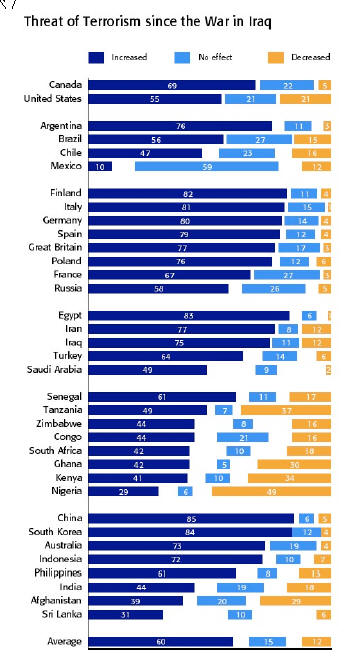
LONDON - Most people in 33 out of 35 countries worldwide believe that the US-led war in Iraq has increased the threat of terrorism, a survey for BBC World Service radio suggested Tuesday.
An average of 60 percent in the 33 nations agreed that the March 2003 invasion had increased the likelihood of terrorist attacks, with just 12 percent believing the opposite. A further 15 percent thought it had no effect.
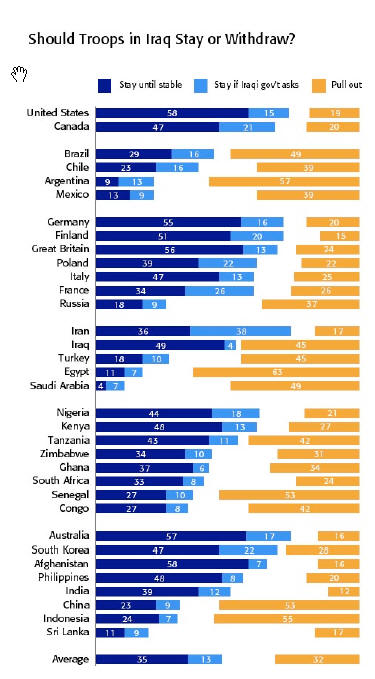
The survey of 41,856 people by Canadian pollsters GlobeScan and the US Program on International Policy Attitudes (PIPA) also claimed there was overall support in 20 countries for US forces to withdraw in the next few months.
But 21 of the 34 countries asked appeared in favour of troops staying in the region until stability is achieved, if the new Iraqi government requested it.
PIPA director Steven Kull said that despite the administration of US President George W. Bush framing the intervention in Iraq as a means of fighting terrorism, "all around the world most people view it as having increased the likelihood of terrorist attacks.
"The near unanimity of this assessment among countries is remarkable in public opinion polling."
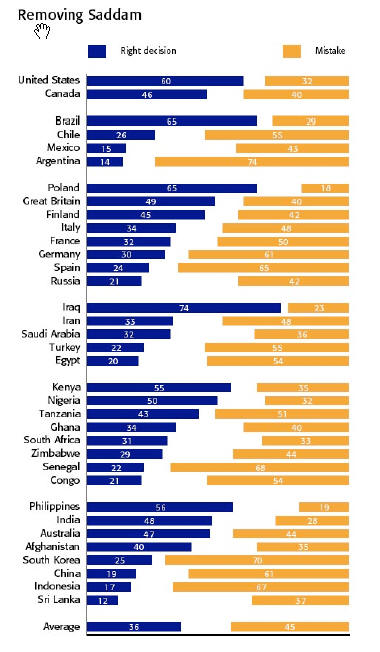
Other responses suggested that 21 countries thought the removal of former Iraqi president Saddam Hussein was a mistake; overall, 45 percent were against removing him from power while 36 percent supported the action.
Greatest criticism of the move came from Argentina (74 percent), with strong opposition from Spain (65 percent) and Germany (61 percent).
In Britain, whose government backed the US-led campaign and still has about 8,000 troops in southern Iraq, 40 percent thought removing Saddam was a mistake; in the United States, the figure was 32 percent and in Iraq, 23 percent.
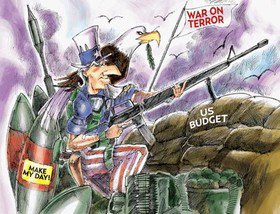
Strongest support for toppling Saddam came from Iraqi respondents (74 percent), Brazil and Poland (65 percent), the United States (60 percent) and Britain (49 percent).
In Britain, 77 percent of those questioned thought the terrorist threat had risen since the war, with 55 percent in the United States saying likewise and 75 percent in Iraq.
China topped the list at 85 percent, followed by South Korea (84 percent) and Egypt (83 percent).
Support for troops to stay appeared more constant: Iraq (49 percent), Britain (56 percent) while American and Afghani respondents were most in favour on 58 percent.
-- The countries polled were: Afghanistan; Argentina; Australia; Brazil; Britain; Canada; Chile; China; Democratic Republic of Congo; Egypt; Finland; France; Germany; Ghana; India; Indonesia; Iran; Iraq; Italy; Kenya; Mexico; Nigeria; Philippines; Poland; Russia; Saudi Arabia; Senegal; South Africa; South Korea; Spain; Sri Lanka; Tanzania; Turkey; the United States; and Zimbabwe.
source
BBC News
click on the images
Posted by audacious at 27.2.06 0 comments
what makes the news
Horses given Viagra to make them go faster at illegal races
Tuesday February 28, 2006
The Guardian
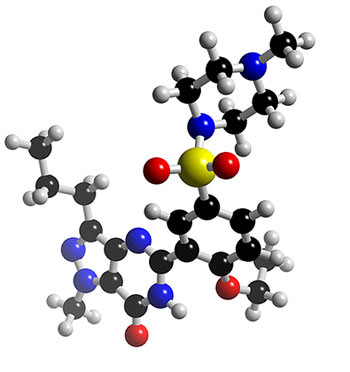
Two vets and a pharmacist were among 24 people arrested by police in Naples yesterday over claims that they fed Viagra to horses running in illegal races to make them go faster.
The arrests were part of a wider investigation into clandestine racing and betting in southern Italy. Police said horseowners and jockeys had also been arrested during the latest raids.
Prosecutors in Naples have been trying to stamp out illegal horse racing, which takes place on public racecourses after hours and attracts hundreds of gamblers. Stolen horses are often used. Some are fed powdered Viagra or other stimulants to improve their performances.
Colonel Mario Pantano, of the paramilitary carabinieri, said all of those rounded up yesterday were suspected of being in an organisation that runs secret races all over the Campania region and which had offshoots in Sicily and Emilia Romagna.
The criminal gang, not linked to the local Camorra mafia, was described as highly professional.
"They set up grandstands and betting parlours," said Col Pantano. "A great number of people turned out at weekends for the races, probably knowing it was illegal." The wide-ranging investigation, which started in 2004, has also discovered that horses have been doped with Viagra before legal races.
Police have so far seized property worth more than £3m during the raids. Last year, officers confiscated 80 horses and closed a racetrack that had been built without planning permission.
Posted by audacious at 27.2.06 0 comments
harper's vanishing act
Reporters strike war-footing with PMO, but Harper won't be dictated by national media
Steely-eyed Prime Minister Stephen Harper doesn't seem to care that the honeymoon is so over with the media.
The Hill Times, February 27th, 2006, Bea Vongdouangchanh
Members of the national media may already be on a war-footing with Stephen Harper and his staff over regular access to the centre of Canadian political power, but the new Prime Minister doesn't care.
Some newspaper columnists and reporters are flummoxed by the steely-eyed Prime Minister Harper (Calgary Southwest, Alta.) who is holding imperial pressers in the Commons foyer, who fired his director of communications in a snap last week and who won't be dictated to by the national media. ...
But in a column headlined, "A Conservative Pierre Trudeau is taking charge," Globe columnist Lawrence Martin said Mr. Harper would not likely be intimidated by the press gallery.
"Like a Pierre Trudeau, he suffers from few internal doubts and will be inclined to take orders only from above--the space between his eyes and hair."
Toronto Star political affairs columnist Chantal Hébert declared in one column last week, "In the week that followed their swearing-in, Harper's controversial Cabinet recruits were left to twist in the bitter wind of a national backlash while the Prime Minister perfected his media vanishing act." ...
This led to a formal complaint from the Parliamentary Press Gallery's President Emmanuelle Latraverse. "When Charest came, they refused to do a photo opportunity because they said it was a private meeting, which we fundamentally disagreed with," said Ms. Latraverse, a Radio Canada political reporter. "They weren't having lunch and discussing their kids' hockey games. They were meeting to discuss affairs of state." ... serious questions about your definition of a healthy and transparent relationship between the government in power and the national press." ... major announcements have been in the House of Commons foyer where political staffers get to decide which reporter gets to ask questions. ...
Mr. Harper doesn't like the media, and he doesn't think he needs them either, the columnist said. "Martin's government very much cared about what was going on in the media, they were called flinchers because they'd flinch every time they saw something they didn't like," the columnist said. "Harper thinks he's very capable and doesn't need the media to carry out his agenda." ...
sourse
Posted by audacious at 27.2.06 1 comments
liberal $ caps, leadership race
Liberals urged to cap leadership spending
Potential candidates seek reform.
Lowering entry fee for race from $75,000 could also help level campaign playing field
JULIET O'NEILL, February 27, 2006
Some potential Liberal leadership candidates are urging party executives to set the stage for a less expensive and fairer contest, saying a distasteful era of corporate influence and "instant Liberals" must be relegated to history.
Lawyer Martha Hall Findlay wants a lower entry fee for the Liberal leadership race than the $75,000 charged last time.
MP Carolyn Bennett wants leadership campaign spending capped at $1 million.
That's one-quarter the limit of $4 million set in 2003 - when Paul Martin won after raising about $12 million, mostly from corporations and wealthy individuals, leaving four other candidates in the dust.
Hall and Bennett are also pushing for Liberal membership rules, or a voluntary code of conduct, that prevents any leadership candidate or their backers from buying party memberships en masse - creating large pools of "instant Liberals" - to vote in the 2006 leadership contest.
Hall, the one declared candidate, and Bennett, one of several MPs considering a run, are calling for campaign rules that prevent any candidate from dwarfing others and that help all candidates take advantage of a new law banning the corporate donations on which Liberals have relied in the past for the majority of financing.
Individual contributions now are limited to a maximum of $5,200 per leadership race.
Mike Eizenga, the Liberal Party's president, said it is working with Elections Canada to enable individuals to channel contributions to candidates through the party, making them eligible for tax credits.
"It's not like you can cut anybody a $100,000 cheque any more, so that will affect every aspect of the campaign, starting with the registration fee," Findlay said in an interview.
"Crisp bills with matching paper clips have got to be history in our party," Bennett said in an interview. "A lot of us feel that some of the leadership costs that weren't even talked about were the costs of buying memberships for other people. There are those of us in the Liberal caucus who have fought against this for a long time."
Bennett said the party can fundraise and keep costs down by launching an Internet aspect to the race modelled on that waged by Howard Dean, the former Vermont governor who created a sensation in his 2004 campaign for the U.S. Democratic presidential nomination by raising nearly $50 million online, with average donations of $80.
"I think that would be part and parcel of renewal of the Liberal Party," Bennett said.
"You want people who believe in the Liberal Party but want to see it renewed to be able to give small amounts to individual candidates in a secure way."
She said some Liberals envy the Conservative Party, which raises the lion's share of funds from donations under $200.
Hall said fellow potential candidates John Godfrey and Ken Dryden, who were not available for comment, have also weighed in on these issues.
"There are a number of us who feel quite strongly that we should have rules established that encourage a level playing field, that it is an opportunity now for the party to have a system that is transparent," she said.
"That hasn't always been the case and that's part of the distaste people have had over some time, and if we do it well this time, it could actually reflect well on the Liberal Party."
While decisions on the rules are up to the executive and its committees, such key players as Ontario Liberal president Mike Crawley are recommending an entry fee that is not much higher than $75,000, nowhere near the $500,000 rumoured on some Liberal blog sites. And a cap on campaign spending in the $2-million range has been proposed by several insiders.
Crawley said a committee of "neutral party elders" will be appointed to oversee management of the leadership contest.
"They will make sure all candidates are being treated fairly, and that the process is fair and that the rules and procedures are being followed," he said.
The party executive expects to announce a leadership vote date and the entry fee at a March 19-20 meeting. A spending cap will be announced after deliberations by a committee.
Ottawa Citizen
Posted by audacious at 27.2.06 3 comments
top cia fired
The CIA's 'Black Sites'
What are we going to do with the secret prisoners who cannot be tried in our courts?
Nat Hentoff, February 24th, 2006
The CIA's top counterterrorism official [Robert Grenier] was fired last week because he opposed detaining Al Qaeda suspects in secret prisons abroad, sending them to other countries for interrogation, and using forms of torture such as "waterboarding," [making a prisoner believe he is about to be drowned] intelligence sources have claimed. The Sunday Times, London, February 12
For more than three years, I've been reporting on what has been increasingly, but fragmentarily, revealed about secret CIA prisons around the world. On September 17, 2001, the president, in a classified order, gave the CIA these "special powers" (as Attorney General Alberto Gonzales agreed during his confirmation hearings).

These "black sites"—as they are called in CIA, White House, and Justice Department files— escaped attempted congressional oversight until December 2005. But in the National Defense Authorization Act, the Senate finally called for regular reports on where those prisons are, what plans there are for the ultimate release of their prisoners, and "a description of the interrogation procedures used." Ted Kennedy and John Kerry introduced the resolution.
A similar December requirement was passed by the House (226 to 187) in a nonbinding resolution to urge the House and Senate negotiators to shine a shaft of sunlight on these "dark sites" in the final National Defense Authorization Act for 2006. But secretly, both the Senate and House resolutions were killed by the conference committee.
This February, Human Rights Watch, the ACLU, Human Rights First, and Amnesty International urged the House International Relations Committee to support three new resolutions of inquiry into American use of torture, citing the fact that "there is still a strong perception in many parts of the world that the United States continues to facilitate or willfully ignore torture by rendering individuals to countries where they are likely to be tortured, and by holding detainees in secret locations closed to the International Committee of the Red Cross." (Emphasis added.)
But on February 10, in a party line vote, the House International Relations Committee defeated all three resolutions.
There has been hardly any notice in the press or anywhere else about these congressional setbacks as part of the Bush administration's continued success in suppressing news of what actually goes on in those "black sites" in the name of the United States and its citizens.
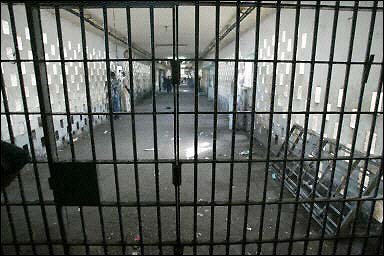
As I have noted in previous columns, there has been a debate for more than two years inside the CIA about the legality of these secret prisons and how to eventually dispose of the prisoners. They cannot be tried in American courts because they have been wholly denied due process under our constitution and so are wrongfully held.
Two years ago, FBI veteran Jack Cloonan, who had been the senior agent on the FBI's bin Laden squad in New York and later was in charge of investigating Al Qaeda master planner Khalid Shaikh Mohammed (now in some CIA "black site"), asked on ABC's Nightline: "What are we going to do with these people [in the CIA secret cells]? . . . Are they going to disappear? Are they stateless? . . . What are we going to explain to people when they start asking questions about where they are? Are they dead? Are they alive? What oversight does Congress have?"
The present answer to Jack Cloonan's last question is this: There is no congressional oversight. Congress has been blocked—by its Republican leadership, the president, Donald Rumsfeld, and CIA chief Porter Goss—from having any oversight at all. The constitutional separation of powers has also fallen into a black hole.
There is, however, a quick look into one of those secret prisons in a December 19, 2005, Human Rights Watch report, "U.S. Operated Secret 'Dark Prison' in Kabul."
Eight "detainees" now being held at Guantánamo, another extralegal U.S. prison, have told their attorneys what it was like when they were individually held, at various times between 2002 and 2004, in a secret U.S. facility for more than six weeks before being transferred to Guantánamo. That secret prison was apparently closed after the transfer. This is their story, as told in the HRW report:
"The detainees, who called the facility the 'dark prison' or 'prison of darkness,' said they were. . . shackled to rings bolted into the walls of their cells, deprived of food and drinking water. . . for days at a time . . . and kept in total darkness with load rap, heavy-metal music, or other sounds blaring for weeks at a time. . . . Some detainees said they were shackled in a manner that made it impossible for them to lie down or sleep."
One of the prisoners added that he was put in "an underground place," and "during the interrogations, he says, an interrogator threatened him with rape."
Ethiopia-born Benyam Mohammed, who grew up in Britain, told his attorney, in English, "[At one point] I was chained to the rails [of my cell] for a fortnight. . . . The CIA worked on people, including me, day and night. . . . Plenty lost their minds. I could hear people knocking their heads against the walls and the doors, screaming their heads off."
Bush, Rumsfeld, Gonzales, et al. regularly intone, in chorus, that the U.S. does not torture and always acts within the law. But if the fearful facts in the darkness in those CIA prisons are ever documented by an independent prosecutor in a future administration, it will finally be proved that, as Human Rights Watch emphasizes, the CIA is responsible—along with the president who gave it "special powers"—for "serious violations of U.S. criminal law, such as the War Crimes Act and the Anti-Torture Statute. . . . The mistreatment of detainees also violates the [International] Convention Against Torture and the International Covenant on Civil and Political Rights, both of which the United States has ratified, and the laws of war."
There is a rising focus around the country on this year's midterm elections. During the campaigning, will there be any mention of the screams in the CIA's underground prisons of darkness? And if there is, how many Americans will care enough to be repelled by their own silent, passive complicity in the growing moral darkness of this nation's leadership?
source
Posted by audacious at 27.2.06 0 comments
who's victory?
Defeat is victory. Death is life
Robert Fisk
02/26/06 "The Independent" -- -- Everyone in the Middle East rewrites history, but never before have we had a US administration so wilfully, dishonestly and ruthlessly reinterpreting tragedy as success, defeat as victory, death as life - helped, I have to add, by the compliant American press. I'm reminded not so much of Vietnam as of the British and French commanders of the First World War who repeatedly lied about military victory over the Kaiser as they pushed hundreds of thousands of their men through the butchers' shops of the Somme, Verdun and Gallipoli. The only difference now is that we are pushing hundreds of thousands of Arabs though the butchers' shops - and don't even care.
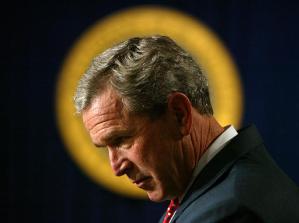
Last week's visit to Beirut by one of the blindest of George Bush's bats - his Secretary of State, Condoleezza Rice - was indicative of the cruelty that now pervades Washington. She brazenly talked about the burgeoning "democracies" of the Middle East while utterly ignoring the bloodbaths in Iraq and the growing sectarian tensions of Lebanon, Egypt and Saudi Arabia. Perhaps the key to her indifference can be found in her evidence to the Senate Committee on International Affairs where she denounced Iran as "the greatest strategic challenge" facing the US in the region, because Iran uses policies that "contradict the nature of the kind of Middle East sought by the United States".
As Bouthaina Shaaban, one of the brightest of Syria's not always very bright team of government ministers, noted: "What is the nature of the kind of Middle East sought by the United States? Should Middle East states adapt themselves to that nature, designed oceans away?" As Maureen Dowd, the best and only really worthwhile columnist on the boring New York Times, observed this month, Bush "believes in self-determination only if he's doing the determining ... The Bushies are more obsessed with snooping on Americans than fathoming how other cultures think and react." And conniving with rogue regimes, too, Dowd might have added.
Take Donald Rumsfeld, the reprehensible man who helped to kick off the "shock and awe" mess that has now trapped more than 100,000 Americans in the wastes of Iraq. He's been taking a leisurely trip around North Africa to consult some of America's nastiest dictators, among them President Zine el-Abidine Ben Ali of Tunisia, the man with the largest secret service in the Arab world and whose policemen have perfected the best method of gleaning information from suspected "terrorists": to hold them down and stuff bleach-soaked rags into their mouths until they have almost drowned.
The Tunisians learned this from the somewhat cruder methods of the Algerians next door whose government death squads slaughtered quite a few of the 150,000 victims of the recent war against the Islamists. The Algerian lads - and I've interviewed a few of them after their nightmares persuaded them to seek asylum in London - would strap their naked victims to a ladder and, if the "chiffon" torture didn't work, they'd push a tube down the victim's throat and turn on a water tap until the prisoner swelled up like a balloon. There was a special department (at the Chateauneuf police station, in case Donald Rumsfeld wants to know) for torturing women, who were inevitably raped before being dispatched by an execution squad.
All this I mention because Rumsfeld's also been cosying up to the Algerians. On a visit to Algiers this month, he announced that "the United States and Algeria have a multifaceted relationship. It involves political and economic as well as military-to-military co-operation. And we very much value the co-operation we are receiving in counter-terrorism..." Yes, I imagine the "chiffon" technique is easy to learn, the abuse of prisoners, too - just like Abu Ghraib, for example, which now seems to have been the fault of journalists rather than America's thugs.
Rumsfeld's latest pronouncements have included a defence of the Pentagon's system of buying favourable news stories in Iraq with bribes - "non-traditional means to provide accurate information" was his fantasy description of this latest attempt to obscure the collapse of the American regime in Baghdad - and an attack on our reporting of the Abu Ghraib tortures. "Consider for a moment the vast quantity of column inches and hours of television devoted to the detainee abuse [sic] at Abu Ghraib. Compare that to the volume of coverage and condemnation associated with, say, the discovery of Saddam Hussein's mass graves, which were filled with hundreds of thousands of innocent Iraqis."
Let's expose this whopping lie. We were exposing Saddam's vile regime, especially his use of gas, as long ago as 1983. I was refused a visa to Iraq by Saddam's satraps for exposing their vile tortures at - Abu Ghraib. And what was Donald Rumsfeld doing? Visiting Baghdad, grovelling before Saddam, to whom he did not mention the murders and mass graves, which he knew about, and pleading with the Beast of Baghdad to reopen the US embassy in Iraq.
With the usual press courtiers in tow, Rumsfeld has no problems, witness George Melloan's recent interview with the Beast of Washington in his Boeing 737: "He generously spares me time for a chat about defence strategy. Bright sunlight streams in and lights his face ... Sitting across from him at a desk high above the clouds, one wonders if the ability of this modern Jove to call down lightning on transgressors will be equal to the tasks ahead."

And so myth-making and tragedy go hand in hand. Iraq's monumental catastrophe has become routine, shapeless, an incipient "civil war". Note how the American framework of disaster is now being portrayed as an Iraqi vs Iraqi war, as if the huge and brutal US occupation has nothing to do with the appalling violence in Iraq. They blow up each other's mosques? They just don't want to get on. We told them to have a non-sectarian government and they refused. That, I suspect, will be the get-out line when the next deluge overwhelms the Americans in Iraq.
Winston Churchill, when the Iraqis staged their insurgency against British rule in 1920, called Iraq "an ungrateful volcano". But let's just sit back and enjoy the view. Democracy is coming to the Middle East. People are enjoying more liberties. History doesn't matter, only the future. And the future for the people of the Middle East is becoming darker and bloodier by the day. I guess it just depends whether "Jove" is up to his job when all that bright sunlight streams in and lights his face.
source
Posted by audacious at 27.2.06 0 comments
and the people of iraq?
Iraq War: Depleted Uranium Contaminates Europe
LEUREN MORET, February 27, 2006
"Did the use of Uranium weapons in Gulf War II result in contamination of Europe? Evidence from the measurements of the Atomic Weapons Establishment (AWE), Aldermaston, Berkshire, UK," reported the Sunday Times Online (February 19, 2006) in a shocking scientific study authored by British scientists Dr. Chris Busby and Saoirse Morgan.
The highest levels of depleted uranium ever measured in the atmosphere in Britain, were transported on air currents from the Middle East and Central Asia; of special significance were those from the Tora Bora bombing in Afghanistan in 2001, and the "Shock & Awe" bombing during Gulf War II in Iraq in 2003.
Out of concern for the public, the official British government air monitoring facility, known as the Atomic Weapons Establishment (AWE), at Aldermaston, was established years ago to measure radioactive emissions from British nuclear power plants and atomic weapons facilities.
The British government facility (AWE) was taken over 3 years ago by Halliburton, which refused at first to release air monitoring data to Dr.
Busby, as required by law.
An international expert on low level radiation, Busby serves as an official advisor on several British government committees, and co-authored an independent report on low level radiation with 45 scientists, the European Committee on Radiation Risk (ECRR), for the European Parliament. He was able to get Aldermaston air monitoring data from Halliburton /AWE by filing a Freedom of Information request using a new British law which became effective January 1, 2005; but the data for 2003 was missing. He obtained the 2003 data from the Defence Procurement Agency.
The fact that the air monitoring data was circulated by Halliburton/ AWE to the Defence Procurement Agency, implies that it was considered to be relevant, and that Dr. Busby was stonewalled because Halliburton/ AWE clearly recognized that it was a serious enough matter to justify a government interpretation of the results, and official decisions had to be made about what the data would show and its political implications for the military.
In a similar circumstance, in 1992, Major Doug Rokke, the Director of the U.S. Army Depleted Uranium Cleanup Project after Gulf War I, was ordered by a U.S. Army General officer to write a no-bid contract "Depleted Uranium, Contaminated Equipment, and Facilities Recovery Plan Outline" for the procedures for cleaning up Kuwait, including depleted uranium, for Kellogg, Brown and Root (KBR), a subsidiary of Halliburton.
The contract/proposal was passed through Madeleine Albright, the Secretary of State, to the Emirate of Kuwait, who considered the terms and then hired KBR for the cleanup.
Aldermaston is one of many nuclear facilities throughout Europe that regularly monitor atmospheric radiation levels, transported by atmospheric sand and dust storms, or air currents, from radiation sources in North Africa, the Middle East and Central Asia.
After the "Shock and Awe" campaign in Iraq in 2003, very fine particles of depleted uranium were captured with larger sand and dust particles in filters in Britain.
These particles traveled in 7-9 days from Iraqi battlefields as far as 2400 miles away.

The radiation measured in the atmosphere quadrupled within a few weeks after the beginning of the 2003 campaign, and at one of the 5 monitoring locations, the levels twice required an official alert to the British Environment Agency.
In addition to depleted uranium data gathered in previous studies on Kosovo and Bosnia by Dr. Busby, the Aldermaston air monitoring data provided a continuous record of depleted uranium levels in Britain from the other recent wars.
Extensive video news footage of the 2003 Iraq war, including Fallujah in 2004, provided irrefutable documented evidence that the US has unethically and illegally used depleted uranium munitions on cities and other civilian populations.
These military actions are in direct violation of not only the international conventions, but also violate US military law because the US is a signatory to The Hague and Geneva Conventions and the 1925 Geneva Gas Protocol.
Depleted uranium weaponry meets the definition of a Weapon of Mass Destruction (WMD) in two out of three categories under US Code TITLE 50, CHAPTER 40 Sec. 2302.
After action mandates have also been violated such as US Army Regulation AR 700-48 and TB 9-1300-278 which requires treatment of radiation poisoning for all casualties, including enemy soldiers and civilians, and remediation.
Dr. Busby's request for this data through Halliburton from AWE, and subsequently provided by the Defence Procurement Agency, was necessary to establish verification of Iraq's 2003 depleted uranium levels in the atmosphere.
These facts demonstrate why Halliburton (AWE) refused to release the 2003 data to him, and it obviously establishes that weaponized depleted uranium is an indiscriminate weapon being distributed all over the world in a very short period of time, immediately after its use.
The recent documentary film BEYOND TREASON details the horrific effects of depleted uranium exposure on American troops and Iraqi civilians in the Gulf region in 1991; not to speak of those civilians continuing to live in permanently contaminated and thus uninhabitable regions.
Global increases since 1991 of melanoma, infant mortality, and frog die-offs can only be explained by an environmental contaminant. Alarming global increases in diabetes, with high correlation to depleted uranium wars in Iraq, Bosnia/Kosovo, and Afghanistan, demonstrate that diabetes is a sensitive indicator and a rapid response to internal depleted uranium exposure.
Americans in 2003 reported visiting Iraqi relatives in Baghdad who were suffering from an epidemic of diabetes.
After returning to the US following 2-3 weeks in Iraq, they discovered within a few months that they too had diabetes.
Japanese human shields and journalists who worked in Iraq during the 2003 war are sick and now have symptoms typical of depleted uranium exposure.
Likewise, after the US Navy, several years ago, moved depleted uranium bombing and gunnery ranges from Vieques Island in Puerto Rico to Australia, health effects there are already being reported.
The documentary film BLOWIN' IN THE WIND, has an interview with a family with two normal teenage daughters, living near the bombing range where depleted uranium weaponry is now being used.
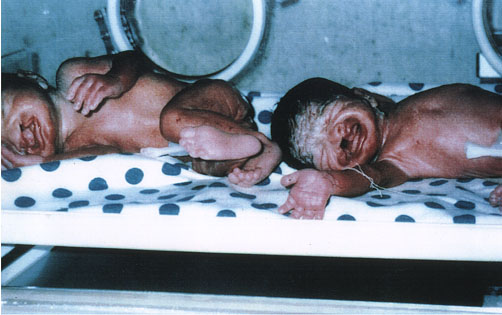
The parents showed photos of their baby born recently with severe birth defects. The baby looked like Iraqi deformed babies, and like many of the Iraqi babies, died 5 days after birth.
Other than anonymous British government officials denying that Iraq was the source of the depleted uranium measured at Aldermaston by AWE, and some unnamed 'establishment scientists' blaming it on local sources or natural uranium in the Iraq environment, there is no one, as of this writing, willing to lend their name or office to refuting this damning evidence reported by Dr. Busby.
All of the anonymous statements used by the media thus far are contradicted by the factual evidence found in the filters, which was all transported from the same region.
The natural abundance of uranium in the crust of the earth is 2.4 parts per million, which would not become concentrated to the high levels measured in Britain during a long journey from the Middle East. These particles traveling over thousands of miles would dilute the concentration rather than increase it.
There are no known natural uranium deposits in Iraq which make it impossible for these anonymous claims to have scientific credibility.
Unnamed government sources blamed local sources in Britain such as nuclear power plants; however that would also leave evidence of fission products in the filters which were not in evidence.
The lowest levels measured at monitoring stations around Aldermaston were at the facility, which means it could not be a possible source. Atomic weapons facilities would be more likely to produce plutonium contamination, also not reported as a co-contaminant at Aldermaston.
In other words, all factual evidence considered, the question must be asked, what were the media's anonymous experts and government officials basing their claims on?
Dr. Keith Baverstock exposed a World Health Organization (WHO) cover-up on depleted uranium in an Aljazeera article, "Washington's Secret Nuclear War" posted on September 14, 2004. It was the most popular article ever posted on the Aljazeera English language website.
Baverstock leaked an official WHO report that he wrote, to the media several years ago after the WHO refused to publish it. He warned in the report about the mobility of, and environmental contamination from, tiny depleted uranium particles formed from US munitions.
Busby's ECRR report challenged the International Committee on Radiation Protection (ICRP) standards for radiation risk, and reported that the mutagenic effects of radiation determined by Chernobyl studies are actually 1000 times higher than the ICRP risk model predicts.
The ECRR report also establishes that the ICRP risk model, based on external exposure of Hiroshima and Nagasaki victims, and the ECRR risk model, based on internal exposure, are mutually exclusive models. In other words, the ICRP risk model based on external exposure cannot be used to estimate internal exposure risk.
The report also states that a separate study is needed for depleted uranium exposure risks, because it may be far more toxic than nuclear weapons or nuclear power plant exposures. In July of 2005, the National Academy of Sciences reported in their new BEIR VII report on low level radiation, that there is "no safe level of exposure".
The report also finally admitted that very low levels are more harmful per unit of radiation than higher levels of exposure, also known as the "supralinear" effect.
This is extremely alarming information on low level radiation risk, since the AWE data from Aldermaston confirms that rapid global transport of depleted uranium dust is occurring.
Dr. Katsuma Yagasaki, a Japanese physicist at the University of the Ryukyus in Okinawa, has estimated that the atomicity equivalent of at least 400,000 Nagasaki bombs has been released into the global atmosphere since 1991, from the use of depleted uranium munitions.
It is completely mixed in the atmosphere in one year. The "smog of war" from Gulf War I was found in glaciers and ice sheets globally a year later.
Even more alarming is the non-specific catalytic or enzyme effect from internal exposures to nanoparticles of depleted uranium. Soldiers on depleted uranium battlefields have reported that, after noticing a metallic taste in their mouths, within 24-48 hours of exposure they became sick with Gulf War syndrome symptoms.
Who is profiting from this global uranium nightmare? Dr. Jay Gould revealed in his book THE ENEMY WITHIN, that the British Royal family privately owns investments in uranium holdings worth over $6 billion through Rio Tinto Mines.
The mining company was formed for the British Royal family in the late 1950's by Roland Walter "Tiny" Rowland, the Queen's buccaneer.
Born in 1917 through illegitimate German parentage, and before changing his name, Roland Walter Fuhrhop was a passionate member of the Nazi youth movement by 1933, and a classmate described him as "...an ardent supporter of Hitler and an arrogant, nasty piece of work to boot."
His meteoric rise and protection by intel agencies and the British Crown are an indication of what an asset he has been for decades to the Queen, as Africa's most powerful Western businessman.
Africa and Australia are two of the main sources of uranium in the world. The Rothschilds control uranium supplies and prices globally, and one serves as the Queen's business manager.
Filmmaker David Bradbury made BLOWIN' IN THE WIND to expose depleted uranium bombing and gunnery range activities contaminating pristine areas of eastern Australia, and to expose plans to extract over $36 billion in uranium from mines in the interior over the next 6 years. Halliburton has finished construction of a 1000 mile railway from the mining area to a port on the north coast of Australia to transport the ore.
The Queen's favorite American buccaneers, Cheney, Halliburton, and the Bush family, are tied to her through uranium mining and the shared use of illegal depleted uranium munitions in the Middle East, Central Asia and Kosovo/Bosnia.
The major roles that such diverse individuals and groups as the Carlyle Group, George Herbert Walker Bush, former Carlyle CEO Frank Calucci, the University of California managed nuclear weapons labs at Los Alamos and Livermore, and US and international pension fund investments have played in proliferating depleted uranium weapons is not well known or in most instances even recognized, inside or outside the country.
God Save The Queen from the guilt of her complicity in turning Planet Earth into a "Death Star."
source
Posted by audacious at 27.2.06 0 comments
Sunday, February 26, 2006
inspired by 'get smart' ?
GunCellphone
At first sight it looks like a regular cell phone — same size, same shape, same overall appearance.
But beneath the digital face lies a .22-caliber pistol, a phone gun capable of firing four rounds in quick succession with a touch of the otherwise standard keypad.
The US Department of Homeland Security and the FBI are aware of the device and have instructed baggage screeners to be on the lookout for suspicious mobile phones. This is especially after 9/11.
European law enforcement officials — stunned by the discovery of these deadly decoys — say phone guns are changing the rules of engagement in Europe. ...
Posted by audacious at 26.2.06 0 comments
u.s. patent - gas hair drier
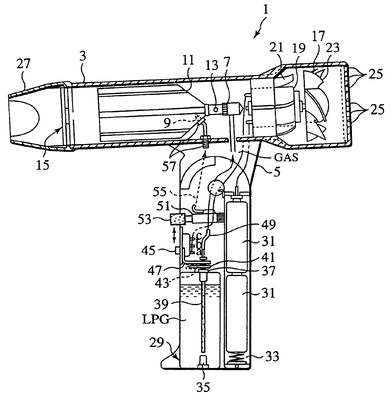
Gas Combustion Type Hair Drier
patent#: US 6959707, patent issued on 11/1/2005
In his State of the Union address on Tuesday, President Bush spoke of the need for the United States to eliminate its dependence on foreign oil. I agree whole-heartedly and I propose that the first step in this direction be the elimination of all petroleum-powered hair dryers and accessories. It is bad enough that our economy is reliant on Middle Eastern countries that despise us. What would we tell our children if World War III erupted over our insatiable desire for dry hair?
Posted by audacious at 26.2.06 0 comments
political unrest and the eclipse
NASA: On Wednesday, 2006 March 29, a total eclipse of the Sun will be visible from within a narrow corridor which traverses half the Earth. The path of the Moon's umbral shadow begins in Brazil and extends across the Atlantic, northern Africa, and central Asia where it ends at sunset in western Mongolia. A partial eclipse will be seen within the much broader path of the Moon's penumbral shadow, which includes the northern two thirds of Africa, Europe, and central Asia.
Iran, oil and the March solar eclipse
Those who cannot learn from history are doomed to repeat it. - George Santayana:
Dave Muller, A South News commentary February 23 2006
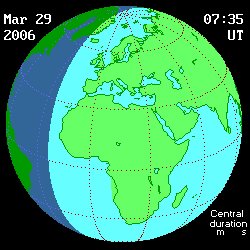
The month of March is shaping up as real crunch time in the history of the Middle East. Iran is to be taken to the UN Security Council by the International Atomic Energy Agency (IAEA) on its nuclear program with the possibility of punitive sanctions. Iran plans on its New Year on March 20 to begin an oil bourse trading in Euros which poses a direct threat to the monopoly of oil pricing enjoyed by the New York and London exchanges and hence to the status of the U.S. dollar itself as the principal world reserve currency. Israel has a general election scheduled for March 28 which could determine the course of the Palestinian peace process for years to come.
The U.S. and Israel has plans afoot for a military strike possibly using mini nukes with military planners paying as much attention to the waxing and waning of the moon as mythical werewolves. A dark sky with little or no visible crescent is a premium time to launch an aerial attack continuing a long military tradition of surprising the enemy in the dead of night.
On Wednesday 29th March not only will no moon be visible but the Sun will temporarily vanish in the sky by a total solar eclipse. The 1991 Gulf War was launched Jan 17 a day after the central solar eclipse the day before.
The shadow of the Moon will sweep a band starting from Brazil, through Atlantic Ocean, Gold Coast of Africa, Saharan Desert, Mediterranean Sea, Turkey, Black Sea, Georgia, Russian Federation, northern shores of Caspian Sea, Kazakhstan; ending in Mongolia. The duration of totality will be less than 2 minutes near the sunrise and sunset limits, but will be as long as 4 minutes and 7 seconds in Libya, at the moment of greatest eclipse. The 1991 Gulf War annular eclipse lasted 7 minutes 53 seconds.
Is history about to repeat itself?
We are all familiar with the recurrence of natural phenomena such as the daily sunrise and sunset, the annual cycle of seasons and the monthly waxing and waning of the moon. Such recurrence in nature gives us a sense of time and calendars in charting cultural festivals and birthdays and invoking a sense of history.
While solar and lunar eclipses regularly occur every 6 months they do so asymmetrically in time and place and do with different physical characteristics and geometry. But there is a longer eclipse period of time of natural recurrence. There is the Meton cycle of 19 years, where eclipses occur of the same day of year within hours. Despite this synchronicity the eclipses have neither the same physical geometry nor occur in the same region of the Earth. Then there is the Exeligmos or a triple Saros (54 years and 34 days) when the shadow of the moon returns the same place and time on the globe with the same geometry and characteristics. - 1898, 1952 and 2006, etc.
Thus it useful to examine the total solar eclipse of February 25 1952 and the political events at that time to see if human history has learnt anything since then.
1952 Total solar eclipse
The total eclipse of February 25 1952 is the 26th eclipse of 71 members that belong to Saros (223 new moons) series 139. The path of totality passes over some of the world largest oil fields - Saudi Arabia, Iraq, Iran, and the former Soviet Union’s oil fields, now Turmenistan, Uzbekistan, Kazakhstan. The eclipse directly passing over Tehran and Baku as key oil capitals.
1952 was also a crunch year for Iran when President Mohammed Mossadaq nationalised the Anglo-Iranian Oil Company in order to ensure that oil profits remain in Iran instead of flowing into British and American oil corporation coffers. British oil professionals left Iran and Britain ordered a boycott of Iranian oil, effectively shutting down the oil industry in Iran for the time being. The Iranian economy headed towards bottom as foreign exchange withered away and oil revenues went to nil Mossadaq realises that Britain will attempt to overthrow his government, so he closes the British Embassy and sends all British civilians, including its intelligence operatives, out of the country.
On the day of this 1952 eclipse, Prime Minister Winston Churchill announces that his nation has an atomic bomb as perhaps a veiled threat to Tehran but it was only later in the year to 1957 that Britain actually conducted 12 major nuclear tests in Australia and Monte Bello islands.
Britain challenged the legality of Iran’s oil nationalisation. However the International Court of Justice in The Hague finally ruled in favor of Iran on July 22nd. (1) Despite appeals Britain finds itself with no way to stage the coup it desires, so it approaches the American intelligence community for help. Their first approach results in abject failure when Harry Truman throws the British representatives out of his office, stating that "We don’t overthrow governments; the United States has never done this before, and we’re not going to start now." After Eisenhower is elected in November 1952, the British have a much more receptive audience, and plans for overthrowing Mossadaq are produced (2).
(1) International Court of Justice, Anglo-Iranian Oil Co. case (United Kingdom v. Iran). Judgment of July 22nd, 1952.(2)
On June 16, 2000, the New York Times published on its Web site PDF files of a secret CIA report: "CLANDESTINE SERVICE HISTORY, OVERTHROW OF PREMIER MOSSADEQ OF IRAN, November 1952-August 1953," an operation planned and executed by the CIA and British
SIS:
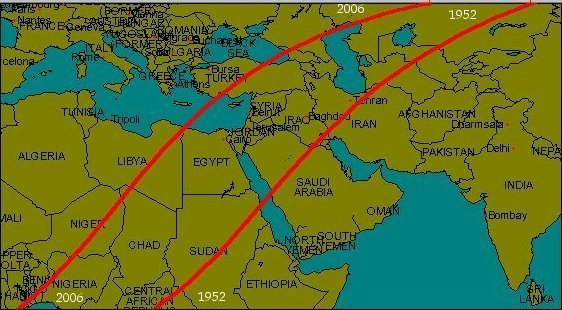
Most recent Saros 139 eclipse
The most recent eclipse in Saros 139 occurred 1988 March 18, also as a total eclipse. Successive eclipses in a Saros (18 years 11 days 8 hours) series are very similar in character but each eclipse the time of maximum totality is shifted by 8 hours so that successive eclipses are about 120º apart in longitude. This eclipse path runs from the Indonesian oil fields through the Philippines northwards through the pacific to end off the coast of Alaska. But it is more than interesting that in the Persian Gulf, during the Iran-Iraq war, at this time with Iran blocking the Straits of Hormuz to oil tankers leaving Arab ports.
Oil Tanker wars of 1988
On April 14, 1988, the frigate USS Samuel B. Roberts was badly damaged by an Iranian mine. U.S. forces responded with Operation Praying Mantis on April 18, the United States Navy's largest engagement of surface warships since World War II. Two Iranian ships were destroyed, and an American helicopter was shot down, killing the two pilots.
In the course of these escorts by the U.S. Navy, the cruiser USS Vincennes shot down Iran Air Flight 655 with the loss of all 290 passengers and crew on July 3, 1988. The American government claimed that the airliner had been mistaken for an Iranian F-14 Tomcat, and that the Vincennes was operating in international waters at the time and feared that it was under attack. It has since emerged, however, that the Vincennes was in fact in Iranian territorial waters, and that the Iranian passenger jet was turning away and increasing altitude after take-off. The U.S. paid compensation but never apologised.
Through all of this, members of the Reagan Administration had at the same time, also been secretly selling weapons to Iran - first indirectly ( through Israel) and then directly. It claimed that the administration hoped Iran would, in exchange, persuade several radical groups to release Western hostages. (for details see the Iran-Contra Affair). The money from the sales was channeled to equip the Nicaraguan Contras, right-wing rebels. Oliver North and Vice-Admiral John Poindexter are indicted on charges of conspiracy on March 16- a day before this eclipse.
Gassing of Kurds in Halabja
According to several accounts, on the evening of March 16/17 Iraq uses US-supplied Bell helicopters to deploy chemical weapons during its campaign to recapture lost territories in its war with Iran. One of the towns that is within the conflict zone is the Kurdish village of Halabja, with a population of about 70,000. Between 3,200 and 5,000 Halabja civilians are reportedly killed by poison gas. But the story gets murkier: immediately after the battle the United States Defense Intelligence Agency investigated and produced a classified report, which it circulated within the intelligence community on a need-to-know basis. That study asserted that it was Iranian gas that killed the Kurds, not Iraqi gas.
The agency did find that each side used gas against the other in the battle around Halabja. The condition of the dead Kurds' bodies, however, indicated they had been killed with a blood agent — that is, a cyanide-based gas — which Iran was known to use. The Iraqis, who are thought to have used mustard gas in the battle, are not known to have possessed blood agents at the time
[New York Times, 1/31/03; Johnson and Pelletiere, 12/10/1990; International Herald Tribune 1/17/03; Weinstein and Rempel, 2/13/1991 cited in Hurd and Rangwala, 12/21/2001; Washington Post, 3/11/1991]
2006 eclipse path of totality
While the 1991 Gulf War eclipse of midnight (GMT) Jan 15/16 belonged to Saros series 131 the total eclipse of 2006 March 29 is the 29th eclipse of 71 members that belong to Saros series 139.
The eclipse track begins in eastern Brazil, where the Moon's shadow first touches down on Earth at 08:36 GMT. Traveling over 9 km/s, the umbra quickly leaves Brazil and races across the Atlantic Ocean for the next half hour. Sweeping in from the Gulf of Guinea totality encounters the coast of Ghana at 09:08 GMT. Located about 50 kilometres south of the central line, the 1.7 million inhabitants of Ghana's capital city Accra can expect a total eclipse lasting 2 minute 58 seconds
Moving inland totality enters Togo at 09:14 GMT. Continuing northeast, the shadow's axis enters Nigeria at 09:21 GMT. Nigeria is the United States' fifth-largest supplier of foreign oil . The eclipse takes about sixteen minutes to cross western Nigeria before entering Niger.
During the next hour, the shadow traverses some of the most remote and desolate deserts on the planet. Niger, an impoverished nation on the western edge of the Sahara desert, is the world's third largest producer of uranium.
One of the chief arguments used by the Bush administration to justify the invasion of Iraq in March 2003 was that Iraq was "reconstituting its nuclear weapons programs." Central to this argument was the claim that Iraq attempted to obtain processed uranium from Niger.
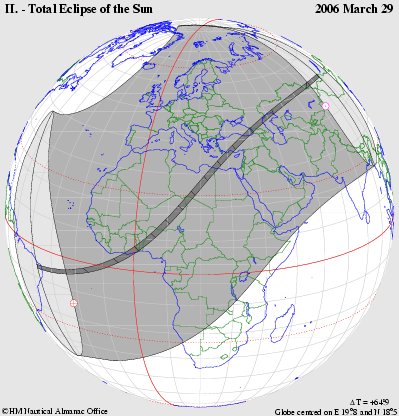
When it reaches northern Niger, it briefly enters extreme northwestern Chad before crossing into oil rich Libya. Maximum duration of totality lasts for about 4m07s in southern Libya where the shadow width is about 184 km wide and travels at about 0.7 km/sec .Here totality will occur at 10:10 GMT
Totality over the eastern Mediterranean will occur about 40 minutes later with only a slightly shorter duration .Passing directly between Crete and Cyprus, the track reaches the southern coast of Turkey at 10:54 GMT.
With a population of nearly 3/4 million people, Antalya lies 50 kilometres northwest of the central line. The coastal city's inhabitants are positioned for a total eclipse lasting 3 minutes 11 seconds while observers on the central line receive an additional 35 seconds of totality. Konya is 25 kilometres from path center and experiences a 3 minute 36 second total phase beginning at 10:58 GMT.
Crossing mountainous regions of central Turkey, the Moon's shadow intersects the path of the 1999 Aug 11 total eclipse.
At 11:10 GMT, the shadow axis reaches the Black Sea along the northern coast of Turkey. Six minutes later, the umbra encounters the western shore of Georgia, entering once again a sensitive oil region Moving inland, the track crosses the Caucasus Mountains, which form the highest mountain chain of Europe. As the shadow proceeds into Russia, it engulfs the northern end of the Caspian Sea and crosses into Kazakhstan.
In the remaining seventeen minutes, the shadow rapidly accelerates across central Asia while the duration dwindles. It traverses northern Kazakhstan and briefly re-enters Russia before lifting off Earth's surface at sunset along Mongolia's northern border.
Lessons of history
The inception of U.S. imperialism is generally traced to 1898, and the acquisition of an overseas empire (Puerto Rico, the Philippines) as spoils of the Spanish-American War. This accompanied the rise of the Rockefeller oil dynastry and its later grab in the Middle East.
Today the U.S. is really bogged down in Iraq and its imperial star in the Pleiades is fading worldwide. Geo-politically, the 7 sisters no longer control the world oil as Venezuelan president Hugo Chavez is demonstrating with his subsidising of heating oil to the U.S. poor
But given the US and its media propaganda are set on surgical strikes on Iran all we can say that the geography is not on its side. The Iranians need only retaliate against two or three major oil installations, besides sinking enough tonnage to make the Straits of Hormuz perilous to navigation and world oil markets.
So - called 'surgical' strikes will transform a nuclear program that is ambiguous into an unambiguously military program designed to obtain nuclear weapons at any cost, and will accelerate rather than prevent, Iran developing nuclear weapons. Even talk of military action inevitably pushes the Iranian government toward the nuclear weapons.
Unfortunately, the message is still not sinking in that George W Bush is not Theodore Roosevelt. It is 2006 not 1898.
What experience and history teach is this -- that people and governments never have learned anything from history, or acted on principles. G. W. Hegel
source
Posted by audacious at 26.2.06 2 comments
x cia, on mosque bombing
Former CIA Analyst: Western Intelligence May Be Behind Mosque Bombing
Ray Mcgovern says US in most danger ever, from its own government
February 26 2006
Former CIA analyst a and presidential advisor Ray McGovern does not rule out Western involvement in this week's Askariya mosque bombing in light of previous false flag operations that have advanced hidden agendas of the ruling elite.
During the mid-eighties, McGovern was one of the senior analysts conducting early morning briefings of the PDB one-on-one with the Vice President, the Secretaries of State and Defense, the Chairman of the Joint Chiefs, and the Assistant to the President for National Security Affairs.
He joined Alex Jones to discuss many topics from martial law to government false flag terrorism and provocation tactics.
McGovern firstly suggested that Posse Comitatus, the law that forbids the military to take on a policing role within the US, is being systematically overthrown.
"Not only have the top ranks of the intelligence community been politicized and corrupted, so has the army. The military establishment is goose stepping around, saluting the President and saying whatever the President wants them to."
A former officer himself, McGovern declared that the unprecedented movement towards a martial law mentality within government and military is a deeply unsettling one and that the US is hurtling toward a dictatorship.
"As I look at the top Pentagon brass, I have to conclude that unlike my days as a US army officer, those folks have been so politicized that if the US President told them to go ahead and exercise police functions in this country they would go ahead and salute and they would do it, and that's really scary."
Moving on to the "war on terror", 27 year veteran McGovern concurred that staged terror has long been used by our governments in order to forward their own agendas at home and elsewhere:
"There's lots of evidence that the government in the past has used these things for its own purposes, for overthrowing governments, as it did in Iran in 1953, and in Guatemala in 1954, the Gulf of Tonkin was a little different...LBJ did deceive Congress and the war went on for seven years."
Concerning 9/11 McGovern declared that although he is still in two minds, he is deeply suspicious of the official version of events and "there is certainly a cover up." The amount of unanswered questions and blatant lies told by Cheney and the NeoCons makes it very easy for him to believe the government was involved.
Moving on to the recent Askariya mosque bombing in Samarra, Iraq McGovern commented;
"The main question is Qui Bono? Who benefits from this kind of thing? You don't have to be very conspiratorial or even paranoid to suggest that there are a whole bunch of likely suspects out there and not only the Sunnis. You know, the British officers were arrested, dressed up in Arab garb, riding around in a car, so this stuff goes on."
Ray McGovern is part of a collective of former Intelligence officers who call themselves Veteran Intelligence Professionals for Sanity (VIPS).
source
Posted by audacious at 26.2.06 0 comments
civil war in iraq
Civil War in Iraq: Who are the Winners and Who are the Losers
Yamin Zakaria, London UK, International Institute of Peace, 2006-02-25
It is commendable that both Sunni and Shi’ite leaders have called for restraint, and have denied that Sunnis were behind the bombings as no clear evidence has been provided. Another pertinent point is that, in its entire history, Iraq’s sectarian-based conflict never took place, so why should it erupt now? If it does, it cannot be down to coincidence but directly related to the designs of the foreign occupational forces as they have the most to benefit from a civil war.
"We have widespread evidence that the outside forces are attempting to instigate a civil war here and Iraqis are conscious of that and have made determined effort not to respond to it" (Dr. Saad Jawad, a political scientist at Baghdad University.)
When a crime is committed, the obvious question to ask is: what was the primary motive and who stands to benefit. The answers would lead to building up a list of suspects. Therefore, at the very least, let us ask the obvious questions before apportioning blame to a particular community or group. Almost everyone concurs that, the primary motive behind the bombings of the Askariyah shrine was to ignite civil war along sectarian lines. The main beneficiary would be the US led coalition forces, as they would face less resistance due to the Sunni-Shia infighting. A deeply divided Iraqi population is less able to channel and focus their collective opposition against the US-led invaders.
It is an axiom that power in the international arena is always determined by the power of rival nations. Naturally, if civil war in Iraq ignites, that would further weaken its position in relation to Israel; another significant beneficiary of a civil war. Logic dictates that the primary suspects behind the bombings of the Askariyah shrines are the US, UK and Israel, most likely a joint CIA, MI5 and Mossad operation. Many would simply dismiss it as a conspiracy theory, but remember to suit the interests of the state, political analysis are often dismissed as conspiracy theory or disseminated by the state as a legitimate point of view.
As expected, the western dominated media wasted no time in blaming the ubiquitous Al-Qaeda in Iraq, Musab Al-Zarqawi and the likes. Blaming the Sunni-led Iraqi resistance for the recent bombings is bizarre, as they have the most to lose from a civil war, as explained above. The city of Samara where the Askariyah shrine is located was under the control of Sunni-Arab resistance, but the Shi’ites places were never attacked, the same can be said for other places that the Sunni-Arab resistance was in control of. Moreover Islamic laws clearly prohibit attacking any place of worship, e.g. Mosques (Sunni or Shi’ites), Churches and Synagogues.
If you examine the mass media, the statements from political commentators to senior politicians, they are the ones who have been promoting the idea of a civil war; it has been constantly on their lips, and constantly amplified by the media. From the onset of the invasion the occupational forces have tried to inflame the sectarian violence to ignite a civil war. It was they who constantly talked about dividing Iraq into the three regions, by constantly alluding to Sunni-Arabs and Shi’ites-Arabs and Kurds (note majority Kurds are also Sunnis). To incite the Shi’ites, they kept reminding them of how the minority Sunni-Arabs have dominated the country for centuries. Likewise, to incite the Kurds, they kept reminding them of their rights over the Kirkuk oil fields and the domination by the Arabs for centuries. Indeed, divide and rule has always been a very effective colonial tool.
Accordingly, the US began to appoint people on the basis of promoting a sectarian conflict. They filled the military, police and other influential positions largely with the Shi’ites and the Kurds. The US forces used these sectarian based militias to attack the Sunni dominated town of Fallujah and other similar towns; this naturally incited the Sunni-Arabs. Then, elections were held under US occupation, which clearly favoured the groups that provided the least resistance to the US occupational forces. Only recently dead bodies of Sunnis were discovered, tortured to death by the Shi’ite dominated regime.
The US hoped that Shia-Sunni schisms would eventually surface - when this did not occur they tried to ignite it themselves. The bombings of Shi’ite Mosques and other similar places were never carried out by the Sunni-led resistance, and no genuine group came forward to admit this. In fact, most of the killings and kidnappings have been blamed on a particular community with little or no evidence in order to incite sectarian feuds, hoping that it would culminate into a full scale civil war. This was largely part of the counter-insurgency activity; and clearest evidence for it was shown by the capture of the two British soldiers last September, who were dressed as Arabs armed with explosives and remote detonations.
Can anyone explain how it would server the interest of any Iraqi group by killing so many Iraqi academics, which the main stream press have kept quiet about? Not surprisingly, many of Iraq’s senior nuclear scientists have been eliminated. Is this the work of the Sunni-led resistance? Nuclear scientists are an asset to any nation. Another clear proof of the coalition forces engaged in terrorism and counter-insurgency activities.
Fortunately, many of the Iraqis have realised the conspiracy to ignite civil war and have resisted all the provocations to their full credit. It is commendable that both Sunni and Shi’ite leaders have called for restraint, and have denied that Sunnis were behind the bombings as no clear evidence has been provided. Another pertinent point is that, in its entire history, Iraq’s sectarian-based conflict never took place, so why should it erupt now? If it does, it cannot be down to coincidence but directly related to the designs of the foreign occupational forces as they have the most to benefit from a civil war.
Some of the Shi’ites are angry towards Sunnis as they are the prime suspect in their eyes, but most have started to blame the US and Israel. Even it is found that some extreme Sunnis were behind the bombings, primary blame still lies with the US, because there were no such attacks prior to the war. The war and the subsequent occupation created the climate for such types of attack.
Moqtada as-Sadr has called on the Sunnis to join the Shi’ites in condemning those Sunnis who have attacked Shi’ite places, but how many have called on the Shi’ite to join the Sunni-led resistance. On the contrary, seeking sectarian interests, Shi’ites and Kurds have provided the greatest level of cooperation to the US forces. For example, Ayatollah Sistani, the most influential Shi’ite scholar in Iraq ordered his followers not to resist the US forces, therefore implicitly aiding the US forces against the Iraqi resistance. He was treacherously silent over Abu-Ghraib and the Fallujah massacre. Therefore, by his conduct, he participated in killing the men, women and children in Fallujah alongside the Americans.
Shi’ites ought to consider the point that anyone cooperating with the US is a legitimate target for the Iraqi resistance. Hence, the Sunni-led resistance targeted all collaborators, Shi’ites, Sunnis and Kurds. Attacks were never driven by ones sectarian identity but the degree of cooperation with the US-led forces.
Many of the commentators view the recent events in the context of the US preparing for an attack on Iran.
• Recent bombings of the holy shrines were designed to ignite a civil war and give the US an excuse to drag Iran into the conflict or initiate an attack on her.
• The Danish cartoon incident was engineered by the neo-cons behind the scene to magnify the anti-Islamic climate in Europe, which would reduce the level of opposition in Europe, if Iran is attacked jointly by the US and Israel.
• The nuclear crisis with Iran is always looming to escalate even though Iran has not violated the NPT (Nuclear Non-Proliferation Treaty) treaty. Clearly the crisis has been manufactured by the West as pretext to attack Iran and like Iraq’s WMD it is a lie.
• Finally, Iran’s oil is now being traded in euros instead of the US dollar and they are preparing to establish an oil bourse to trade oil using the euro – this will threaten to eradicate the petro-dollar, and weaken the US dollar significantly, posing a serious threat to the US economy and its super power status. No wonder Iran is part of the axis of evil. This may be the most significant reason behind the conflict with Iran.
source
Posted by audacious at 26.2.06 0 comments
russian press at condolezza
Condoleezza Rice gets ready for presidency
18.02.2006
Earlier this week U.S. Secretary of State fired another salvo of harsh criticisms at Iran. She also criticized Syria for inciting the “war of cartoons.” Well, such statements by the head of U.S. diplomacy have long ceased being a surprise to anyone. Making statements like that is one of her duties. In the meantime, we can assume that Ms. Rice is also pursuing some other goals apart from doing her regular job.
Many experts, especially those who are critical of the U.S. administration, regard Condoleezza Rice a generator of ideas for President George W. Bush at least in terms of designing n a foreign policy. We are not going to make an unambiguous statement regarding strong influence exerted by the state secretary on the president. At the same time, it is easy to see that Secretary Rice’s stance on most issues is tougher than that of the President Bush. Earlier this week, she said that the president was still considering all options for resolving the Iranian issue including the possibility of launching an attack on Iran. The first question that pops up: Why did not the president himself say about it? An explanation probably lies in a clear-cut division of labor inside the U.S. administration. Compared to Bush, Rice delivers more radical statements as if to trigger a certain reaction of the international public opinion. The president then takes the reaction into account and does as he thinks fit.
The pattern is also applicable to Russia. Ms. Rice never misses an opportunity to criticize Russia. Well, she was trained to do it. Needless to say, the Cold War Kremlinologists were trained to play hardball. They were often America’s main weapons in the ideological war. By all appearances, the double standards have been the secretary of state’s character trait since the Cold War era. But we should not be too critical for Ms Rice is too grown up now for retraining.
The notorious double standards can be seen in issues relating to Iran’s nuclear program.
After all, President Bush is not considering the possibility of taking a military action against Pakistan and India because they broke the nonproliferation treaty. While speculating about the role of Condoleezza Rice in the U.S. foreign policy, we should bear in mind that her tough stance actually pays as the secretary of state is scoring extra points for the upcoming presidential election. In this case she is trying to win support of the influential conservative circles. In theory, President Bush has already met with strong opposition among influential Republicans with regard to his potential choice of Rice as a top Republican contender for the next presidential election.
The Republican Party veterans, some of them are real ultraconservatives, would like to see a presidential candidate handpicked from the respectable and experienced party members, somebody they have known for years. Being a representative of professional bureaucrats, Rice does not enjoy a good deal of support. She seems to be trying to please the ultraconservatives and win their support by making tough statements.
source
Posted by audacious at 26.2.06 0 comments
to think he was elected
Posted by audacious at 26.2.06 0 comments
Labels: Colin Mayes
Saturday, February 25, 2006
media protest, march 15th
Protests Planned Against Media War Coverage
February 21, 2006, Danny Schechter, MediaChannel.org
ANNOUNCEMENT: UNITED FOR PEACE AND JUSTICE IS PARTNERING WITH MEDIACHANNEL.ORG TO FOCUS ATTENTION ON MEDIA COMPLICITY IN THE IRAQ WAR.
Last week, new photographs of detainees abused by US soldiers in the infamous Abu Ghraib gulag in Iraq surfaced. They were discovered by the American Civil Liberties Union. The story was covered on TV… in Australia!
The most elaborate statistics on the abuse scandal appeared in the press.
· 1,325 images of suspected detainee abuse
· 93 video files of suspected detainee abuse
· 660 images of adult pornography
· 546 images of suspected dead Iraqi detainees
· 29 images of soldiers in simulated sexual acts
This information made headlines in the Guardian newspaper… in England!
Meanwhile, in the United States, all of the networks covered a speech by Defense Secretary Donald Rumsfeld, the man who once famously said, “As we know, there are known knowns. There are things we know we know. We also know there are known unknowns. That is to say we know there are some things we do not know. But there are also unknown unknowns, the ones we don't know we don't know."
Now, the Pentagon’s Rumsfeld is declaring a new war — on the press. The Washington Post reports:
“Defense Secretary Donald Rumsfeld on Friday called for the U.S. military and other government agencies to mount a far more aggressive, faster and nontraditional information campaign to counter messages of extremist and terrorist groups in the world media. Rumsfeld … lashed out at the U.S. media, whose coverage he blamed for effectively halting recent military information initiatives, such as paying to place articles in Iraqi newspapers.”
Rumsfeld’s attack on the media for mildly questioning propaganda posing as news is consistent with the Administration’s management of war news through a billion dollar “information warfare” program that engineered positive media coverage for the invasion.
That continuing coverage documented by critics, including in my own new book, "When News Lies: Media Complicity and the Iraq War,” is on its way from being a public complaint to becoming a political issue.
America’s largest anti-war coalition, United For Peace and Justice, is broadening its anti-war protest to include targeting a US media system that has largely substituted jingoism for journalism and backed the war — often in the name of supporting the troops.
UFPJ Coordinator Leslie Cagan announced her organization is partnering with MediaChannel.org and other media groups to organize a Media Day of War Coverage Protest on March 15, 2006. It takes part during a week of organizing and activism marking the third anniversary of the war. Plans are also underway for forums and film screenings on March 20th.
“We are thrilled that anti-war activists will now be connecting with media reform activists to challenge mainstream media 'coverage' that has underreported civilian casualties and much of the costs of the war,” says MediaChannel Director David DeGraw.
“Sadly, the media helped make the war possible, and despite mea culpas about flawed pre-war coverage, the coverage has basically not changed, an approach which treats every Administration claim seriously, while marginalizing the anti-war movement.”
Even as public opinion shifted against the war — only 37% of the American people are said to still back the war - most of the media downplay reporting on demands for troop withdrawal.
Focusing on the media role is a departure for the anti-war movement that helped organize the protests that brought 30 million people to the streets on March 15, 2003. Until now, protesters have focused almost entirely on government policies and practices.
Recognizing the media role indicts a corporate America that has, in some cases, profited from the war with rises in ratings and revenues. This includes General Electric (GE), owner of NBC-Universal, who received $600,000 in Iraq reconstruction contracts.
Before the war began broadcast networks lobbied the FCC for rule changes to allow them to buy more stations. At the time, Washington insiders spoke of a quid pro-quo with the networks asking the FCC to waive their rules while their news shows waved the flag. In that period, then FCC Commissioner Michael Powell justified a need for more media concentration with the claim that “only big companies can cover a war like the one in Iraq.”
Many journalists and media organizations have since blasted one-sided coverage. Editor & Publisher, a media industry trade magazine, has consistently documented and criticized pervasive media practices that boosted the war with more "selling than telling."
Mediachannel.org launched a “Tell the Truth About the War” campaign months ago, calling for better and more consistent coverage. Thousands of emails from readers have gone to media executives.
If the war is to end, the coverage has to change. We need to press the press and move the media.
Now MediaChannel plans to organize meetings between critics and media companies. Planning for protests and panels is underway - not only in New York, but at local newspapers, radio and TV stations across the nation as part of a national effort. A national email campaign will be launched as well.
If you would like to endorse or participate in this effort, or help in your community by organizing meetings, house parties - including screenings of WMD (Weapons of Mass Deception) and other films critical of the war media coverage - contact Priya@mediachannel.org
source
Posted by audacious at 25.2.06 2 comments
george goes to india
Bowing Before Emperor Bush
PRASHANT BHUSHAN,OPINION, Outlook India
Now that the plenipotentiary Caesar of the world, leading the most viciously amoral administration in living memory, has deigned to honour us with a personal visit, instead of these panting paroxysms of excitement, isn't it time to let him be known what we really think of him?
The Foreign Service bureaucracy is buzzing with excitement these days with the prospect of a US Presidential visit. The almighty George Bush himself, plenipotentiary Caesar of the world has deigned to honour us with a personal visit. The US has been wooing us by inviting us (along with Brazil) to sit at the high table at the G-8 summit. We are being lauded as an "emerging superpower" and being tantalized with a seat at the Security Council. The US government is prepared to concede to us the status of an overt nuclear power and is willing to lift sanctions against supply of nuclear material. Of course, in return for our agreeing to put our nuclear facilities under International AERB supervision. We are at the threshold of a new era of a close relationship with the US, some of our foreign policy analysts think. Who knows, they say, we might even be admitted to NATO. Such is the enthusiasm for entering the US fold that we are willing to give up our prospective partnership with Iran and China for forming an Asian energy grid. The replacement of Mani Shankar Aiyar by Murli Deora in the Ministry of Petroleum is also a pointer in the same direction. Much of the English language media too is clearly enthused by this prospect of India becoming at least the Asian right hand of the US.
All this is happening at a time when the US is led by the most viciously amoral administration in living memory. The Bush Administration controlled by a neo-conservative cabal of Vice President Dick Cheney, Defence Secretary Rumsfeld, Security Advisor Condoleeza Rice and the current World Bank President, Paul Wolfowitz, has not only attacked and destroyed Iraq and Afghanistan, on false pretexts and in gross violation of International law, it has violated or withdrawn from a large number of International treaties including the Anti Ballistic Missile treaty, the treaty to prevent the militarisation of space, the UN Convention against torture, among others. These have seriously compromised international law and order, and have undermined the security of the entire world including the US. As Chomsky succinctly puts it, the US policies in this regard have promoted US hegemony in the world at the expense of Global security and indeed the US’s own security
Preparations are currently under way in the US and Israel to attack Iran, this time with tactical nuclear weapons as well. Even the profuse use of depleted Uranium shells in Iraq has released the radioactive yield of hundreds of nuclear weapons, which will result in the slow genocide of millions of people over the years. Michael Chossodovsky, a highly respected Canadian International policy analyst says that he has seen US administration documents which point to this nuclear attack on Iran being launched as early as March this year. Though Iran is in full compliance with the Nuclear Non Proliferation treaty and is only asserting its right to develop nuclear power, the pretext for the attack is that Iran "harbours intentions of developing nuclear weapons". And it is surely a coincidence that Iran has announced its intensions to stop trading its oil in US dollars and shift to the Euro from March this year. This is exactly what Saddam was about to do when the US attacked and took over Iraq.
Few people know that the US economy today survives precariously on the twin steroids of an oil trade in US dollars and the deposit of the Saudi money from oil sales to the US in US banks and bonds, as well as the Chinese trade surplus in US Bonds.
source
Posted by audacious at 25.2.06 0 comments
victim of truth
Shock over Iraqi reporter's death
news.bbc.co.uk
Bahjat was a well-known face reporting from Baghdad
The killing of Atwar Bahjat, who rose to fame reporting from Iraq for both main Arabic satellite news networks, has shocked Arab journalistic circles.
Gunmen kidnapped and killed her and two members of her crew near Samarra where they had gone to cover reaction to Wednesday's shrine bombing.
A member of the al-Arabiya TV team who escaped described how two gunmen showed up as they stood in a crowd of Iraqis.
They dragged Bahjat and her colleagues away and shot them.
Their bodies were found on the outskirts of Samarra, an area racked by sectarian violence since Wednesday's explosion that destroyed the revered Shia Muslim al-Askari shrine.
One of them started shouting 'We want the anchorwoman'. Atwar was in the news van and shouted to the crowd to help her
A spokesman for al-Arabiya said Bahjat, an Iraqi citizen, was a Sunni Muslim. She was one of very few women to work as frontline conflict reporters for Arabic television.
The 26-year-old had only recently moved to Saudi-owned al-Arabiya TV from the rival Qatari-owned station al-Jazeera.
The Qatari station has been heavily criticised by US military and political leaders for its coverage in Iraq, including suggestions that correspondents had prior knowledge of insurgency attacks - a charge denied by al-Jazeera.
Panic
Al-Arabiya said it lost contact with its team at 1500 GMT, shortly after nightfall. The three bullet-ridden bodies were found the following morning.
The station has been showing the last report Bahjat filed - in fading light beside a road outside Samarra, close to where the team was kidnapped.
They had been about to return to base in the northern city of Kirkuk when two gunmen drove up in a pick-up truck, al-Arabiya correspondent Ahmed al-Saleh reported on the morning news programme.
"The two gunmen started firing their machine-guns in the air, which caused the people to panic and to run away," Saleh said.
"One of them started shouting 'We want the anchorwoman'. Atwar was in the news van and shouted to the crowd to help her.
"The crew tried to speak to the gunmen, but they snatched them and took them an unknown location."
Deadly conflict
The correspondent described Bahjat as a "victim of truth; she loved her country and died because of her impartiality."
The channel named the other dead team members as cameraman Adnan Khairallah and soundman Khaled Mohsen, who both worked for the local Wassan production company.
At least eight employees of al-Arabiya have died in Iraq since the 2003 US-led invasion, some of them killed by US forces and others by suspected militants.
They are among more than 60 journalists who have fallen in the conflict, making Iraq one of the most deadly and hard-to-cover stories.
In September 2004, al-Arabiya's Mazen al-Tumeizi was killed on camera in Baghdad when a US helicopter opened fire to destroy an abandoned US army vehicle that had been hit by an insurgency attack.
source
Posted by audacious at 25.2.06 0 comments
iraq bombing-specialist job
Iraq shrine bombing was specialist job: minister
Feb 24, 11:14
BAGHDAD (AFP) - The bombing of a revered Shiite shrine which sparked a wave of violence in Iraq was the work of specialists, Construction Minister Jassem Mohammed Jaafar said Friday, adding that the placing of the explosives must have taken at least 12 hours.
"According to initial reports, the bombing was technically well conceived and could only have been carried out by specialists," the minister told Iraqia state television.
Jaafar, who toured the devastated thousand-year-old shrine on Thursday a day after the bombing which brought down its golden dome, said "holes were dug into the mausoleum's four main pillars and packed with explosives."
"Then the charges were connected together and linked to another charge placed just under the dome. The wires were then linked to a detonator which was triggered at a distance," the minister added.
To drill into the pillars would have taken at least four hours per pillar, he also estimated.
Damage to the mausoleum, holding the tombs of the 10th and 11th Shiite Imams, was extensive.
"The dome was completely wrecked and collapsed on the tombs which were covered over by debris. The shrine's foundations were also affected as 40 percent of the power of the blast was directed inwards," he added.
"It's a historic site, a symbol of Iraqi culture and must be treated as such," he said, adding that he would call on Iraqi officials and on UNESCO to help rebuilt the golden mosque.
Jaafar said he survived a double bomb attack while returning from Samarra when blasts went off in front of his convoy and behind it.
source
Posted by audacious at 25.2.06 0 comments
cnn, bush strategy
CNN Pundit: Mosque Bombing Shows Bush Strategy Is Working In Iraq
This afternoon, Terry Jeffery — the editor of Human Events who is paid by CNN to provide political analysis — was asked about the bombing of a Shiite shrine in Iraq. Jeffery said the bombings — part of a wave of violence that have left 200 people dead in the last 24 hours — is evidence that the Bush strategy is working. Watch It:

WOLF BLITZER: Terry, is Iraq falling apart right now?
TERRY JEFFERY: Well, I certainly hope not, Wolf. But I think actually these attacks on Shia shrines can be attributed to the potential success of the Bush strategy.
Question for Mr. Jeffery: What, exactly, would be evidence that Bush’s strategy in Iraq isn’t working?
JEFFREY: Right now the ambassador there is pushing hard as he can to get Shias to bring Sunnis into the government that’s forming. Try and get enough power handed over to the Sunnis so they feel comfortable with the political process. Zarqawi who is the head of Al Qaeda in Iraq has quite literally declared sectarian war against the Shias. He’s trying to keep these Sunnis in the insurgency mode. I think this is his biggest gambit yet to do it. If we can get past this crisis maybe we can form a government that does bring stability to Iraq.
source
see fox news take: screen shots, pure stupidity
Posted by audacious at 25.2.06 0 comments
alberta's oil
O Canada, can we have Alberta?
Jon D. Markman, editor, The Daily Advantage
Canada's oil sands could rival Saudi Arabia's vast reserves as a source for oil. And even if we don't annex, investors can buy a piece of the action. Consider these 4 companies.
Last month, Canada threw out its namby-pamby liberal government and ushered in a new era of conservative rule. Thank goodness for small favors. Now when we run out of crude oil and natural gas down here in the United States, we won’t have to invade our neighbors to the north to make sure the lights stay on. We can just arrange a friendly annexation.
O Canada! We love your beer, your funny accents, your flag with the botanical theme. Now be a dear and just let us have Alberta. Hey, it’s just one province. You have nine more, plus three territories. You can keep the ones named after a dog (Labrador) and an SUV (Yukon) and all the rest. We just want the one with those nasty, dirty tar sands. We’ll practically be doing you a favor.
Why the tar sands? It’s not just that it sounds like "Tarzan" after a couple of Molsons. (Funny, eh?) It’s just that, well, we think all that sticky, gooey mess up in the Athabasca region is North America’s answer to Saudi Arabia, as I explained back in mid-2004. And most of North America is already chez nous anyway, as they say in Quebec. So hand it over. Or else.
Stable, with a capital C
You may have heard that President Bush, in his State of the Union address last week, mentioned that the U.S. must slash its dependence on oil from “unstable nations” in favor of cute little science projects like ethanol, nuclear plants and solar panels. But surely you knew that was sort of an inside joke. Most of those projects are a decade away from viability.
What he really meant was that we’d rather strip-mine our BTUs from the perfectly stable Alberta tar pits, which are so close to home that they might as well be ours.
Federal energy officials figure U.S. oil imports from Canada will almost double over the next 20 years, to 2.7 million barrels a day from 1.6 million. That would go a long way toward cutting our imports of Mideast oil to 3 million barrels a day from 6 million. But it’s only a start.
It’s a little hard to believe, but the tar sands in Alberta -- also sometimes called “bitumen,” which rhymes with vitamin -- hold 175 billion barrels of recoverable oil. That rivals Saudi Arabia’s reserves, and would help get us well in a hurry. Might as well call it Vitamin T.
Scientists believe another 315 billion barrels will be recoverable when new technology comes online, which would expand Canada’s conventional oil reserves by a factor of 70x. If that works out as expected, Canada could ultimately produce as much as 25 million barrels of oil per day and leapfrog ahead of Iran, Mexico, China and Norway to become one of the world’s top three energy producers.
However, it isn’t expected to come within 20% of that level even within the next 20 years due to the difficulty of production.
Worth taking?
It’s little wonder that Alberta opened up an office of its own in Washington recently, headed by former energy chief Murray Smith. All the easier to negotiate a peaceful surrender.
To be perfectly frank, you’d think that Canada would be happy to be rid of it. Tar sands may represent up to two-thirds of the world’s entire stockpile of oil, with most of it in Alberta and northern Venezuela. But the fact that every Canadian does not live like a sheikh is testament to the plain reality that it’s really hard to turn the stuff into useful energy.
First you need to strip-mine it from deep in frozen ground with enormous bulldozers and cart it away with gigantic dump trucks. And then you need to blast it with steam to separate the oil from the sand and clay, an operation that demands a vast amount of water -- which is not particularly plentiful -- and pricey natural gas. It also leaves behind a big, mucky mess, much to the chagrin of anyone who cares about the environment. It also emits a lot of greenhouse gases and destroys boreal forests and bogs.
Then, when you’re done, the oil is very heavy and “sour” -- unlike the sweet, light crude oil of West Texas and Saudi Arabia -- so it is hard to transport by pipeline, and even then can really only be used for diesel. And the plants are subject to a lot of hardships, such as the lack of skilled labor, the breakdown of the heavy machinery and a worldwide shortage of the sort of super-sized tires used by the mining trucks.SuperModels newsletter
Victory, without firing a shot
If our play to put the Great White North under the Red White and Blue doesn’t work out -- and maybe it shouldn’t, come to think of it -- we could always just invest in the top tar-sands companies. The top Canadian oil sands pure plays rose more than 200% on average in 2005, and there’s probably still a long ways to go. Companies with a lot of exposure to oil sands will generate tremendous free cash flow for at least 20 years, judging from the current estimates of reserves and rates of production, even if they have to invest another $10 billion or more to get the job done. The projects break even when the world crude-oil benchmark is at $20 per barrel, or one-third the current price.
One of the top names up there is Suncor Energy (SU, news, msgs). The company did $8 billion in sales and earned $782 million over the past 12 months, which was good for a $35 billion stock-market capitalization. But a lot of investments the company has made in tar sands are just coming on line, so the turnaround in earnings power has been fantastic. It earned $1.75 a share in 2004 and $1.98 in 2005, but it expected to earn as much as $4.85 in 2006 and $5.40 in 2007. Put a price-to-earnings multiple of 20 on the latter number, and you could be looking at a $100 stock in 18 months, up from $78 today.
Philip R. Skolnick, an excellent analyst at Genuity Capital Markets, likes Canadian large-caps Nexen (NXY, news, msgs), Encana (ECA, news, msgs) and Canadian Natural Resources (CNQ, news, msgs) even more. He figures that they have 27% to 60% of their future values locked up in oil sands. I’ll skip over his earnings estimates for each, and just note that they imply price targets of $78, $57 and $74, which are 20% to 40% above current levels.
So if turns out we can’t take 'em, you might as well buy 'em (or pieces of 'em, anyway). This is going to be a long, long secular story: something like investing in Saudi Arabia in the 1940s. But I really do hope the State Department works out a friendly merger with our neighbors on the Athabasca plains one day, if for no other reason than it will give us a chance to shout, “Tar nation!”
Fine Print
The nice thing about ribbing our neighbors to the north is that they have a great sense of humor; I'm kidding about the annexation, but not about the opportunity and the stocks. … In the United States, innovation is primarily focused these days around creating a better Internet search engine. In Canada, the smart kids are trying to figure out how to suck bitumen out of the ground faster.
Check out the technology of OPTI Canada here. The company trades on the Toronto stock exchange. … To learn more about the oil sands of Athabasca, read here. …The Western Oil Sands site has some nice pictures of strip mines and extraction equipment. …You can learn all about the mighty and historic Syncrude project at the Nexen site. …Suncor explains itself here. …Encana also is a major play in coal-bed methane, explained here.
source
Posted by audacious at 25.2.06 2 comments
screen shots, pure stupidity

Only on Fox: "All-Out Civil War in Iraq: Could It Be a Good Thing?"
Feb 24, 2006, Media Matters for America
Summary: Fox News featured two onscreen captions during a segment on escalating violence in Iraq that read: " 'Upside' To Civil War?" and "All-Out Civil War in Iraq: Could It Be a Good Thing?"
A segment about escalating sectarian violence in Iraq on the February 23 edition of Fox News' Your World with Neil Cavuto featured onscreen captions that read: " 'Upside' To Civil War?" and "All-Out Civil War in Iraq: Could It Be a Good Thing?"
The segment, guest-hosted by Fox News Live (noon-1:30 pm hour ET) anchor David Asman, featured commentary by Fox News military analyst Lt. Col. Bill Cowan and Center for American Progress senior fellow Col. P.J. Crowley.
source
Posted by audacious at 25.2.06 2 comments
length to pass a drug test
Police: Man Fled With Severed Body Part
KDKA, Pittsburgh, Feb 24, 2006
MCKEESPORT McKeesport Police say they are now checking surveillance video to get a picture of the man who allegedly asked a clerk to heat up a severed male body part in a microwave at a local convenience store.
McKeesport Police say a man walked into the store, located on Fifth Avenue, and asked the clerk to use the microwave oven.
After the clerk noticed a strange smell coming from the microwave, she told police she opened the door and discovered human male genitalia wrapped in a paper towel cooking inside.
McKeesport police told KDKA the man fled with the severed body part after she made the discovery. She then called the police.
According to police, blood was found on the bathroom floor.
Some people were shocked at the news.
“I mean what can you say. Hopefully, they’re looking for the person who it belongs to,” said Sandy Furman of McKeesport.
One man told KDKA he wasn’t surprised by what happened.
"I think that's the one they ought to look for - the one who may be hurt," said Denny Adler, of McKeesport. "It's shocking that I'm not (surprised). It's just the nature of the beast."
Authorities are now trying to find the man who fled the store.
McKeesport Police Uncover Twist In Bizarre Case
KDKA, Pittsburgh, Feb 24, 2006
McKeesport There’s a new twist in an extremely bizzare story out of McKeesport.
Police had been investigating a report that a customer handed a clerk a severed penis to heat up in the store’s microwave.
Investigators have since learned that it was not a real body part; but instead, it was part of a couple’s alleged plan to pass a drug test.
According to McKeesport’s police chief, a man and a woman had inserted urine into a fake penis that the woman was planning to use to pass a drug test.
One of them then went into the store and asked the clerk to microwave the object, which they had wrapped in a paper towel, so the urine could reach body temperature.
When the clerk noticed an unusual odor, she unwrapped the item to discover what she thought was a severed body part.
“Hands down the most bizarre. I’ve never come across anything like this before,” said Chief Joe Pero.
Upon hearing media reports about the incident, the couple contacted police to explain the situation.
The couple could face charges of harassment, criminal mischief and disorderly conduct.
Giant Eagle, the company that owns Get-Go, says the microwave involved in the incident was immediately removed from service and will be discarded.
source
Posted by audacious at 25.2.06 0 comments
Friday, February 24, 2006
polls to suit themselves
Posted by audacious at 24.2.06 2 comments
harper dinner, social ...
Premiers use Harper dinner to call for more education funding
BRUCE CHEADLE
OTTAWA (CP) - Premiers used their first dinner with Canada's new prime minister to lay out a full menu of their concerns - topped by the need for more education funding - before Stephen Harper.
Several emerged from their Friday night session with the new Conservative prime minister sounding confident their message was heard at what they described as a convivial get-together.
No new arrangements were struck and all said that nothing concrete had been expected from their first get-together with Harper, whose Tories won a minority mandate in the Jan. 23 federal vote.
"We didn't talk any deals. We didn't negotiate . . . It was intended to be an informal meeting," said Manitoba Premier Gary Doer, coming out of the dinner at 24 Sussex Drive.
"We had a first opportunity to sit down and discuss where our agendas are at."
At the top of many agendas was the need for more funding for post-secondary education and training, the topic of earlier sessions involving seven of the country's premiers.
Harper let them know that he hopes to work co-operatively with the provinces, even as he implements his own agenda, said one premier.
"He said, 'I want to proceed on the promises I made,' " said Quebec Premier Jean Charest, quoting the prime minister after their dinner.
Earlier, at a day-long summit on education and skills training, the premiers were united in calling for an immediate downpayment of $2.2 billion annually from Ottawa on education - money they say was slashed in the mid-1990s by the former Liberal government.
They want a dedicated education fund that increases by $4.9 billion in the longer term.
Ontario Premier Dalton McGuinty said the provinces want to impress upon federal leaders the urgent need for more education funding and a recognition of the importance of higher learning.
Charest told the crowd of provincial premiers and cabinet ministers, business and labour leaders, student groups and education administrators at the summit that they would be making a few suggestions to Harper on how to improve education.
"This will be his first instalment on the fiscal imbalance. And the second instalment - we will offer him a few suggestions on how he can accomplish that."
Harper himself played down expectations as he greeted his provincial counterparts on the doorstep of 24 Sussex on Friday evening.
"This meeting is about dinner - not dollars," Harper quipped to reporters standing outside his residence.
Harper also welcomed Nova Scotia Premier Rodney MacDonald just hours after MacDonald's swearing-in ceremony in Halifax.
"I'm no longer the newest first minister. He's newer than I am," Harper cracked.
The education appetizer was not the only demand on the premiers' menu. Harper's campaign vow to axe funding for a fledgling national child-care program has a number of premiers concerned.
Others, like New Brunswick's Bernard Lord, took specific requests for highway funding to the table. Saskatchewan Premier Lorne Calvert talked a little about the Kelowna agreement on aboriginal health and housing, along with equalization reforms and agriculture funding.
All were preoccupied with what they see as a fiscal imbalance between Ottawa's revenue stream and the spending needs of the provinces and territories.
Calvert said a boost to education spending would allow Harper to address his campaign promise to address the imbalance.
"The national government can invest further in post-secondary education and we can accomplish some very significant goals for the country," he said following the dinner.
Education, stressed McGuinty, should not be seen by any level of government as simply an expenditure.
"Canada's path to prosperity travels through our colleges and universities, our graduate schools and research labs, our workplace training programs and our apprenticeships."
McGuinty opened the education summit by noting it makes little sense to demand Canada's hockey players compete against the world's best, yet fail to have the same national expectations of its higher education system.
Everybody - governments, schools, business, labour and students - has to pitch in, McGuinty said.
Harper has promised to address the funding imbalance between Ottawa and the provinces and wants to re-establish a dedicated education transfer.
But Harper has not specifically addressed the $2.2-billion request from the Council of the Federation, which represents the 10 provinces and three territorial governments.
Seven premiers attended the education summit, and all but British Columbia's Gordon Campbell were in Ottawa for the dinner with Harper.
Calvert characterized Harper as being "businesslike" during the two-hour dinner, although he said that might have been due to the shortage of time the group had to spend together.
"This is now my third prime minister in that dining room and each, of course, brings his own personality," Calvert said, making reference to former prime ministers Paul Martin and Jean Chretien.
"Mr. Harper, I think, of the three . . . is the more focused and businesslike immediately and wants to get right down to the tasks at hand."
Posted by audacious at 24.2.06 0 comments
stick it to the working poor
Harper government puts provinces on notice about cuts for day care spaces
February 24, 2006
TORONTO (CP) -
The new Conservative government has notified the provinces it will terminate child-care agreements signed by the previous Liberal regime as of next March.
Finance Minister Jim Flaherty says his government has a mandate to scrap the child-care deals with the provinces in favour of a tax credit for parents.
During the election campaign, the Conservatives promised to give parents $1,200-a-year cash for each child under age six.
It was unclear if Flaherty misspoke or was signalling a departure from the election promise when he referred to the payment as a tax credit.
While the Liberals signed various deals with provinces, Ontario's intergovernmental affairs minister, Marie Bountrogianni, says the change will mean the loss of 20,000 new child-care spaces for her province alone.
In Ottawa, the premiers are planning to tell Harper tonight they want him to live up to the day-care agreements.
Quebec, Ontario and Manitoba all signed pacts with the former Liberal government.
Toronto Mayor David Miller said Friday that Harper's cut in day-care funding will mean the loss of 6,000 new subsidized spaces "for the poorest people in the poorest neighbourhoods."
Bountrogianni said she'd hate to see Harper kill the plan by cutting its funding.
Ontario is committed to giving parents "one-stop shopping" at schools for everything from day care to before-after school care and breakfast programs, she said.
source
Posted by audacious at 24.2.06 2 comments
de-criminalize pot
Pot can make you psychotic?
24 HOURS, February 24, 2006
Heads up potheads. Cannabis use may lead to psychosis.
At an SFU forum on cannabis, mental health and addiction, Professor David Ferguson from the University of Otago, New Zealand, told his audience pot is definitely not a harmless drug.
Based on an ongoing 25-year study of 1,200 youth, Ferguson found daily cannabis users reported various symptoms of psychosis about 1.5 times more than non-users.
But this small increase of symptoms in individuals will boost the rate of psychosis in society by about 10 per cent, he said.
The youths were tested for cannabis while aged 18 to 25 and control tested for additional social factors from birth.
However, Ferguson said it's important not to over-exaggerate his findings in the debate about marijuana de-criminalization.
"In susceptible individuals, cannabis use may lead to mental illness, but in many it does not have harmful effects," Ferguson said.
"It's about weighing the rights of the majority for whom use is not harmful, against the risk of the minority who experience adverse consequences."
He said youth are most susceptible to the mental health risks of pot use because their brains are still developing.
source 
INDEPTH: MARIJUANA
CBC News Online Updated Aug. 2, 2005
New statistics released in July 2004 suggest more than 10 million Canadians aged 15 or older have tried marijuana or hashish at least once. Under Canada's current laws, those 10 million Canadians are guilty of a crime.
But many people want marijuana possession decriminalized, and courts in some provinces have even struck down the federal law.
In some cases, the laws have been struck down because of people using marijuana for medicinal purposes, and courts have said blanket prohibition of marijuana infringes on their rights. Canada was the first country to regulate the medical use of marijuana. CBC.ca has an audio diary of a woman who uses marijuana to control her multiple sclerosis symptoms.
Even if the laws against possessing marijuana are decriminalized, growing marijuana will still be a criminal offence (except if done under contract from Health Canada). Grow operations, such as the one found in January 2004 at the former Molson brewery in Barrie, Ont., are getting more and more sophisticated.
The debate over marijuana has been raging for decades, and politicians and activists on both sides have had a lot to say on the topic. (So have readers of CBC.ca.) The CBC Archives has reports going back to 1969 on the marijuana debate from CBC Radio and CBC Television.
source 
Resource information courtesy the Canadian Marijuana Party
Posted by audacious at 24.2.06 1 comments
good!
Majority opposed to Afghan mission
24/02/06 , Globe and Mail
A robust majority of Canadians say they would opt against sending troops to Afghanistan and would like to see parliamentarians have the opportunity to vote on the issue.
The results are included in a Globe and Mail/CTV poll that suggests the new Conservative government may have to be careful when and if it decides to extend the 18-month commitment for the Provincial Reconstruction Team in Kandahar. That obligation is in its sixth month and ends a year from now. Moreover, a Canadian general takes command of the NATO forces in southern Afghanistan on March 1.
"I'm very, very surprised at the degree of opposition to something that is not well known by the population," said Allan Gregg, chairman of the Strategic Counsel, which conducted the poll.
"I think you've got a knee-jerk against doing anything with the Americans, especially on the military front, but also part of this distinctiveness and difference with the United States is our unwarlike nature."
The poll found that 62 per cent of Canadians are against sending troops to Afghanistan, while only 27 per cent are in favour. Furthermore, 73 per cent of those surveyed said parliamentarians should have the chance to vote on deployment.
It's unclear at this point whether the Canadian tour of duty will be extended, although some defence officials expect it will be.
Yesterday, Defence Minister Gordon O'Connor promised unflagging government support for the deployment of the 2,200 Canadian troops in the country. The soldiers are facing an increasingly dangerous insurgency bent on the downfall of U.S.-backed President Hamid Karzai.
"Not only is our deployment to Afghanistan the largest and most important Canadian Forces operation at the moment, it's also quite representative of the type of missions that our military will be called upon to perform in the future," Mr. O'Connor said.
The poll of 1,000 Canadians was taken Feb. 16-19 and is accurate to within 3.1 percentage points, 95 per cent of the time.
The numbers suggest that Canadians are supportive of increasing the size of the military and like the idea of spending more money on it. But Canadians are still skeptical about taking part in international conflicts that aren't seen as peacekeeping ventures or that are part of a U.S.-led effort.
Former prime minister Jean Chrétien decided in 2003 that Canada would not participate in the U.S.-led war in Iraq.
Mr. Gregg said support for the increased spending commitments represents the "table stakes" that Canadians would be willing to pay in order to have a more significant voice in international affairs.
On the question of how Canadians would vote on the issue of sending troops, 76 per cent of Quebeckers were against the idea, while 56 per cent of respondents in Western Canada -- who are seen to be closer in values to the United States -- also do not like the idea.
Quebeckers were also the most likely to want their MPs to have a say in the matter, with 83 per cent saying there should be a vote.
On a related question, the poll found that among those who support sending troops, 31 per cent would change their minds if the operation leads to significant casualties.
The poll also found a split over whether Canada should participate in the war on terrorism. Of those surveyed, 48 per cent supported participation, while 43 per cent were against.
Mr. Gregg said Prime Minister Stephen Harper will have to be cautious in how he manages Canada's relationship with the United States in general.
If the Conservative Leader really is intent on having his party wrest away from the Liberals their traditional role as the party of Canadian nationalism, Mr. Harper cannot be seen to cave in to U.S. requests.
Mr. Gregg said he expects Mr. Harper will have a two-pronged strategy toward the Americans that will try to repair strained relations while being seen to defend Canadians' rights.
He may, for example, discuss such issues as Canadian involvement in ballistic missile defence, while at the same time pushing forward with such issues as Canadian sovereignty over the Arctic.
Polling on Afghanistan
Should a decision to send troops to Afghanistan require parliamentary approval?
Yes: 73%
No: 20%
Don't know: 7%
If you were an MP would you vote in favour of sending troops to Afghanistan?
Yes: 27%
No: 62%
Don't know: 11%
Would your position change if you knew it might lead to significant casualties?*
Yes: 31%
No: 64%
Don't know: 5%
4. Do Canadians think Canada should be participating in the war on terrorism?
Yes: 48%
No: 43%
Don't know: 9%
*This question asked only to those who voted yes to the previous question.
SOURCE: STRATEGIC COUNSEL
source
Posted by audacious at 24.2.06 0 comments
Thursday, February 23, 2006
u.s. induced or civil war?
Baghdad Dweller
Free Iraq
Samara's black day .... لا سُـرّ من رأى
Destruction of holiest Shia shrine brings Iraq to the brink of civil warIndependent, 23 February 2006
Iraq took a lethal step closer to disintegration and civil war yesterday after a devastating attack on one of the country's holiest sites. The destruction of the golden-domed Shia shrine in Samarra sparked a round of bloody sectarian retaliation in which up to 60 Sunni mosques were attacked and scores of people were killed or injured.
The bomb attack has enraged the majority Shia population, who regard the shrine in the same way that Roman Catholics view St Peter's in Rome.
In a number of respects civil war in Iraq has already begun. Many of the thousand bodies a month arriving in the morgues in Baghdad are of people killed for sectarian reasons. It is no longer safe for members of the three main communities the Sunni and Shia Arabs and the Kurds to visit each other's parts of the country. ...
Shia leaders suspect that this is a manoeuvre by the US to keep them out of power. Washington has long been worried that the outcome of its invasion and overthrow of Saddam would be a Shia-dominated Islamic republic closely linked to Iran. It is also concerned with the rise of Mr al-Sadr, always against the occupation, to the position of power broker in the Shia coalition.
There are signs of increasing anti-American feeling among the Shia as they see the Americans allying themselves with the Sunni. As news spread of the attack on the Golden Mosque yesterday, thousands of young men marched shouting anti-American slogans through Sadr City, the great Shia slum with a population of two million. About 3,000 people marched through the Shia city of Kut shouting slogans against America and Israel and burning US and Israeli flags.
The extent of Shia retaliation may also depend on the Iranian government. The Iranian supreme leader, Ayatollah Ali Khamenei, urged Shia not to seek revenge against Sunni Muslims, saying there were definite plots "to force the Shia to attack the mosques and other properties respected by the Sunni. Any measure to contribute to that direction is helping the enemies of Islam and is forbidden by sharia."
Instead Ayatollah Khamenei blamed the intelligence services of the US and Israel for being behind the bombs in Samarra.
source
Posted by audacious at 23.2.06 2 comments
pledges that harper broke
Democracy WatchFebruary 22, 2006
STEPHEN HARPER BREAKS PLEDGE TO CLOSE FIVE LOOPHOLES IN ETHICS RULES FOR MINISTERS, THEIR STAFF AND TOP BUREAUCRATS -- ONE LOOPHOLE LEFT OPEN ESPECIALLY FOR DAVID EMERSON? -- SHOWS CLEAR NEED FOR HONESTY-IN-POLITICS LAW, DEMOCRACY WATCH PLANS TO FILE ETHICS COMPLAINTS
read more
Backgrounder on the Conservative Party and Stephen Harper’s Broken Pledges to Close
“We’re only making promises we can keep . . . read our platform, and you’ll see
December 15, 2005
“We’re not just saying to people ‘trust us.’ We’re saying, if you elect us, the first thing
January 19, 2006
“We have committed to Canadians that accountability and ethics will be at the centre
Conflict of Interest and Post-Employment Code for Public Office Holders
released February 6, 2006 by new Prime Minister Stephen Harper
Posted by audacious at 23.2.06 0 comments
expense to run from the press
Emerson gets on the road briefings while weathering political storm in Vancouver
February 22, 2006
OTTAWA -- A handful of civil servants have been dispatched to Vancouver in an unusual move that allows Trade Minister David Emerson to receive transition briefings while he weathers a political storm in his riding.
At least seven high-ranking bureaucrats from the Department of International Trade have joined Emerson since he left Ottawa while under fire for switching parties immediately after the election, The Canadian Press has learned.
Emerson had been avoiding the national media for days and went home while many of his constituents clamoured for a by-election.
Government officials could not put a price tag on the travelling transition briefings.
Emerson has received briefings in his regional office from deputy minister Rob Fonberg, as well as several assistant deputy ministers and other top-level staff.
"It will cost something, I'm sure,'' one government official said.
But another government official said the final bill would be modest.
Almost none of the bureaucrats have been lodged overnight in Vancouver and several have only made same-day stops while travelling back and forth from events in Asia, he said.
Trade spokesman Andre Lemay said transition briefings are exhaustive and must be done in person. Given those constraints, he said the cost will be reasonable.
"You can't do this over the phone,'' Lemay said.
"The senior managers that were going out or coming in were basically asked to stop in Vancouver to meet with the minister.
"So it's not like we sent seven people from Ottawa.''
The official reason given for Emerson's departure to Vancouver was that he needed to work on regional files. His ministerial portfolio includes the Pacific Gateway and the 2010 Vancouver-Whistler Olympics.
"The (Prime Minister's Office) hasn't told him, `Disappear,' '' said one government official.
"He has a lot of B.C.-sensitive files. And since the House (of Commons) is not sitting, he has to tackle those files in B.C., obviously.
"It would be awkward if he was getting briefed in Halifax, or in Parry Sound-Muskoka while he was vacationing.
"The minister is not on vacation.''
Federal officials couldn't say whether any other ministers had such similarly sized contingents following them home.
But one admitted his own skepticism that Emerson needs to be in B.C. to work on provincial issues.
"I suspect he is meeting his constituents because there's a lot of flack coming out of there.''
The Opposition Liberals have their own theory: that Emerson was asked to avoid microphones and cameras for a while, and it's now costing taxpayers money.
"It could be perceived that he's hiding from the national media,'' said Liberal spokeswoman Susan Smith.
"It's a pattern from Mr. Harper. It's a pattern from Mr. Harper's ministers.''
But Lemay said that the way briefings work, it's easy to get them done on same-day trips while ministers are working in their ridings.
He said the sessions each last several hours while a revolving door of experts delivers lessons on the finer points of a minister's file.
Former Liberal minister Jim Peterson, for instance, got five separate briefings on softwood lumber alone.
One was a blow-by-blow chronology of the Canada-U.S. dispute. One described key provincial players on the file. Another listed important contacts in Washington.
"Briefings aren't given for days and days on end by the same people. They're not all in the same room at the same time,'' Lemay said.
There were also separate briefings on free trade: How is NAFTA working? What about Canada's other free-trade agreements? What other trade deals is Canada seeking?
Peterson also sat in for a tutorial on science and developing technologies.
Lemay noted that Emerson has already had a strong head-start learning his files and knows them well for a rookie trade minister.
He was a leading softwood-lumber executive before entering politics. That was 20 months ago, when he was named minister in Paul Martin's Liberal government.
source
Posted by audacious at 23.2.06 0 comments
harper's paranoia: the press
PM can't keep blaming messenger
National Post, February 22, 2006
OTTAWA - It's about communications, stupid.
Probe the reasons behind our rookie Prime Minister's stumbles in the month since his election and a failure to communicate will form the core of almost every one.
And when Stephen Harper doesn't like the messaging, he's perfected a standard response: Fire his messenger.
An unassuming, unflappable, upright fellow named William Stairs was named Harper's director of communications just two weeks ago. Flattering media profiles had barely been published by journalists hoping to induce their subject to commence preferential leaking when he was canned without explanation on Monday night, the fourth Harper mouthpiece put to pink-slip pasture in three years.
"One is a mistake, four is a pattern," quipped one former Canadian Alliance staffer with unfortunate Harper experience.
And let the record show Harper is also on his fourth chief of staff. But I digress.
In self-deprecating moments of brutal honesty, Stairs would call himself "Sgt. Schultz," the German prison guard of Hogan's Heroes television fame best known for closing his eyes while muttering "I know nothing, Nothing, NOTHING."
It was, sadly, part of his job description.
But the notoriously in-the-dark Stairs sent an unambiguous message by losing his job in such abrupt in-and-out fashion: This Prime Minister is the real director of communications. And a very bad one at that.
Consider the alleged offence that ultimately triggered Stairs's dismissal by a peeved PMO.
Stairs thought the backlash against former Liberal Cabinet minister David Emerson's defection to the Conservative front bench was dragging on longer than necessary because the besieged minister was evasive or missing at the microphone.
Staging a phone-in news conference by Emerson to deal head-on with the aftershocks of his floor-crossing was Stairs's idea. Cancelling it half an hour after its scheduled start, ostensibly because the minister was trapped in heavy traffic while sitting inside his own office, was Harper's doing.
The result was that the potential story of a defiant Emerson facing his critics was replaced by a Where's Waldo? yarn about a minister who couldn't figure out how to use his cellphone and then fibbed to save his skin.
The revolving communications door is not just a minor personnel matter, although it puts to question Harper's judgment as an employer for hiring and firing so frequently while struggling to fill dozens of key positions in his various departments.
It highlights a much bigger challenge for a minority government that can't afford warped messages, mixed messages or, perhaps worst of all, no messages at all to frame its behaviour.
Harper's problem is two-fold. Sidekick Carolyn Stewart Olsen, in the junior position of press secretary, has become more powerful than any director of communications by telling Harper what he wants to hear and feeding his lifelong paranoia of the press.
But this Prime Minister needs to understand that listening to his own muse doesn't always work. He needs the professional input of strategic experts like Stairs and perhaps his fifth-time-lucky pick for the task, former lobbyist Sandra Buckler (who should be warned not to take out any long-term mortgages based on the new job's six-figure income).
"I will be available when I have something to announce," Harper sniffed yesterday at a news conference that had all the makings of media relations damage control. He then went on to support Quebec's plan to shorten waiting lists using private-sector alternatives. Unfortunately, that plan was released by Jean Charest last week. And that ensures his proud endorsement will fall somewhere between an editor's delete button and a news brief. Another day, another lousy and late communications strategy.
Look, I know this sounds very much like inside baseball by a whining journalist denied a daily spoonfeeding of news to substitute for honest research. But governing well is an unknown accomplishment if it isn't communicated effectively.
If the new MO in the PMO is to hunker in the bunker until the Prime Minister is inclined to talk about a topic that strikes his fancy, a personnel problem looms. There are, after all, a limited number of communications directors to fire.
source
Posted by audacious at 23.2.06 0 comments
rice talks passionate ways?
Rice denied united front against Hamas
THE WASHINGTON TIMES, February 23, 2006
RIYADH, Saudi Arabia -- Iran yesterday offered to finance a Hamas-run Palestinian Authority and Saudi Arabia said it would continue to send aid to the new government, despite a U.S. appeal to cut off assistance until Hamas recognizes Israel.
The developments were a setback for Secretary of State Condoleezza Rice, who is seeking a united front against Hamas on a three-nation trip to the Middle East.
Iran's announcement came during a visit to Tehran of Hamas leader Khaled Meshaal, who is touring countries in the region in search of financial support.
"We will definitely provide financial aid to this government so that they can stand up against the oppression of America," Ali Larijani, secretary of Iran's Supreme National Security Council, was quoted as saying by the semiofficial Iranian Students' News Agency.
"We hope that the new Palestinian government overcomes its current problems with the help of Islamic countries, including Iran," Mr. Larijani said.
"The Saudis, who have yet to invite Hamas to their country, were more reserved than the Iranians. A senior State Department official said they privately told Miss Rice that they might divert the $15 million a month they send the Palestinian Authority so that it goes to President Mahmoud Abbas' office.
Saudi Foreign Minister Saud al-Faisal was vague about direct support for a Hamas-led government, although he included aid for infrastructure projects together with humanitarian assistance.
"We think it would be the ultimate of irony that, at the time when we need to take care of these people who are seeking peace, that we shall fall short of doing so," Prince Saud said at a press conference with Miss Rice.
How do we distinguish between humanitarian and non-humanitarian aid? Infrastructure project or a humanitarian aid projects? They need both," he said. "And that is why we are continuing to help the Palestinians."
The senior State Department official said it was unlikely that the United States would continue to finance Mr. Abbas' office because it would be part of a Hamas-run Palestinian Authority. Mr. Abbas is the leader of the rival Fatah party of the late Yasser Arafat.
The United States considers any support for a terrorist group, such as Hamas, a criminal activity.
At breakfast in Cairo earlier yesterday, Egyptian President Hosni Mubarak told Miss Rice that his government would be able to persuade Hamas to make peace with Israel. Mr. Mubarak asked that Hamas be given a chance.
Miss Rice told reporters in Riyadh that she found some of the Danish cartoons depicting the prophet Muhammad "personally offensive" but defended freedom of speech and said that some of the reaction to them has been "wrong." She also urged Muslims to speak out as passionately when they see other religions as the target of attacks.
"There have often been in various parts of the world statements or pictures or cartoons that have been offensive to many different religions, and I hope that across all lines people will seek to respect one another's religious traditions and one another's religious sensitivities," she said.
source
Posted by audacious at 23.2.06 0 comments
Wednesday, February 22, 2006
war or peacekeeping?
U.S. might be dragging NATO into new Afghan war
22/ 02/ 2006
RIA Novosti, Opinion & analysis
Moscow. (RIA Novosti political commentator Pyotr Goncharov.) – The United States, in a manner that is already becoming hard to ignore, is clearly doing its best to drag the Atlantic Alliance into a new Afghan war.
Committing to build up the NATO peacekeeping force in Afghanistan to 15,000 last October, NATO Secretary General Jaap de Hoop Scheffer left an impression that the Alliance was just going to expand the area of responsibility of its International Security Assistance Force (ISAF). This deployment had been made reluctantly under intense pressure from Washington who sought to share at least part of responsibility for Afghanistan action with its European allies and was therefore encumbered with a tight ring fence of self-imposed limitations.
In the first two to three years of the broader counter-terrorist Operation Enduring Freedom, the U.S. did not doubt its future success. In a media questions session at the U.S. base in Bagram on Christmas Eve 2003, Joint Chiefs Chairman Richard Myers and David Barno, the allied commanding general, were very optimistic about Enduring Freedom and said the U.S. presence in Afghanistan would not last longer than the situation required. Now, in fact, the situation seems to require more ISAF contingents and a larger area of responsibility.
There is a rumor in the media that the current ISAF area of responsibility, which does not go far beyond the loyal capital Kabul and northern and western provinces bordering on Tajikistan, Uzbekistan, Turkmenistan, and Iran, will expand into volatile southern provinces, and the Allied Command will send around 6,000 British, Canadians and Dutch there.
Southern provinces Zabol, Kandahar, and Helmand, and eastern Paktia, Paktika, and Khost, broadly known as a “Pushtu tribal area”, have long been an engine of instability for the whole country, which comes as no surprise as its Pakistani border has been porous and insecure since the early days of the Afghan statehood, whoever was in power. This area, where it is unclear at what point Afghanistan ends and Pakistan begins, is the most volatile; it is home to al-Qaeda leftovers and rebounding Taliban.
Of course the multinational force will all but reach its stated goal to ensure security and stability across Afghanistan if it builds on the “assistance from a moderate U.S. capability” to secure control over the south and east of the country, but that would require a huge military operation. Though the United States will doubtless take the lead in military action, it will be hard for the ISAF Canadian, Dutch, and British forces to stay firmly within their self-imposed police mandate.
Involvement in military action seems to be the last thing ISAF wants. Its carefully built peacekeeping image and hard-earned grass-root loyalty rely heavily on the public perception of their mission there as protecting peace, rather than spreading war.
Germany, France, and Spain have repeatedly denied their men in Afghanistan would be in any way involved in U.S.-led counter-terrorist military activities. But a decision in favor of an additional deployment in the south would signal that the U.S. pressure has worked, and NATO is being finally drawn into military action.
In fact, the U.S. has little choice but to get other Western countries equally involved in military operations in Afghanistan as a country that has so far remained largely out of U.S. control could turn into a crucial toehold if the looming prospect of an Iraq-style military attack against Iran becomes reality. If Tehran finally defies European pleas and American demands and goes on with its efforts to build a full-cycle enrichment capability – which looks highly likely – the time-pressed Washington will very soon be facing a dilemma of attacking Iran and beginning a two-front war or looking impassively at the emergence of a new nuclear power. To wage a war against Iran without a secure Afghanistan in the back would be insane.
That a NATO deployment in the southern and central parts of Afghanistan will give the Alliance and the U.S. a military edge is beyond doubt, but whether the end is worth the investment remains unclear. As the peacekeeper image evaporates, the southern NATO task force might face intense resistance and casualties (and Uruzgan province where the Dutch contingent will be deployed is no exception), which will not be welcome back home and might undermine the whole idea of bringing peace to a war-torn country.
source
Posted by audacious at 22.2.06 0 comments
ethics in the coin distribution
wonder which retail outlets will gain from breast cancer awareness coin?
Royal Canadian Mint to take another shot at making troublesome coloured coins
February 22, 2006
OTTAWA (CP) - The Royal Canadian Mint is planning another foray into the troublesome - and sometimes controversial - business of producing coloured coins for general circulation. ...
The red-coloured "poppy" quarter was distributed exclusively through 2,300 Tim Hortons outlets in the fall of 2004, prompting outrage from opposition MPs who said the deal was unethical because it promoted one business over others. ...
Undaunted, the mint is planning its second coloured circulation coin for the fall that will mark national breast cancer awareness month in October. The 25-cent piece will feature four breast-cancer ribbons on one side, with the centre ribbon coloured pink. ...
The project is being undertaken with the Toronto-based Canadian Breast Cancer Foundation, but spokeswoman Mariam Mesbah also declined to comment, referring all questions to the mint.
Approval for the new coin was one of the last acts of the former Liberal cabinet, which gave its blessing in mid-January. ...
But the bigger headache was the exclusive deal with Tim Hortons. Then-president David Dingwall, who later left his job over an unrelated expense-account imbroglio, was forced to appear before the Commons' government operations committee last May to defend the deal.
Some Opposition MPs were upset that the mint had spent $2 million on marketing and advertising to the benefit of the doughnut chain. Dingwall promised that the mint would review the practice.
"In the future, we hope to have a framework to send out to various retailers," he said at the time.
Aquino said the mint has since adopted a new policy that will require formal bids from prospective companies, as recommended to the agency by Auditor General Sheila Fraser.
"If the mint decides to strategically partner with the retail sector for the distribution of our circulation coins, we will undertake an RFP (request for proposals) process," she said. ...
source
Posted by audacious at 22.2.06 0 comments
i feel for this woman ....
a better statement / impact could have been made by spending $600. on many pairs of shoes and dropping them off at a shelter.
B.C. finance minister faces questions over $600 Gucci shoes bought for budget
February 21, 2006
VICTORIA (CP) - Despite the stylish shoes, Carole Taylor portrayed herself as a cost conscious shopper in presenting her first full budget Tuesday as B.C.'s finance minister.
"I believe strongly in infrastructure investment," joked Taylor, former chairwoman of the CBC who was first elected to the legislature last May. "My shoes are amortized over 20 years."
She recently bought the cream coloured, gold-buckled Guccis at Holt Renfrew, carrying on the tradition of finance ministers who wear new shoes to deliver their budgets.
Asked about the shoes, estimated to cost $600 at her news conference, Taylor noted that she wore a 15-year old pair of refurbished kicks when she delivered the budget update in September.
Her predecessor, Colin Hansen, wore a pair of sneakers to present last year's budget as a symbol of the province's momentum.
Taylor, in a long string of pearls and stylish black glasses, defended her wardrobe after she was asked about wearing shoes that few British Columbians could afford.
"The jacket I'm wearing is from the time when the mini was popular," she shot back.
source
Posted by audacious at 22.2.06 2 comments
proposed b.c. holiday, again
Holiday proposed for February
24 HOURS, February 21, 2006
B.C. labour leaders want government to help beat the February blahs with a new statutory holiday.
The B.C. Federation of Labour is asking for a Canadian Heritage Day holiday the third Monday in February, when Albertans have a Family Day holiday.
The idea has been raised and rejected before, but B.C. Fed President Jim Sinclair says the usual argument that the extra holiday would hurt employers and productivity isn't true. ...
source
Posted by audacious at 22.2.06 0 comments
can't get his stories straight
Rumsfeld: Planting Stories Under Review
ROBERT BURNS, AP Military Writer
Tue Feb 21
WASHINGTON - Defense Secretary Donald H. Rumsfeld said Tuesday that the Pentagon is reviewing its practice of paying to plant stories in the Iraqi news media, withdrawing his earlier claim that it had been stopped.
Rumsfeld told reporters he was mistaken in the earlier assertion.
"I don't have knowledge as to whether it's been stopped. I do have knowledge it was put under review. I was correctly informed. And I just misstated the facts," Rumsfeld said at a Pentagon news briefing.
Rumsfeld had said in a speech in New York last Friday and in a television interview the same day that the controversial practice had been stopped. ...
source
Posted by audacious at 22.2.06 2 comments
Tuesday, February 21, 2006
love-hate relationship
So, how's it going, eh?
CBC News Online February 21, 2006
source
The relationship between North America's two largest countries may have been a bit testy as the 20th century wrapped up and the 21st began. But compared to the 18th and 19th centuries, it was an arm-in-arm stroll through the park.
In the years following the American war of Independence, the United States and British North America relations were testy at best. People opposed to the American break with Britain headed north and settled in what would become New Brunswick, Nova Scotia, Quebec and Ontario.
There was a movement south of the border that argued for an invasion – and annexation – of parts of what would become Canada. Britain was tied up fighting Napoleon's European ambitions and many Americans saw that as an opportunity to strengthen the new republic's security.
In 1812, the Americans invaded southern Ontario – but met much stiffer resistance than expected. By 1814, the war had ended with neither side making gains of note.
Relations between the two countries slowly but steadily improved after the war – until the 1837 rebellion in Upper and Lower Canada. The Canadian rebels – who sought more domestic and less British control of the government – received support from Americans in bordering states. Some of the Americans who were captured were tried and hanged. Others were shipped off to penal colonies in Australia. A few were sent home because they were deemed too young to have known better.
By the time Canada was officially a country in 1867, the United States was busy repairing the divisions caused by civil war. But by 1876, cross-border tensions would rise again. After annihilating General Custer and his army at Little Big Horn, Chief Sitting Bull and 3,000 of his followers slipped into what would become Saskatchewan. The Mounties spent the next five years working to keep the Sioux and the U.S. Army from launching cross-border raids on each other. By 1881, the Sioux were persuaded to return to the U.S.
In the years that followed, relations between Canada and the U.S. ebbed and flowed, mainly over economic matters, or boundary disputes. In 1903, an international tribunal imposed a settlement over a long-running dispute over the boundary between Alaska and British Columbia. A British judge on the panel sided with the Americans. Then prime minister Sir Wilfrid Laurier complained that because Canada had to rely on Britain to negotiate treaties, Canada could not adequately protect its international interests.
It wasn't as though Ottawa could ask its ambassador to Washington to deliver a sharply worded letter to the American president when these disputes flared up. Canada didn't have its own representative in Washington until 1944, when Leighton McCarthy was appointed. Before that, Canada was officially represented by the British, and unofficially represented by Canadian diplomats operating from legations in major world centres like Washington, London and Paris.
By 1957, Canada and the U.S. had jointly set up NORAD, the North American Air Defence Command. But the economy – and the growing American influence over Canadian industry – was catching the attention of Canada's new prime minister, John Diefenbaker. He argued for Canadian independence from U.S. influence. Following two decades of heavy U.S. investment in Canada. Americans controlled 70 per cent of the capital of Canada's petroleum and natural gas industry and 90 per cent of the auto industry.
The 1960s and 1970s featured testy relations right at the top. Diefenbaker said America's first president of the 60s –John F. Kennedy – was too young and brash for the job. When the U.S. announced its blockade of Cuba, it did so without telling Diefenbaker, which contravened the NORAD agreement. When Kennedy asked Diefenbaker to move Canadian troops into an advanced state of readiness, he didn't respond.
But compared to Lyndon Johnson and Lester Pearson, Kennedy and Diefenbaker were pals. In 1965, Pearson drew the ire of Johnson for suggesting in a speech that the U.S. cease bombing North Vietnam, and give negotiation a chance. At a lunch at Camp David later, an angry Johnson grabbed Pearson by the collar, lifted him off the ground and shouted, "You pissed on my rug!"
Relations between Canadian and American leaders hit a modern low with Pierre Trudeau at 24 Sussex Drive and Richard Nixon in the White House. In 1969, tensions between Canada and the U.S. peaked as Ottawa openly criticized the U.S. role in the Vietnam war and opened Canadian borders to American draft dodgers. Nixon was widely quoted as calling Trudeau an "asshole." Trudeau shrugged and said, "I've been called worse things by better people."
It wasn't until the mid-1980s that a Canadian prime minister and an American president would enjoy close relations. Brian Mulroney and Ronald Reagan became close friends. But that didn't prevent the birth of the softwood lumber dispute in 1984, an issue that would dog the two countries for two decades. It also made it easier for the two sides to negotiate the Free Trade Agreement in 1988.
Relations continued to go relatively smoothly after Mulroney and Reagan left the scene. Jean Chretien and Bill Clinton enjoyed a good working relationship that included frequent trips to the golf course.
But the election of George W. Bush in 1998 signaled the first time in a decade and a half that ideological opposites occupied the highest offices in the two countries. Bush's first trip as president was to Mexico and not Canada, Washington's biggest trading partner.
In the days after the 2001 attacks on Washington and New York, Bush thanked several countries for their support. He didn't mention Canada. When Chrétien decided not to join the American-led attack on Iraq in 2003, Bush's schedule suddenly got too busy to accommodate a planned trip to Ottawa. The schedule did, however, permit Bush to entertain Australian Prime Minister John Howard at his Texas ranch on the days Bush was to have visited Canada. Australia had sent troops to Iraq.
Bush didn't make an official trip to Canada until Nov. 30, 2004 – after he had won a second term in office and after Chrètien had stepped aside as prime minister for Paul Martin.
Bush used the visit to make his first major speech on foreign policy since his re-election. He didn't offer much on resolving the softwood lumber dispute – or ending the American ban on Canadian beef over fears of mad cow disease, even though there had been no cases of infected Canadian cattle in more than a year and a half.
Martin's decision – a few months later – not to join in Bush's proposed ballistic missile defence system also did not sit well. It was a decision Stephen Harper promised to revisit as he made mending fences with the United States a key part of his election campaign. His government also committed to signing a new NORAD treaty that will expand the air-defence agreement with the United States to include maritime surveillance.
Still, it didn't take Harper long as prime minister to ruffle a few American feathers when he stressed that Canada will invest heavily in protecting its claim to Arctic waterways – a claim Washington has never recognized.
Posted by audacious at 21.2.06 0 comments
when does it stop
Report probes US custody deaths
BBC, 21 February 2006
The report says that charges for mistreating prisoners are rare Almost 100 prisoners have died in US custody in Iraq and Afghanistan since August 2002, according to US group Human Rights First. The details were first aired on BBC television's Newsnight programme.
Of the 98 deaths, at least 34 were suspected or confirmed homicides, the programme said.
The Pentagon told Newsnight it had not seen the report but took allegations of maltreatment "very seriously" and would prosecute if necessary.
The report, which is to be published on Wednesday, draws on information from Pentagon and other official US sources.
Torture
Human Rights First representative Deborah Pearlstein told Newsnight she was "extremely comfortable" that the information was reliable.
The report defines the 34 cases classified as homicides as "caused by intentional or reckless behaviour".
It says another 11 cases have been deemed suspicious and that between eight and 12 prisoners were tortured to death.
But despite this, charges are rare and sentences are light, the report says.
Speaking on the programme, the US ambassador to Iraq said the "overwhelming number" of troops behaved according to the law.
But Zalmay Khalilzad said abuses did exist.
"They are human beings, they violate the law, they make mistakes and they have to be held accountable and the good thing about our system is that we do hold people accountable," he said.
Investigation call
UK MP Bob Marshall-Andrews told the Press Association that the report confirmed "in statistical terms the appalling evidence already available in footage".
""If it is indeed systemic, then the responsibility for it must go right to the top, and that would apply to both British and American governments," he said.
A spokesman for Amnesty International UK called for a probe into the deaths in custody.
Deaths in custody during the war on terror are a real matter of concern to us and we want to see the US and its allies allowing a full independent and impartial investigation into these deaths, as well as mounting incidents of alleged torture and other mistreatment," he said.
He said Amnesty had raised the issue of "overly lenient sentences" for those found guilty of mistreating prisoners. ...
source
Posted by audacious at 21.2.06 0 comments
thank gawd for our laws
Ethics worries delay US execution
Ethics worries delay US executionThe planned execution of a man convicted of raping and murdering a 17-year-old girl has been delayed after two anesthesiologists refused to participate because of ethical concerns. With the execution scheduled for 12.01am (0801GMT) on Tuesday, defence lawyers requested a stay from the federal judge who last week ordered San Quentin State Prison to have an anesthesiologist on hand to minimise Michael Angelo Morales' pain as he was put to death by lethal injection.
source
Calif. execution postponed indefinitely
seattle pi, February 21, 2006
SAN FRANCISCO -- State officials on Tuesday postponed indefinitely the execution of a condemned killer, saying they could not comply with a judge's order that a medical professional administer the lethal injection.
Prison authorities called off the execution after failing to find a doctor, nurse, or other person licensed to inject medications to give a fatal dose of barbiturate, said Vernell Crittendon, a spokesman for San Quentin State Prison.
"We are unable to have a licensed medical professional come forward to inject the medication intravenously, causing the life to end," he said. ... .
source
Posted by audacious at 21.2.06 0 comments
if polls hold merit, i like this
Conservatives' popularity slips: poll
Tue Feb 21, 2006
OTTAWA (Reuters) - The federal Conservatives have lost some public support since winning the January 23 election and are now slightly behind the opposition Liberals, according to a new poll released on Tuesday.
The SES survey put backing for the Conservatives at 33 percent, compared with the 36.3 percent they won on election night. The Liberals, who were ousted after 12 years in power, were up to 34 percent from 30.2 percent.
Prime Minister Stephen Harper formally assumed power on February 6 and immediately provoked a storm of criticism by giving senior cabinet jobs to a Liberal defector and an unelected campaign aide.
"Polling indicates that the Conservative government's honeymoon was short-lived ... We can expect a period of voter volatility as Canadians assess the new Harper-led federal government," said SES President Nik Nanos.
The New Democrats were up slightly to 18 percent from the 17.5 percent they won in the election.
The SES survey of 1,000 people was conducted from February 4 to February 9 and is considered accurate to within 3.1 percentage points, 19 times out of 20.
source
Posted by audacious at 21.2.06 2 comments
shoots his mouth off
think peter mackay has to learn to open his mouth when he has something relativent to say, instead of shooting off his mouth too get press attention. or needs a lesson in communications at the federal level.
Canada tones down optimism on Iraq hostages
Tue Feb 21, 2006
OTTAWA (Reuters) - Canada's Foreign Minister Peter MacKay on Tuesday toned down his earlier upbeat remarks about the fate of four peace activists being held hostage in Iraq, saying Ottawa had not received any new information about them.
MacKay had told the Canadian Press on Monday that he was "very optimistic" about the four and that "the most recent information leads us to believe they have, on a number of occasions, been moved from one location to another."
On Tuesday, MacKay was more guarded, saying Ottawa had had no word of the four since a video dated January 21 was shown on Al Jazeera television on January 28.
"That information is unfortunately the last information that we have," he told reporters. "Sadly, we do not have any more recent information but that is what leads us to remain optimistic about their eventual release."
The four men -- two Canadians, one Briton and one American -- were seized in Baghdad on November 26 by the previously unknown Swords of Truth group.
Asked how he knew the hostages were being moved around, MacKay replied: "The risk is of course to comment extensively on information that is unreliable and so for security reasons we can't comment any further."
Muslim scholars and activists from around the world, including leaders of the militant Hamas and Hizbollah groups, have appealed for the release of the aid workers.
source
Posted by audacious at 21.2.06 0 comments
editorial with a twist
Paul Martin – forgotten but not gone
Arthur Weinreb, Associate Editor,
February 20, 2006
Paul Martin has stepped down as leader of the now Official Opposition but is he coming back? He just might be.
Martin as anyone who has followed him knows was not just born to lead the Liberal Party of Canada but to govern the country with a healthy majority government. His two elections as Liberal leader resulted in failure; the first enabled him to hang on with a slim majority while the second saw the Conservatives come into power. He took the once mighty party of Jean ChrÈtien and moved it across the aisle to the opposition benches. The party, and no doubt Martin himself, were not amused. Many of the party faithful wondered not when but if their great institution would once more be in control of the country.
What a difference two weeks made. On February 6, Stephen Harper was sworn in as prime minister. Harper not only did not have a honeymoon but he barely survived the wedding ceremony. Watching his newly appointed cabinet arrive at Rideau Hall to be sworn in, Canadians learned for the first time that the new Harper cabinet would contain an unelected and appointed new senator as well as an instant Conservative Party member who two weeks before had run for re-election as a proud Liberal. There were a lot of unhappy Conservative and conservative campers that day.
Many Canadians came to the realization that while the policies of the Conservatives will differ from those of the Liberals, it was going to be business as usual in Ottawa. The new government lacks the culture of corruption and the culture of entitlement that permeated the Liberals only because culture, by definition, takes time to become entrenched and time is not necessarily something that Stephen Harper’s minority government will be granted.
As the greatest American philosopher of all time once said it seems like dÈjý vu all over again. Harper’s cabinet appointments breathed new life into the depressed Liberals and they now see a Liberal majority government at the end of the minority Parliament led by Stephen Harper. Harper’s cabinet appointments were deliberately thought out moves; not the type of rookie mistake (like Potato Patch Pete’s plan for stopping the violence over Danish cartoons by reaching out to Muslims) that everyone knew they would make. The cabinet appointments put an end to Harper’s honeymoon before it even started.
The aftermath of the election saw all of the "Tier One" candidates for leadership of the Liberal Party announce that they were declining to run, using family and other reasons as reasons why they will not be seeking the party’s highest office. Now look for some of those to see the errors of their ways announce their re-entry into the race.
And Paul Martin is just as likely to announce that he will stay as Brian Tobin or John Manley is to enter the race. Many of his same cabinet ministers are still around and he can even get David Emerson back; won’t be that difficult (and if Emerson loses the next election, Martin could always appoint him to the senate. Not only is there precedent for such a thing, there is recent precedent). It would be just like old times except that Martin will have at least a reasonable expectation of governing Canada with a majority government.If it happens, it will not happen immediately. But it is still a possibility.
source
Posted by audacious at 21.2.06 0 comments
who's the crazy one?
Chavez mocks US as 'crazy'
February 17 2006
Natalie Obiko Pearson, Sapa-AP
Caracas, Venezuela - President Hugo Chavez described Washington's foreign policy as "crazy" on Thursday after the US Secretary of State labelled his government as one of the region's biggest dangers just days after making a diplomatic overture to mend frayed ties.
"Are they crazy?," the leftist Chavez told reporters. "Could it be true what the people in the street are saying? That Chavez is driving them crazy?"
Chavez was responding to comments made earlier on Thursday in Washington by US Secretary of State Condoleezza Rice to the House Foreign Relations Committee: "The Western Hemisphere is our neighbourhood. One of the biggest problems is Venezuela."
Close ties to Cuba
"The Chavez government is attempting to influence Venezuela's neighbours away from democratic processes," Rice had said, adding that the country's close ties to Cuba were "particularly dangerous" for regional stability.
"See this aggression?," Chavez said. "They are the ones that attack us, everyday."
"They've tried for some years to isolate us, to block us. They've failed and they will fail because they are wrong," he said. "World opinion is with Venezuela."
Thursday's dispute reverses what had appeared to be slight detente in the two countries' strained relations. On Tuesday, US Assistant Secretary of State Thomas Shannon invited Venezuela's ambassador Bernardo Alvarez to a meeting in Washington that was welcomed by both sides as a significant step toward greater communication despite political tensions.
"The government of (US President George) Bush does not have a foreign policy," said Chavez.
'They are the ones that attack us'
"I don't think Mr Bush is in charge in Washington. Other factors are in charge, and so as soon as someone shows a conciliatory sign toward Venezuela, the vultures come out and destroy any initiative to come together," he continued. "That isn't a government, that's madness."
Relations between Chavez and the Bush administration hit new lows in recent days after Washington expelled a high-ranking Venezuelan diplomat in response to Caracas booting out a US embassy official for alleged spying. The dispute launched a round of name-calling in which officials from both sides likened each other to Adolf Hitler.
Rice accused Chavez Thursday of leading a "Latin brand of populism that has taken countries down the drain." She also accused his government of conducting a "kangaroo trial" against leaders of a Venezuelan nonprofit group, Sumate, that was accused of conspiracy for receiving US funding.
Chavez, a fierce Washington critic, accuses the US government of repeatedly trying to discredit his government and orchestrate his ouster. American officials deny those charges but accuse him of authoritarian tendencies and threatening democracies in the region.
Vice President Jose Vicente Rangel claimed Thursday that the US was trying to block Venezuela from a seat on the UN Security Council after John Bolton, the US ambassador to the world body and current council president, reportedly told said that Venezuela's addition to the 15-member council would be undesirable.
The council at present has 10 members elected for two-year terms and five permanent members with veto power - the US, Russia, China, Britain and France.
source
Posted by audacious at 21.2.06 0 comments
80-90% innocent
US 'aware' of Iraq torture
Times of Malta
Herman Grech
Monday, February 20, 2006
The US is "aware" of torture taking place in Iraqi prisons, according to the outgoing Maltese UN human rights chief in Iraq.
"Yes, torture is happening now, mainly in illegal detention places. Such centres are mostly being run by militia that have been absorbed by the police force," says John Pace, who retired last week as human rights chief for the UN assistance mission in Iraq.
In a frank interview with The Times, Dr Pace says photos and forensic records have proved that torture was rife inside detention centres. Though the process of release has been speeded up, there are an estimated 23,000 people in detention, of whom 80 to 90 per cent are innocent.
He says the Baghdad morgue received 1,100 bodies in July alone, about 900 of whom bore evidence of torture or summary execution. That continued throughout the year and last December there were 780 bodies, including 400 having gunshot wounds or wounds as those caused by electric drills.
Dr Pace expresses deep concern over the progress of the Saddam Hussein trial, saying he would have preferred to see the former dictator tried internationally.
After two years serving in Iraq, Dr Pace says that the non-existence of law and order has left society without any protection, clearly reflecting that the US invasion was not properly planned.
source
Posted by audacious at 21.2.06 0 comments
bad apple theory, bogus
Stop the 'bad apples' theory
Linda S. Heard, Special to Gulf News
02/21/2006
With the release by the Australian broadcaster SBS of pictures depicting the sheer stomach-churning horror of Abu Ghraib, which coincided with the publication of a UN-sponsored report demanding closure of Guantanamo Bay, the US military is once again unfavourably in the spotlight.
The Bush administration is trying to gloss over the new evidence of abuse as the work of a few bad apples. Its spokesmen say the perpetrators have already been dealt with even though not a single officer has been seriously called to account. At the same time, White House spokesman Scott McClellan has rejected calls from UN Secretary-General Kofi Annan, Britain's Northern Ireland Secretary Peter Hain, and a slew of human rights organisations to close Guantanamo, insisting the US military treats all detainees humanely.
Mr Justice Collins, a British high court judge, isn't buying it. At a hearing concerning British residents still being held at the camp, he said "American ideas of what is torture are not the same as ours and do not appear to coincide with those of most civilised nations."
Dr John Sentamu, the Archbishop of York, was even more vociferous, saying the administration's rejection of the UN report indicated "a society that is heading towards George Orwell's Animal Farm. The Archbishop is also urging the UNHCR to take legal action against the US, citing torture practices highlighted by the report. These include the use of dogs, sleep deprivation and prolonged isolation, which the report says cause "extreme suffering".
The dichotomy between what the US administration perceives to be torture and the rest of the world was recently contextualised by Professor Alfred McCoy of the University of Wisconsin-Madison, speaking on the Democracy Now network. McCoy, who is the author or a new exposé titled A Question of Torture: CIA Interrogation, From the Cold War to the War on Terror totally rejects the "bad apple" theory.
CIA torture techniques
Take the Abu Ghraib photograph of a hooded man standing on a box attached to fake wires, he says. "He is hooded for sensory deprivation and his arms are extended for self-inflicted pain. These are two of the most fundamental CIA torture techniques."
McCoy explains how the CIA once spent over a million dollars annually to "crack the code of human consciousness". He says the CIA tried LSD, truth serum and mescaline but none of these worked because they scrambled the brain.
"They found the most effective technique was self inflicted pain," he said. "They make someone stand for a day or two and say 'if you cooperate with us, you can sit down'."
He explains that as they stand their fluids go down to their legs, lesions form, they erupt, they suppurate and finally there is kidney failure. It was the picture of the hooded man attached to fake electrodes that inspired McCoy to pick up his pen. "I wrote this book when that photo was shown on CBS news at the time William Safire wrote in the New York Times that this was the work of creeps," and while others were saying this was abuse "from a few people on the nightshift" or "recycled hillbillies from Maryland. What I saw was two textbook CIA interrogation techniques: self-inflicted pain and sensory disorientation."
McCoy says that early CIA experiments produced a distinctive system of American torture "that is with us today and has proved to be resilient, quite adaptable and enormously destructive. In the US, this is referred to as torture-light but is far more destructive and does far more lasting damage to the human psyche than does physical torture."
The author believes that the CIA torture paradigm was perfected at Guantanamo when General Geoffrey Miller was appointed head of that facility in late 2002.
"General Miller turned Guantanamo into a de facto research lab," he says. There, "they added two key techniques, including an attack on cultural sensitivity and Arab male sensitivities to issues of gender and sexual identity."
Miller then exported these techniques to Abu Ghraib in September 2002 when the individual responsible for the prison General Ricardo Sanchez subsequently issued orders for expanded interrogation techniques.
With the passing of the Detainee Treatment Act in 2005, which bars inhumane and cruel treatment, most Americans think such abuses are over, says McCoy. In fact, due to last minute amendments, this may not be the case.
In particular, when George W. Bush signed the bill into law, he reserved the right as commander-in-chief and head of the executive to do what he needs to do to defend America. Furthermore, Senator John McCain, sponsor of the bill, inserted a provision allowing a cop out for CIA interrogators, who, if they believe they are following lawful orders, cannot be prosecuted.
Lastly, Guantanamo was exempted as being outside US territory. It was this provision that allowed the administration to order Federal courts to drop all habeas cases related to its Cuba-based gulag.
"Torture is an extremely dangerous thing," says McCoy. "Torture taps into the deep unexplored recesses of human consciousness when an infinite capacity for goodness and cruelty coexist. Once it starts, it spread out of control.
"You can see from those photos (Abu Ghraib) that it becomes Dante's hell. This is why we need an absolute prohibition on torture. There is no such thing as a little bit of torture."
source
Posted by audacious at 21.2.06 0 comments
Monday, February 20, 2006
freedom of expression/crime
David Irving Convicted
February 20th 2006
Now that the “Notorious Holocaust Denier,” as the New York Times characterized David Irving, has pleaded guilty and faces three years in an Austrian prison for the crime of deviating from the official, Zionist-sanctioned and imposed history of the Second World War, we can expect triumphant ballyhoos from the Zionists, a screaming and obnoxious declaration of victory for the small outlaw nation of Israel and its endless blackmailing of millions of people who had nothing to do with Auschwitz and its discredited gas chambers.
“Mr. Irving’s trial came during a period of intense debate in Europe over freedom of expression, after European newspapers printed caricatures of the Prophet Muhammad that set off deadly protests worldwide,” notes the New York Times. In other words, straying from the Holocaust orthodoxy is a punishable crime while sacking the Prophet Muhammad is freedom of expression.
Of course, when you take a good hard look at the reason why the Prophet Muhammad was dragged through the mud of Europe, you soon understand why Flemming Rose, the “cultural” editor of Jyllands-Posten, still has a job and Irving will be packed off to prison.
source
Posted by audacious at 20.2.06 3 comments
harper considers afghanistan
which direction will our forgein policy take us, and our involvement from more traditional rolls from peacekeeping to active war; and who do we take our directives from?
Harper considering Afghanistan for first prime ministerial trip
Fri Feb 17
OTTAWA (CP) - Stephen Harper is considering one of the most chaotic corners of Afghanistan as a preferred destination for his first prime ministerial foreign trip. ... In a post-election briefing with top military brass, Harper was urged to visit Canadian troops stationed in the southern Afghan city.
The prime minister was told that such a visit would send a strong message about his commitment to the military, and about Canada's desire to make a difference in the world. ... Another official said he found it significant that the one foreign country Harper mentioned in his Jan. 23 victory speech was Afghanistan - not the U.S. or any other European ally. ...
"Canada may not be a superpower - but we stand for higher values to which all peoples aspire," Harper told the audience.
"And it is important that our actions as Canadians promote these values in all corners of the Earth." He cited freedom, democracy, the rule of law, human rights, and compassion for the less fortunate as core values Canada can export. Afghanistan and Haiti are at the front lines of Canada's democracy-building efforts. ...
In Kandahar, Canada's military presence is being increased to 2,200 this month in an effort to improve security in the longstanding Taliban stronghold. The posting is considered far more dangerous than Canada's earlier mission to the capital Kabul. ...
source
Posted by audacious at 20.2.06 0 comments
value of a life
Woeful Record on Detainees
The Palestine Chronicle
Jim Trautman is a freelance journalist from Orton, Ontario, who specializes in military matters.
Sunday February 19, 2006
What is striking in the new photos are pictures of corpses; no one has ever been convicted of murder in the Abu Ghraib cases.
As Canada increases its troop commitment in Afghanistan, there is one question no one in Ottawa wants to ask: What happens to prisoners under Canadian control who are turned over to U.S. military forces? Since Canadian policy has been to treat prisoners humanely, maybe it is time to look at how its U.S. coalition partner treats detainees.
A new, 54-page UN report calls for the release of all detainees held at Guantanamo Bay. And in the past several days, new photos of British soldiers abusing Iraqi civilians have appeared in British newspapers.
Australian television has aired images of prisoners being tortured at infamous Abu Ghraib jail in Iraq. The U.S. defense department claims the photos are nothing new and several soldiers have been punished because of it.
What is striking in the new photos are pictures of corpses; no one has ever been convicted of murder in the Abu Ghraib cases. Whether the photos are authentic or not, it would not be shocking to learn that prisoners died while in U.S. care.
On Oct. 24, 2005 the American Civil Liberties Union issued a report that analyzed autopsy and death records of detainees held in American facilities in Iraq and Afghanistan. Detainees were hooded, water-boarded, gagged, strangled and beaten with various metal objects. At least 44 deaths were attributed to homicides that were committed by U.S. Navy Seals, full-time employees of the CIA, or so-called CIA contract workers or military intelligence or police.
The autopsy reports listed causes of death as "strangulation," "asphyxiation," and "blunt force," and "others due to heart failure from lack of oxygen." Few have been charged and not one has been convicted of murder. The few who have been convicted of abuse have received letters of reprimand and little jail time.
Chief Warrant Officer Lewis Weishofer was charged in 2003 with murdering Iraqi Gen. Abed Hamed Mowhoush by sealing him headfirst in a sleeping bag and jumping and sitting on the Iraqi's chest while questioning him.
Weishofer faced life in prison. But on Jan. 24 he was convicted on the lesser charges of negligent homicide and negligent dereliction of duty. Instead of being sentenced to three years in prison and a dishonourable discharge, he received a letter of reprimand.
In January 2004, Army Staff Sgt. Shane Werst was charged with murdering an unarmed Iraqi during a search of the man's home. Werst admitted he shot the man. His defence was that the man had lunged at another soldier. But the other soldier testified that Werst had spoken of killing the Iraqi to avenge the death of a friend the previous day.
To make this version credible, Werst fired a bullet into the wall of the home and then placed the pistol in the hand of the dead civilian. The six-man military court found Werst innocent of murder and obstruction of justice.
The death of two young Afghan men at the U.S. Bagram base north of Kabul shines a light on the nature of American military justice. Both men were found hanging in cells in December 2002, in an area controlled by military intelligence, CIA and CIA contract employees.
Other wounds listed on the autopsy report included severe injuries to the legs, as if each man had been run over by a bus. Several soldiers pleaded guilty to minor charges and one received a sentence of five months in prison. The only one convicted at trial received no prison time.
The CIA agents claim "laws do not apply to them" and their contract workers are under no jurisdiction of any kind.
In studying the hundreds of cases involving abuses and death involving U.S. personnel several things stand out.
First, the prosecution never calls witnesses because of claims that it would be a great financial burden to the U.S. government to bring individuals from Iraq or Afghanistan.
Second, the main military defense is that the accused is in a hostile environment and therefore unsure of what constitutes "humane treatment" — a defense that was rejected at Nuremberg after World War II.
However, this does not mean U.S. military courts never convict anyone. For example, two soldiers were caught placing extra Armour on their vehicle. Each received a six-month sentence.
Hopefully, Canadians have learned from atrocities in Somalia and will begin to ask hard questions of how the U.S. military is treating prisoners.
Military oversight and accountability are essential for a country's reputation.
source
Posted by audacious at 20.2.06 0 comments
i roll my eyes
from our local paper ... yikes ... sounds impressive, and to think he was our local mayor ...
Mayes meets Ottawa
Feb 10 2006
Okanagan-Shuswap's new MP isn't wasting any time getting down to business.
Colin Mayes was planning to attend his first meeting of the Conservative government caucus Tuesday.
"It's been somewhat overwhelming," said Mayes of the learning experience since arriving in Ottawa. The highlight was walking into the House of Commons for the first time.
"It was pretty awesome. It's so elegant and regal," he said. "There's so much great heritage there and to see all of the paintings of the prime ministers is overwhelming."
On Feb. 2, rookie MPs went through an orientation session to become familiar with the Parliament buildings as well as its traditions and procedures. One of the messages hammered home is not to let the job dominate your life.
"You have to make sure you manage your time and take time for your spouse and family. They had MPs and the spouses of MPs speaking to us about that," said Mayes.
Mayes had not been assigned an office when interviewed, but he was already receiving considerable advice from Darrel Stinson's Ottawa assistant.
Mayes wasn't anticipating a cabinet post.
"I'm one of the greenhorns but I will work behind the scenes and assist in any way I can," he said.
In terms of parliamentary committee work, Mayes is interested in both aboriginal affairs and transportation.
source
Posted by audacious at 20.2.06 0 comments
Labels: Colin Mayes
Sunday, February 19, 2006
buried, security announcement
Harper to create Canadian CIA
Canadian Intelligence Resource Centre
Ed Hollett 06/01/2006
Stephen Harper will create a Canadian spy organization like the Central Intelligence Agency (CIA) to collect information on threats to Canadian security, counter threats overseas and add to allied intelligence capabilities.
There is no explanation of how Harper's spy agency will counter threats overseas, although CIA has recently been aggressively capturing and reportedly torturing suspected terrorists in secret prisons overseas.
There is also no explanation as to why a major foreign and security policy announcement was buried in the back of a document that for the most part focused on gun and youth crime. The release, aimed to exploit recent gun violence in Toronto, made no mention of intelligence agencies.
The Conservative plan is buried in a backgrounder to an announcement on security made on Thursday.
* Expand the Canadian Foreign Intelligence Agency to effectively gather intelligence overseas, independently counter threats before they reach Canada, and increase allied intelligence operations.
The Harper commitment to expand the agency is unusual since no such overseas intelligence agency currently exists.
There is no information on Harper's plan beyond the brief mention buried in the party backgrounder. The Conservative policy statement released in March contains reference only to a new agency to co-ordinate existing intelligence activities within the Privy Council Office.
Today's announcement describes an agency with powers significantly beyond those currently held by PCO.
As the 1996 Auditor General's report notes, the main Canadian source of foreign intelligence is the Canadian Security Establishment (CSE). (Left - CSE badge)
This agency, part of the Department of national Defence collects and analyzes electronic intelligence from a number of sites, including automated equipment at Gander and Argentia. CSE is comparable to the National Security Agency (NSA), the American electronic intelligence gathering and cryptological service.
The United States maintains a data collection facility at Argentia that includes equipment to monitor launches from Cape Canaveral.
Canadian foreign intelligence collection and assessment is also provided by the Department of Foreign Affairs, the Privy Council Office, the Canadian Security Intelligence Service (CSIS) and elements of the Canadian Forces.
The Martin government has considered adding to CSIS' limited overseas operations, however Harper's proposal would create an entirely separate agency under new legislation. (Left: CSIS badge)
Earlier this year, the head of the CSIS oversight committee warned that CSIS' overseas operations may be straying outside the mandate of the counter-terror agency. Under current legislation CSIS is able to collect intelligence both within Canada and overseas.
A bill to establish the Canadian Foreign Intelligence Agency was introduced two years ago as a private member's bill but died on the order paper at the end of the 37th Parliament.
Recent international news stories have highlighted CIA operations in the fight against terrorism, including the existence of secret overseas prisons, the use of torture by the CIA and suspected shuttling of detainees on CIA-contract flights that sometimes transit Canadian airports like Gander, St. John's and Goose Bay.
source
------------------------------------------------------------------------------------------------
considering the last study, but then that was the previous government ...
Panel ponders CIA-style spy service for Canada
Canadian Press
Mar. 24 2004
OTTAWA — A panel of senior spymasters is quietly mulling the vexing question of whether Canada should create a CIA-style foreign intelligence service.
Newly obtained documents show the high-level panel was asked late last year to determine if Canada is “adequately supplied” with valuable information from around the world.
Many believe the issue of whether Canada's eyes and ears are sufficiently focused on people and events abroad has taken on added urgency since the Sept. 11, 2001, terrorist attacks on the United States.
“Does the government want/need more foreign intelligence?” asks a set of notes prepared for the panel, known as the Security and Intelligence Strategic Review Working Group.
“Would Canada want to follow a New Zealand model, wherein its Security Intelligence Service was given authority to conduct CIA/Secret Intelligence Service-type operations?”
The working group, formed in the spring of 2003, includes senior officials from the Canadian Security Intelligence Service, the RCMP, and the departments of Foreign Affairs, Immigration and Public Safety.
The group is trying to devise ways members of the intelligence community can function “better together,” said Francois Jubinville, a spokesman for the Privy Council Office, the agency of senior federal advisers that set up the panel. “The work of the group is ongoing.”
PCO released the documents to The Canadian Press under the Access to Information Act following a complaint to the federal information commissioner.
Canada's foreign intelligence currently comes from a variety of sources: collection by CSIS within Canada, the diplomatic reporting of Foreign Affairs, signals intelligence collection by the Communications Security Establishment (the country's electronic spy agency) and sharing of data with allies.
The newly obtained notes, prepared last August and September, underscore key questions including:
If Canada created a dedicated foreign intelligence service, which department would it fall under, to which minister would it report and what type of watchdog would it have?
Should this capacity be placed in a new agency, or located within CSIS, Foreign Affairs or another department?
Should Canada model itself after the United States and create a director of central intelligence position that would be the head of the foreign spy service as well as leader of the intelligence community?
One uncertainty is the degree to which CSIS, created in 1984 to protect Canada from terrorists and spies, can meet the country's needs for information about an increasingly dangerous world.
CSIS is permitted under the law to collect intelligence, at home or abroad, in investigating threats to national security such as a possible terrorist attack.
But while it can gather this sort of “security intelligence” anywhere, the spy agency is limited by the CSIS Act to the collection of “foreign intelligence” within Canada. As a result, CSIS could not, for instance, go beyond Canada's borders to collect information on military manoeuvres in another nation.
The strategic review of security and intelligence issues is feeding into a larger exercise to draft a new national security policy. Public Safety Minister Anne McLellan plans to outline the federal approach to the policy in a speech Thursday.
The government announced $605 million in new money for security over five years in the budget Tuesday.
But it's too early to say whether Canada needs to improve its foreign intelligence gathering, said McLellan's spokeswoman, Farah Mohamed.
“We currently feel very confident in the mechanisms that are in place -- they serve us very well,” she said. “But the culture's always changing, you have to make sure that you have to the tools to respond to that culture. That review is ongoing.”
source
Posted by audacious at 19.2.06 2 comments
promises, politically motivated
Tory defence plans long on ambition, short on financing: analysts
February 18, 2006 Canadian Press
OTTAWA -- Conservative election promises to bolster the military with new ships, soldiers and an Arctic force are long on ambition, but may have come up short on money, say defence analysts.
The Tories promised to recruit 13,000 new, full-time soldiers and another 10,000 reservists; to build three heavy, armed icebreakers, an Arctic deepsea port and a surveillance system to keep watch over the North; and to buy new ships and planes.
They pledged to add $5.3 billion to the defence budget over five years.
Details remain sketchy, with Defence Minister Gordon O'Connor expected to start fleshing out the policy skeleton later this year. That process may begin in the new government's first budget, expected shortly after Parliament resumes in April. ...
Dan Middlemiss, director of the Centre for Foreign Policy Studies at Halifax's Dalhousie University, says that seems very low. ... The Canadian American Security Review, published at Simon Fraser University in British Columbia, is also doubtful about the Conservative accounting. ...
The plan to recruit 13,000 new troops, for example, is ambitious.
"There's a lot of people rolling their eyes at that," says Middlemiss. "They're facing really tough demographic issues in attracting folks right now."
The military feeds on the shrinking pool of 18-to 24-year-olds in the population. Over the last three years, recruiters have signed up 10,000 people a year, regulars and reservists, just to keep the ranks static. The Tory plan to more than double the Liberal promise of 5,000 regulars will strain recruiting and training capabilities.
Szeto said the military is having trouble keeping the soldiers it has, much less trying to find more during economic good times. ...
"Let's face it: economic prosperity will make the employment landscape even more competitive, with the Canadian Forces being unable to be as appealing an employer."
This recruiting drive comes at a time when the military is offering bonuses of up to $10,000 to civilians or former soldiers with certain needed skills. Doctors and dentists willing to sign up for four years can get bonuses of up to $250,000.
And the new bodies will add to the overall bill. Just paying 13,000 privates will cost $377 million a year, before they are outfitted, equipped or trained. ...
"All of these promises were politically motivated," says Staples. "They weren't based on any objective study of what the threats are to Canada and what is needed to address them - and certainly not on the cost."
source
Posted by audacious at 19.2.06 0 comments
recruting at the university
Iranian suicide bombers warn against enemy strike
February 18, 2006
TEHRAN, Iran (AP) - An Iranian group that claims its members are dedicated to becoming suicide bombers warned the United States and Britain on Saturday they will strike coalition military bases in Iraq if Tehran's nuclear facilities are attacked.
Mohammad Ali Samadi, spokesman for Esteshadion, or Martyrdom Seekers, boasted of having hundreds of potential bombers in his talk at a seminar on suicide-bombings tactics at Tehran's Khajeh Nasir University.
"With more than 1,000 trained martyrdom-seekers, we are ready to attack the American and British sensitive points if they attack Iran's nuclear facilities," Samadi said.
"If they strike, we have a lot of volunteers. Their (U.S. and British) sensitive places are quite close to Iranian borders," Samadi said.
Samadi reviewed the history of suicide bombing as a weapon, praising it as the most effective Palestinian tactic in their confrontation with Israel.
The organizers showed video clips of suicide attacks against Israelis, including one in the Morag settlement near Rafah in the Gaza Strip in February 2005. One Jewish settler, three Israeli soldiers and the two attackers were killed in the attack.
Hasan Abbasi, a university instructor and former member of Iran's Revolutionary Guards, told the audience of about 200 Iran is not seeking nuclear weapons as claimed by the United States and some of its allies.
"Our martyrdom-seekers are our nuclear weapons," said Abbasi, the event's main speaker.
After his speech, about 50 students filled out membership applications.
"This is a unique opportunity for me to die for God, next to my brothers in Palestine. That was why I signed up," said Reza Haghshenas, a 22-year-old electrical engineering student.
A 23-year-old woman student, Maryam Amereh, said: "We are trying to defend Islam. It's a way to draw the attention of others to our activities."
But Rahim Hasanlu, a 22-year-old industrial management student, declared himself not interested in joining.
"I just attended to learn what they're saying, thats all."
Esteshadion was formed in late 2004, calling for members on a sporadic basis at Friday prayer ceremonies, state-sponsored rallies and at the group's occasional meetings.
source
Recruiting suicide bombers ruled not terrorism
--Italian judges uphold acquittals for men seeking recruits to fight U.S. troops 16 Feb 2006 A panel of Italian judges upheld the November acquittals of three North Africans on international terror charges, ruling that recruiting suicide bombers to fight against U.S. soldiers is not terrorism, a lawyer said Thursday. The judges ruled that recruiting suicide bombers could not be considered terrorism because during an armed conflict the only acts that count as terrorism are "acts exclusively directed against a civilian population," according to a copy of the ruling given to The Associated Press. "The recruitment of volunteers in Iraq to fight against the Americans cannot be considered under any circumstance terrorist activity," it adds.
Posted by audacious at 19.2.06 0 comments
were to spend tax dollars
Missile defence too costly for Canada, says U.S. expert
18 Feb 2006 CBC News
A military adviser to three U.S. presidents says the cost of the missile defence plan is climbing and Canada should not get involved.
Philip Coyle, who was an adviser to presidents Jimmy Carter, George Bush Sr. and Bill Clinton, says cost and reliability are two reasons to stay out.
Coyle says the U.S. has spent $100 billion US on missile defence since Ronald Reagan introduced the "Star Wars" program.
The U.S. is now spending $10 billion a year to develop a space-based "shield" that can theoretically shoot down nuclear missiles before they land.
Coyle says it's a lot of money for a questionable system that some critics say could reinvigorate the old arms race between the nuclear powers.
"The [missile defence] hardware that's being deployed now in Alaska and California has not demonstrated capability to actually defend the U.S., let alone Canada," Coyle said in an interview for CBC Radio's The House.
Some of the tests have had some snags, but others have been successful, says Maj.-Gen. Rich Rowe, who is in charge of missile defence for U.S. Northern Command in Colorado Springs.
Rowe says five out of the nine tests so far have been successful. He says if the system were needed today, it would work, adding that it's hard to put an economic value on the possibility that a rogue missile could be stopped.
Rowe says he appreciates Canadian participation in the North American Aerospace Defence Command, which observes and warns of potential incoming threats. He says he'd like even more co-operation and a bigger team working on missile defence.
When the Liberals were in power in Ottawa, they decided Canada should not participate. But during this year's election campaign, the Conservatives, who went on to form a minority government, promised to take another look at the idea.
source
Posted by audacious at 19.2.06 0 comments
Saturday, February 18, 2006
no sanctions, no military
Don't punish Palestinians for electing Hamas: Abbas
18/02/2006
Pedro UgarteRAMALLAH, West Bank (AFP) - Palestinian leader Mahmud Abbas told the new Hamas-dominated parliament that he would continue working towards a negotiated Middle East peace agreement while urging the international community and Israel not to "punish" voters for electing the radical Islamists.
In his speech at the Ramallah-based parliament's inauguration, Abbas warned the new intake of deputies that there was no military solution to the conflict with Israel -- a state whose right to exist Hamas refuses to recognise. ... that they should respect all previous international agreements signed with Israel. ...
A senior official for the Israeli government, which has already lined up a range of sanctions, said that the Palestinian Authority would be considered a "hostile" entity unless a Hamas-led government respected the Jewish state's right to exist, renounced violence and recognised past agreements. ...
In an early sign of how Israel intends to make life as difficult as possible for the new regime, all Hamas's deputies from the Gaza Strip had to view proceedings in Ramallah via videolink after they were refused permission to travel to the West Bank for the ceremony.
Hamas's sensational election win has also led to threats by the United States and European Union to cut funding if Hamas forms a new government without revoking its political platform aimed at Israel's demise.
However Abbas said the outcome of the January 25 election must be respected.
Mohammed Abed"The Palestinian people should not be punished for making their democratic choice. The Palestinian leadership, and I personally, reject this blackmail and appeal to the international community to renounce it." ...
"The Palestinian Authority presidency and the government remain committed to negotiation as a realistic strategic option."
Abbas said Hamas should respect agreements such as a stalled peace plan known as the roadmap which calls for the creation of a Palestinian state living in peace alongside a secure Israel. ... stressed that Israel should accept that peace could only come about through negotiations amid expectations that the next Israeli government will try to unilaterally fix the borders.
"We totally reject (Israel's) unilateral approach and exhort the peace-loving world, namely the quartet and American administration, to make serious, immediate efforts to restart negotiations on the basis of the signed agreements, namely Oslo and the roadmap," Abbas declared.
"There is no military solution to our conflict. Only negotiations between equal partners are able to end the cycle of violence." ...
"We promise you to work to put an end to the (Israeli) occupation, to defend the just cause of our people and our right to legitimate defence and resistance to the occupation."
Israel is set to approve at Sunday's cabinet meeting a series of sanctions, including a halt to the payment of customs duties owed to the Palestinian Authority and new travel restrictions.
source
Posted by audacious at 18.2.06 0 comments
another bounty
$11.5m BOUNTY
19th February 2006
LUCKNOW: An Indian state government minister has offered a reward of $11.5 million (BD4.5m) for the beheading of any of the cartoonists who drew the controversial images of Prophet Mohammed.
The offer was made by Mohammed Yaqoob Qureshi, a minister in Uttar Pradesh state. He told the crowd after Friday prayers in Meerut, 400km northwest of the state capital Lucknow, that he would give "the avenger" Rs510m ($11.5m) and his weight in gold.
source
this looks like the 3rd one,
the taliban, to the clerics
reward, gold for cartoonist
Posted by audacious at 18.2.06 0 comments
Friday, February 17, 2006
sign, electoral reform?
Press Release: Canadian Action Party To Run Candidates as Liberals and Conservatives in Next Election, CAP takes Lesson from Emerson Strategy
15 February 2006
for immediate release
The Canadian Action Party may have been far from electing an MP in the last election, but a new strategy should ensure a breakthrough next time.
The Party, which up to now has been frustrated in its efforts to become mainstream, intends to use to its advantage a recently-invoked quirk in the electoral system.
As part of its new strategy, the Canadian Action Party will get its candidates to run as Liberals or Conservatives in the next election. They will, unlike in the past, be well financed and organized, and have an army of volunteer workers.
Then, the week after they are successful in the election, they will announce that they are crossing the floor of the Commons, to join THE CANADIAN ACTION PARTY and sit as CAP Members of Parliament.
They will issue a statement that they will support changes to the system to prevent others from doing the same. Of course, such changes would not be retroactive.
Further info:
Catherine Whelan Costen
Canadian Action Party President & Communications Director 403-660-0449
E-MAIL: cathpublish@wildroseinternet.ca
source
Posted by audacious at 17.2.06 0 comments
does the wind change
Canada's Foreign Policy Turning Pro-American
The American Thinker
February 17th, 2006
Canadian Prime Minister Stephen Harper has forcefully made clear his pledge to improve relations with the United States by appointing a pro-American business executive and former Conservative politician as the country’s new ambassador to Washington and firing the nation’s Liberal-Leftist ambassador to the United Nations and replacing him with a non-partisan career diplomat.President George W. Bush and Vice-President Dick Cheney must be smiling today on the news that Michael Wilson will take over Liberal appointee Frank McKenna’s place in Washington, and that Allan Rock is being replaced at the UN by John McNee, currently Canadian ambassador to Belgium.
“Strong Canada-U.S. relations are a priority for my government,” said Harper in announcing Wilson’s appointment, and the change at the UN.
Wilson was both finance minister and international trade minister in Progressive Conservative Prime Minister Brian Mulroney’s 1984-1993 pro-American government and a chief architect of the free trade pact between the two nations. Under the pact, more than 80% of Canada’s world exports are now sold to the U.S., and one out of four Canadian jobs depends directly on those exports.
One of Wilson’s first public comments after his appointment was confirmed was that he “knows his way around Washington” and that since relations between the two nations have been “rocky in the past” there is clearly a need for improvement with a “proper tone.”
“As the tone from the top changes, I think it will make it easier for me as ambassador to reach into the U.S. administration, and reach into the elements of Congress who have got very distinct points of view, and have dialogue with the proper tone,” he said.
Added Harper,
“Michael Wilson’s in-depth knowledge and experience in the financial sector and in government will make him a strong advocate for Canada in negotiations with our most important bilateral partner.”
No one doubts that at all.
Former Liberal prime ministers Jean Chretien and Paul Martin angered the Bush administration with their policies and anti-American vitriol, both by themselves and by their senior aides. It’s been a long time since a Canadian prime minister and ambassador to Washington spoke so positively and optimistically about the Canadian-American relationship and where it is going.
Wilson grew up in Toronto’s upper class Rosedale district and went to the nation’s most prestigious private school, Upper Canada College. He became a Bay Street stockbroker — Bay Street is Canada’s equivalent of Wall Street — and then spent 14 years in the House of Commons as a Progressive Conservative Member of Parliament. He was on close terms with many in President Ronald Reagan’s government, particularly Secretary Treasure James Baker. He knows George H.W. Bush well, but has never met George W. Bush.
There will also be a sea change in Canada’s stance at the UN.
As an example, during the Chretien/Martin years the Liberal government backed 78 anti-Israeli resolutions put before the assembly by Arab Sheikdoms and their allies and quietly abstained on another 35 anti-Israeli votes. The Conservatives tend to be very pro-Israel.
Communist China is Canada’s biggest foreign aid recipient, even though it has made multi-billion dollar bids for Canadian companies. Again, the tendency of Conservatives is to support Taiwan. In the whole, Canada is now likely to support U.S. initiatives in the UN, unless those initiatives would be counter to specific Canadian interests.
Rock was both justice minister and health minister in the Liberal government of Chretien. He is most infamous in Canada for putting into law a gun registry he said would curb crime and cost only $25 million (Cdn.). The cost has now ballooned to $2 billion (Cdn.), an enormous sum considering Canada’s population and economy is about as large as that of California. Farmers and hunters claim they have been made to feel like criminals in having to register their rifles, while other critics charge not a single criminal has ever gone to a police station to register their gun. Statistics show that gun crimes have actually skyrocketed since the gun registry was set up.
The Conservatives plan to dismantle Rock’s gun registry and use the money for workable law enforcement programs.
Strangely, after the Jan. 23 election, Rock proclaimed he hoped to keep his UN ambassadorship under the Conservatives. Considering he was one of the most Liberal-Left cabinet ministers and openly taunted Conservative values and policies it’s hard to see how he could even vaguely hope this possible. He was also a proponent of using ‘soft power’ — diplomacy — rather than hard power — the military or sanctions — to being rogue nations to the table and understanding.
Wilson, now 68, as finance minister, was the architect of Canada’s widespread federal sales tax — the Goods and Services Tax (GST) – that is largely credited with destroying Mulroney’s government in 1993. The 7% tax on virtually all goods and services replaced the selective hidden Manufacturers’ Sales Tax (MST) that had crept up to 13.5% under Liberal Prime Minister Pierre Trudeau. Mulroney and Wilson’s theories were the MST hindered Canadian manufacturers in selling their products abroad, and that a wider, but smaller, and open sales tax would level the field and let Canadians realize the true taxes they were paying. It could also never be secretly raised as was the MST.
But the two were never able to sell the idea to the public, and Mulroney resigned prior to the 1993 federal election when his government fell from a hefty majority status to just two seats in Parliament. The Liberals had promised to abolish the tax when they won power, but never did. Coincidentally, Harper’s government plans to cut the GST to 5% from 7%. That plank was a major factor in allowing them to win the Jan. 23 election.
Wilson, now 68, once took a run for the old Progressive Conservative leadership but finally handed his delegates over to Mulroney. After leaving politics in 1993, he returned to Bay Street, eventually taking on the chairmanship of UBS Canada, subsidiary of the Swiss-based UBS GA, an international investment banking and asset management group.
He faces six main challenges in his new position, with most, even all, of them being easily met:
Both he and the prime minister must build friendly personal relationships with Bush and his cabinet members. Chretien and Martin seemed to almost purposely antagonize the president and his administration at every touch and turn. Since most Canadians regard Americans as friendly neighbors, the Chretien/Martin strategy was hard to understand. It’s often said Mulroney was so close to Reagan and Bush. Sr. he could get concessions for Canada at the snap of a finger. Harper, fighting slurs he would be putty in the hands of Washington, will likely try to be more discreet in his relationship with Bush, but Washington will know why, and understand, and try to show Canadians the new relationship is paying off for them.
Washington has constantly urged Canada to rebuild its armed forces and tenaciously upgrade its security network against terrorism. Canada, with the second largest land area in the world after Communist China, spends less of its GNP on defence than any other NATO country except the Grand Duchy of Luxembourg. With only 60,000 members, the Canadian armed forces have only 20,000 combat troops, many of them without equipment. Harper has already vowed to increase Canada’s military budget of $13 billion (Cdn) by $5 billion over the next several years. A Canadian dollar is worth 85-cents U.S.
On national security, Harper has already appointed rightwing Member of Parliament Stockwell Day as Minister of Public Safety, the equivalent of the Secretary of Homeland Security in the U.S. Under the Liberals, the Public Security portfolio was a hip-pocket affair; now it has full cabinet status.
Bush was furious not only when the Liberals declined to join the missile defence shield, but because Martin kept hinting he would sign on, but then at the last minute backed out, and didn’t even tell Bush face-to-face of his decision. Washington found out from newspaper reports. Harper will likely allow a free vote in the House of Commons on whether to join.
Harper and Wilson would make huge gains in popularity, and prove newer, friendly relations with the U.S. bring benefits, if the softwood lumber export controversy could be quickly solved. Canadian lumber companies have about one-third of the softwood lumber business in the U.S., and Washington has imposed a 10%import duty on Canadian lumber because U.S. companies claim Canadian lumber is unfairly subsidized by low stumpage fees on government forestry land. So far, the penalties collected by Washington have reached $4 billion (U.S.) and the issue festers by the day.
While the U.S. Coalition for Fair Lumber Imports claim Canadian softwood prices for timber are 70% below those of American timber, U.S. home builders insist Canadian imports keep the cost of new homes down. Home builders in the U.S. also say the domestic industry alone can’t meet their needs by any measure. A quick negotiated solution to the dispute — even a 50/50 split — would ease one of the rawest issues between the two nations. A 75/25 split for Canada would do so dramatically.
A smaller thorny issue is the U.S. continually rejects Canada’s claim of sovereignty over parts of the High Arctic and the Northwest Passage. Harper plans to build armed ice breakers and station troops there to make a point about Canada’s sovereignty. Some believe the Northwest Passage could one day become even more important than the Panama Canal as a trade route. A hopeful sign is Washington has at times quietly hinted it might respect Canada’s contentions if it joined the U.S. in establishing a North American border security perimeter. This would also boost Washington’s standing in Canada — and Harper’s, too.
The past several years have been a frustrating and bitter time for the U.S. in dealing with Canada, and for Canadian Conservatives and other pro-American Canadians. Indeed, it’s hard to recall a time when relations between the two nations were lower.
Chretien once suggested the U.S. provoked the 9/11 terrorist attacks on itself because of America’s “wealth, greed and power.” One of his senior aides publicly called Bush a “moron.” During the 2000 president election campaign, Chretien’s nephew, Raymond Chretien, then ambassador to Washington, let it be known his Liberal government favored Democrat Al Gore over Bush. Martin tried to win votes and cling to power in Canada’s Jan. 23 federal election campaign by painting Harper as planning to sell out Canadian interests to the U.S. Liberal strategists also suggested Harper’s campaign for the Conservative leadership had been financed by mysterious U.S. rightwing interests.
Amongst other incidents that upset Washington were Liberal MP Carolyn Parish’s comment, “Americans! I hate the bastards!” and her calling Bush’s allies a “coalition of idiots” Martin never rebuked Parrish for the comments. During the 2004 presidential election campaign a number of Liberal cabinet ministers and senators openly supported John Kerry over Bush.
McKenna, a former Liberal premier of New Brunswick, resigned almost immediately after Harper’s Conservatives won minority power on Jan. 23. McKenna had complained the U.S. system of government was “dysfunctional” because of its checks and balances on presidential power. Coincidentally, Harper’s Conservatives intend to incorporate many of those “checks and balances” into Canada’s Parliamentary system, including cutting back the absolute power of the Prime Minister’s Office (PMO), giving more power to bi-partisan Parliamentary committees, and allowing free votes in the House of Commons on any issue that would not mean the defeat of the government.
For instance, currently there is no nomination or vetting procedure for appointments to the Supreme Court of Canada. The prime minister alone selects justices. In the House of Commons, government MPs — especially Liberals members — are always expected to toe the government line on all issues.
Somewhat out of character, the usually straight-laced Wilson — straight-laced but with personal charm — is a friend of Mick Jagger of the Rolling Stones, whom he met in the Caribbean while on vacation in 1989. The two found that, coincidentally they had both attended the London School of Economics in the 1960s. Jagger, though, dropped out within a year finding it boring. Wilson threw a party in Toronto for Jagger and his group on one of their Canadian tours. “I keep this under wraps,” Wilson once said jokingly when asked about the friendship.
On a less amusing note, Wilson suffered a personal tragedy when, in 1995, his 29-year-old son committed suicide after battling depression for years. Wilson, grief-stricken, began non-stop campaigns to raise money and larger government budgets for programs for the mentally ill.
Praise for Wilson’s appointment came from many quarters — the strangest from interim Liberal leader and former Liberal —again ‘soft power’ —defence and foreign affairs minister Bill Graham who said the selection was positive and welcome.
It’s perhaps indicative Harper’s chief advisor on his government transition team is Derek Burney, former Chief of Staff to Mulroney and also a former ambassador to Washington under Mulroney. Burney, like Allan Gotlieb, another ambassador to Washington under Mulroney, have both been longing for a return to the days when friendship between the two nations was active and cooperative. Even President Bill Clinton’s ambassador to Canada, James Blanchard, has bemoaned the low state of relations of late between the two countries. Now that happier era is again on the horizon. Perhaps even in high gear.
Certainly, current American Ambassador to Canada, David Wilkins will be a much happier man, and his predecessor, former Massachusetts governor Paul Cellucci, who fought so hard to have Canada pull its weight on defence and national security issues, will breathe a sigh of relief.
source
Posted by audacious at 17.2.06 4 comments