







Precision killing in Iraq
Michael Schwartz
Jan 13, 2006
atimes.com/atimes/Middle_East/HA13Ak01.html
A little more than a year ago, a group of Johns Hopkins University researchers reported that about 100,000 Iraqi civilians had died as a result of the Iraq war during its first 14 months, with about 60,000 of the deaths directly attributable to military violence by the US and its allies.
The study, published in The Lancet, the highly respected British medical journal, applied the same rigorous, scientifically validated methods that the Hopkins researchers had used in estimating that 1.7 million people had died in Congo in 2000. Though the Congo study had won the praise of the Bush and Blair administrations and had become the foundation for UN Security
Council and State Department actions, this study was quickly declared invalid by the US government and supporters of the war.
This dismissal was hardly surprising, but after a brief flurry of protest, even the anti-war movement (with a number of notable exceptions) has largely ignored the ongoing carnage that the study identified.
One reason the Hopkins study did not generate sustained outrage is that the researchers did not explain how the occupation had managed to kill so many people so quickly - about 1,000 each week in the first 14 months of the war. This may reflect our sense that carnage at such elevated levels requires a series of barbaric acts of mass slaughter and/or huge battles that would account for staggering numbers of Iraqis killed. With the exception of the battle of Fallujah, these sorts of high-profile events have simply not occurred in Iraq.
Mayhem in Baiji
But the Iraq war is a 21st-century war and so the miracle of modern weaponry allows the US military to kill scores of Iraqis (and wound many more) during a routine day's work, made up of small skirmishes triggered by roadside bombs, sniper attacks and US foot patrols. Early this month, the New York Times and the Washington Post reported a relatively small incident (not even worthy of front-page coverage) that illustrated perfectly the capacity of the US military to kill uncounted thousands of Iraqi civilians each year.
Here is the Times account of what happened on January 3 in the small town of Baiji, 240 kilometers north of Baghdad, based on interviews with various unidentified "American officials":
A pilotless reconnaissance aircraft detected three men planting a roadside bomb about 9pm. The men "dug a hole following the common pattern of roadside bomb emplacement", the military said in a statement. "The individuals were assessed as posing a threat to Iraqi civilians and coalition forces, and the location of the three men was relayed to close air support pilots. The men were tracked from the road site to a building nearby, which was then bombed with 'precision guided munitions'," the military said. The statement did not say whether a roadside bomb was later found at the site. An additional military statement said navy F-14s had "strafed the target with 100 cannon rounds" and dropped one bomb.
Crucial to this report is the phrase "precision guided munitions", an affirmation that US forces used technology less likely than older munitions to accidentally hit the wrong target. It is this precision that allows us to glimpse the callous brutality of US military strategy in Iraq.
The target was a "building nearby", identified by a drone aircraft as an enemy hiding place. According to witness reports given to the Washington Post, the attack in effect demolished the building, and damaged six surrounding buildings. While in a perfect world, the surrounding buildings would have been undamaged, the reported human casualties in them (two people injured) suggests that, in this case at least, the claims of "precision" were at least fairly accurate.
The problem arises with what happened inside the targeted building, a house inhabited by a large Iraqi family. Piecing together the testimony of local residents, the Times reporter concluded that 14 members of the family were in the house at the time of the attack and nine were killed. The Washington Post, which reported 12 killed, offered a chilling description of the scene:
The dead included women and children whose bodies were recovered in the nightclothes and blankets in which they had apparently been sleeping. A Washington Post special correspondent watched as the corpses of three women and three boys who appeared to be younger than 10 were removed Tuesday from the house.
Because in this case - unlike in so many others in which US air power uses "precisely guided munitions" - there was on-the-spot reporting for a US newspaper, the military command was required to explain these casualties. Without conceding that the deaths actually occurred, Lieutenant-Colonel Barry Johnson, director of the Coalition Press Information Center in Baghdad, commented, "We continue to see terrorists and insurgents using civilians in an attempt to shield themselves."
Notice that Johnson (while not admitting that civilians had actually died) did assert US policy: if suspected guerrillas use any building as a refuge, a full-scale attack on that structure is justified, even if the insurgents attempt to use civilians to "shield themselves". These are, in other words, essential US rules of engagement. The attack should be "precise" only in the sense that planes and/or helicopter gunships should seek as best they can to avoid demolishing surrounding structures. Put another way, it is more important to stop the insurgents than protect the innocent.
And notice that the military, single-mindedly determined to kill or capture the insurgents, cannot stop to allow for the evacuation of civilians either. Any delay might let the insurgents escape, either disguised as civilians or through windows, back doors, cellars or any of the other obvious escape routes urban guerrillas might take. Any attack must be quickly organized and - if possible - unexpected.
The real rules of engagement in Iraq
We can gain some perspective on this military strategy by imagining similar rules of engagement for a police force in some large US city. Imagine, for example, a team of criminals in that city fleeing into a nearby apartment building after gunning down a police officer. It would be unthinkable for the police simply to call in airships to demolish the structure, killing any people - helpless hostages, neighbors or even friends of the perpetrators - who were with or near them.
In fact, the rules of engagement for the police, even in such a situation of extreme provocation, call for them to "hold their fire" - if necessary allowing the perpetrators to escape - if there is a risk of injuring civilians. And this is a reasonable rule ... because we value the lives of innocent US citizens over our determination to capture a criminal, even a cop-killer.
But in Iraqi cities, US values and priorities are quite differently arranged. The contrast derives from three important principles under which the Iraq war is being fought: that the war should be conducted to absolutely minimize the risk to US troops; that guerrilla fighters should not be allowed to escape if there is any way to capture or kill them; and that Iraqi civilians should not be allowed to harbor or encourage the resistance fighters.
We are familiar with the first principle, the determination to safeguard American soldiers. It is expressed in the elaborate training and equipment they are given, as well as the continuing effort to make the equipment even more effective in protecting them from attack. (This was most recently expressed in the release of a Pentagon study showing that improved body armor could have saved as many as 300 American lives since the start of the war.) It is also expressed in rules of engagement that call for air strikes such as the one in Baiji.
The alternative to such an air attack (aside from allowing the guerrillas to escape) would, of course, be to use a unit of troops to root out the guerrillas. Needless to say, without an effective Iraqi military in place, such an operation would be likely to expose American soldiers to considerable risk. The administration of President George W Bush has long shied away from the high casualty counts that would be an almost guaranteed result of such concentrated, close-quarters urban warfare, casualty counts that would surely have a strong negative effect on support in the United States for its war. (The irony, of course, is that, with air attacks, the US is trading lower American casualties and stronger support domestically for ever-lessening Iraqi support and the ever-greater hostility such attacks bring in their wake.)
The second principle also was applied in Baiji. Rather than allow the perpetrators to take refuge in a nearby home and then quietly slip away, the US command decided to take out the house, even though they had no guarantee that it was uninhabited (and every reason to believe the opposite). The paramount goal was to kill or capture the suspected guerrilla fighters, and if this involved the death or injury of multiple Iraqi civilians, the trade-off was clearly considered worth it. That is, annihilating a family of 12 or 14 Iraqis could be justified, if there was a reasonable probability of killing or capturing three individuals who might have been setting a roadside bomb. This is the subtext of Johnson's comment.
The third principle behind these attacks is only occasionally expressed by US military and diplomatic personnel, but is nevertheless a foundation of US strategy as applied in Baiji and elsewhere. Though Bush administration officials and top US military officers often, for propaganda purposes, refer to local residents as innocent victims of insurgent intimidation and terrorism, their disregard for the lives of civilians trapped inside such buildings is symptomatic of a very different belief: that most Sunni Iraqis willingly harbor the guerrillas and support their attacks - that they are not unwilling shields for the guerrillas, but are actively shielding them. Moreover, this protection of the guerrillas is seen as a critical obstacle to our military success, requiring drastic punitive action.
As one American officer explained to New York Times reporter Dexter Filkins, the willingness to sacrifice local civilians is part of a larger strategy in which US military power is used to "punish not only the guerrillas, but also make clear to ordinary Iraqis the cost of not cooperating". A marine calling in to a radio talk show recently stated the argument more precisely: "You know why those people get killed? It's because they're letting insurgents hide in their house."
This is, by the way, the textbook definition of terrorism - attacking a civilian population to get it to withdraw support from the enemy. What this strategic orientation, applied wherever US troops fight the Iraqi resistance, represents is an embrace of terrorism as a principle tactic for subduing Iraq's insurgency.
Escalating the war against Iraqi civilians
Baiji, a loosely settled village, is not typical of the locations where US air power is regularly used. In Iraq's densely packed cities, where much fighting takes place, buildings usually house several families with other multiple-occupancy dwellings adjacent. Moreover, city battles often involve larger units of guerrillas, who ambush US patrols and then disperse into several nearby dwellings, or snipers shooting from several locations.
As a consequence, when US F-14s, helicopter gunships or other types of aircraft arrive, their targets are larger and more dispersed. Liquidating guerrillas can then require the "precise" leveling of several buildings (with "collateral damage"), or even a whole city block. Instead of 100 cannon rounds and one 500-pound (227-kilogram) bomb, such an attack can (and often does) involve several thousand cannon rounds and a combination of 500- and 2,000-pound (907kg) bombs.
Needless to say, the casualties in such attacks are likely to be magnitudes greater, though we hardly read about them in the US press, since reporters working for US newspapers are rarely present before, during or after the attack. This has started to change since "Up in the air", a New Yorker piece by Seymour Hersh, garnered much attention for outlining a Bush administration draw-down strategy in which air attacks are to be increasingly relied upon.
One particularly vivid recent account by Washington Post reporter Ellen Knickmeyer discussed the impact of air power during the US offensive in western Anbar province last November. Using testimony from medical personnel and local civilians, Knickmeyer reported that 97 civilians were killed in one attack in Husaybah, 40 in another in Qaimone, 18 children (and an unknown number of adults) in Ramadi and uncounted others in numerous other cities and towns. (The US military typically denied knowledge of these casualties.)
All of these resulted from the same logic and the same rules of engagement as the Baiji attack, and in most cases the attacks seem to have been chosen in place of mounting ground assaults. In each case, "precision guided munitions" were used, and - for the most part, as far as we can tell - US forces destroyed mainly the targets they intended to hit. In other words, this mayhem was not a matter of dumb munitions, human error, carelessness, or gratuitous brutality. It was policy.
These same principles apply to all engagements undertaken by the US military. There are about 100 violent encounters with guerrillas each day, or about 3,000 engagements each month, most of them triggered by IEDs (improvised explosive devices or booby traps), sniper fire, or low-level hit-and-run attacks. (Only a relative handful of these - never more than 100 in a month and recently far fewer - involve suicide bombers). The rules of engagement call for the application of overwhelming force in all these situations.
The hiding places of the attackers - houses, commercial shops, even mosques and schools - in essence become automatic targets for attack. For the most part, rifles, tanks and artillery are sufficient to eradicate the enemy, and air power is only called in as a last resort (though with a recent surge in air missions reported, that "last resort" is evidently becoming an ever more ordinary option).
Instead of body counts ranging as high as 100 per incident, only a small minority of these daily engagements produce double-digit mortality rates. Nevertheless, the 3,000 small monthly engagements often involve attacking structures with civilians in them, and the lethality of these battles, combined with the havoc and destruction wrought by the air attacks, does add up to possibly thousands and thousands of civilian deaths each year.
Hersh's article made public the new Bush administration policy of relying on air power. It involves, in the near future, substituting Iraqi for US foot patrols as often as possible (which means an instant drop in the quality of the soldiering involved); and, since the Iraqi military does not have tanks, artillery or other heavy weaponry, the US plans to compensate both for weaker fighting outfits and lack of on-the-ground firepower by increasing its use of air strikes. In other words, in the coming months those 3,000 encounters a month are likely to produce even more victims than the already staggering civilian casualty rates in Iraq. Each incident that previously might have killed a few civilians will now be likely to kill many more.
The Washington Post, along with other major US media outlets, has confirmed that a new military strategy is being put in place and implemented. Quoting military sources, the Post reported that the number of US air strikes increased from an average of 25 per month during the summer, to 62 in September, 122 in October and 120 in November. The Sunday Times of London reports that, in the near future, these are expected to increase to at least 150 per month and that the numbers will continue to climb past that threshold.
Consider then this gruesome arithmetic: if the US fulfills its expectation of surpassing 150 air attacks per month, and if the average air strike produces the (gruesomely) modest total of 10 fatalities, air power alone could kill well over 20,000 Iraqi civilians in 2006. Add the ongoing (but reduced) mortality due to other military causes on all sides, and the 1,000 civilian deaths per week rate recorded by the Hopkins study could be dwarfed in the coming year.
The new US strategy, billed as a way to de-escalate the war, is actually a formula for the slaughter of Iraqi civilians.
Friday, January 13, 2006
us goal, slaughter iraqies
us soldier no murder charge
Murder charge dropped against soldier
ROBERT WELLER
January 13, 2006
chieftain.com/national/1137150343/6
DENVER - The Army has decided to drop a murder charge against one of two soldiers accused in the suffocation death of an Iraqi general during interrogation and will pursue administrative discipline instead, his attorney said Thursday.
Chief Warrant Officer Jefferson Williams could face home arrest, suspension, demotion or a loss of pay but will not be expelled from the service, attorney William Cassara said.
The other soldier, Chief Warrant Officer Lewis Welshofer Jr., is scheduled to go on trial in a military court on Monday on a murder charge.
Williams and Welshofer were accused in the 2003 death of Maj. Gen. Abed Hamed Mowhoush. Military documents said he was killed with an electrical cord, and a Pentagon investigation reportedly says a soldier sat on Mowhoush as he was restrained headfirst inside a sleeping bag.
Williams is expected to testify in Welshofer’s court-martial, but not as part of any deal to drop the charge, Cassara said.
Army spokesman Lt. Justin Journeay said he could not confirm the charges against Williams were dropped.
The move was first reported by The Denver Post and The Gazette of Colorado Springs in Thursday editions.
Cassara said Williams was never suspected of beating Mowhoush or forcing him to get into the sleeping bag but was accused of failing to intervene when it became obvious the victim’s life was threatened.
Welshofer’s attorney, Frank Spinner did not immediately return a call.
The Washington Post reported that documents it examined said that two days before Mowhoush was suffocated, he had been severely beaten by a paramilitary Iraqi group sponsored by the Central Intelligence Agency.
A CIA spokeswoman refused to comment and declined to give her name.
Williams and Welshofer were both assigned to the 3rd Armored Cavalry, deployed to Iraq from Fort Carson, at the time of Mowhoush’s death.
american style isn't canada
U.S. disappointed that Canada deports alleged terrorist
January 13, 2006
The U.S. agency involved in the sentencing of convicted terrorist Ahmed Ressam expressed disappointment Friday that the Canadian government deported a man it believed was ``involved in worldwide terrorism'' and whom it wanted extradited to face terrorism charges.
here goes more freedom
Jailed for criticising U.S.-puppets
1/13/2006 3:30:00 PM GMT
aljazeera.com/cgi-bin/review/article_full_story.asp?service_ID=10423
A lot of conflicting reports have been circulating about the legal case involving Dr. Kamal Sayid Qadir, who was arrested according to law and an established court system for writing an article criticising the puppet U.S.-led government in Iraqi Kurdistan.
In accordance with law no. 21, article 1, enacted by the Kurdistan National Assembly (KNA) in 2003 pertaining to defamation of public institutions, Dr. Qadir, a leading Kurdish academic and one of the region's most prominent writers, has been sent to jail for 30 years for harshly criticising leaders of the U.S.-backed, KDP.
Representatives of many International Human Rights organizations stressed that KRG, now facing pressure from NGO's and UN instruments, angered by KDP's inhuman act(s), must release Dr. Sayid Qadir if it seeks carrying on with its bid to become an applicant for democracy.
And some analysts believe that the arrest of Dr. Sayid Qadir comes as a crucial test of KRG's relations with the international community on one hand, and the KRG protection of freedom of expression on the other hand.
Dr. Sayid Qadir is accused of 'insulting' Massoud Barzani, head of the U.S. backed Kurdish Democratic Party, KDP, one of two parties that rule Iraqi Kurdistan, and publishing critical views of the system in the region.
Kamal Sayid Qadir wrote that “if a writer was jailed for 30 years for exposing government corruption in Iran or Syria, there would be outrage in the U.S. and Britain and demands for military strikes. But when that happens in Iraq there is silence.”
Despite the apparent deterioration in the overall situation in IRAQ, the U.S. PRESIDENT GEORGE W. BUSH and the British Prime Minister TONY BLAIR maintains that steps taken by both government are achieving their intended goals, bringing “freedom and democracy” to Iraq.
And self rule areas have been held up as a model of post-SADDAM IRAQ.
On a visit to Kurdistan in October 2005, Dr. Qadir, 48, was kidnaped by members of Parastin, the security forces belonging to the KDP.
Qadir, who used to live in Vienna, has become a leading critic of the corruption and nepotism that has become a feature of daily life in Iraqi Kurdistan.
Last year he wrote, "Kurdish parties have transformed Iraqi Kurdistan into a fortress for oppression, theft of public funds and serious abuses of human rights like murder, torture, amputation of ears and noses, and rape."
Kurdish authorities were angered by his article, calling Qadir for a a meeting with officials then arresting him.
On 16 December 2005, he wrote from his prison cell in the Iraqi Kurdish city of Arbil, saying "I was arrested by a group of armed people on 23 October 2005 in Arbil. I was kidnapped without being asked for my name, or told what I had been accused of or where they were taking me. And to date, I still have no idea who issued a warrant for my arrest."
Qadir was denied proper legal representation and ill-treated during his arrest and interrogation.
In an impassioned plea from his cell, Dr. Sayid Qadir, who is now on hunger strike, wrote, "Oppression is one of the main features of human history… I have now become a small sample of this oppression, deprivation and violation of my very basic rights as a human being since I have been detained."
Following the U.S.-led March 2003 occupation, Dr. Qadir wrote a damning indictment of the U.S. and British policies in the country, "It is maybe pure coincidence that the history of modern IRAQ has ended as it began, namely with the British occupation beginning from the south of Iraq after the WORLD WAR I, ending with the invasion of British troops, this time under the leadership of their American allies," warning, "If they start to play the role of an arrogant occupant and show no respect for local customs and the will of the people, they will very soon face resistance from the Iraqi people — and it will not be an easy task to rule 25 million people."
KRG leaders in Arbil hate “democracy and freedom of speech”, but what they shouldn’t ignore is the fact that people are the power behind their regime.
harper supports the extreme
Stephen Harper Raises Funds for Radical Right-wing Organization
January 12, 2006
liberal.ca/news_e.aspx?id=11379
Ottawa – Conservative Leader Stephen Harper spoke at a large fundraising dinner in Richmond, B.C. on March 31, 2005, for a far right group that advocates against same-sex marriage and abortion, and published cartoons depicting Liberal Prime Ministers as Nazis.
The Canadian Alliance for Social Justice and Family Values Association (CASJFVA) is a far-right-wing association that recently published a caricature on the cover of its July/August issue which portrayed Prime Minister Paul Martin as a Nazi receiving an award from Hitler for “the destruction of Canada’s foundational institution (family).” The group also published a similar illustration of former Prime Minister Jean Chrétien.
Mr. Harper was joined at the March event by Conservative MPs Art Hanger and John Duncan. The event raised approximately $15,000, which helped CASJFVA spread their anti-gay, socially-conservative message as a third-party political advertiser.
For example, the group lobbied against the inclusion of sexual orientation under hate crimes laws by hosting a booth at the 2003 Pacific National Exhibition that featured a banner reading (in Chinese): “Protect freedom of speech. You must not support C-250 or you cannot publicly criticize child molestation, necrophilia, self-mutilation or torture, polygamy or unnatural sexual behaviour.”
The Conservative Party, and the Canadian Alliance before it, has had a long-standing relationship with CASJFVA:
Conservative Justice Critic Vic Toews received an achievement award from the group and praised their efforts in the House of Commons, saying “Canadians across the country are grateful for its efforts.”
On October 16, 2005 – less than two months before this campaign began – Conservative MP Jason Kenney spoke at a fundraiser for the group, saying “Your organization is respected across Canada for its work to defend the most important institution of society: family.”
This is yet more evidence that the moderation that the Conservative Party has sought to portray to Canadians in this election is just a thin veneer.
Backgrounder: Stephen Harper Raises Money for CASJAFVA
us can't handle their money
Debt disease
THURSDAY, JANUARY 12, 2006
iht.com/articles/2006/01/12/opinion/edbowring.php
In an International Herald Tribune commentary, Philip Bowring chastises the several English-speaking countries, including the U.S. and Britain, that can't seem to get a hold of their deficits. Bowring points to Australia and New Zealand as being particularly egregious in their money handling.
harper's radical ties
Stephen Harper is Trying to Hide his Radical Ties
January 13, 2006
liberal.ca/news_e.aspx?id=11386
Stephen Harper yesterday soft-peddled his June 1997 speech before the Council for National Policy (CNP) - an ultra-conservative American political advocacy group - as "the leader of a conservative organization addressing another conservative organization."
In describing the similarities between the National Citizen's Coalition, which Mr. Harper once led, and the CNP, Mr. Harper said, "[Y]ou know, obviously, we admire values of freedom and democracy and the promotion of our traditional values and I think we've, we all understand that."
THE FACTS
The Council for National Policy was founded in 1981 by Tim LaHaye, an anti-Catholic, social conservative author of the bestselling Left Behind apocalyptic novels in the United States, which have sold over 60 million copies.
The Council is described as "a secretive group of wealthy donors that has funnelled billions of dollars to right-wing Christian activists." At its meetings, it "unites right-wing billionaires with scores of conservative Christian activists and politicians, and these encounters have spawned countless campaigns and organizations."
Jerry Falwell, the founder of the virulently anti-abortion Moral Majority, speculates that the CNP has been the key organization behind the power of social conservatives in the United States: "My guess is that literally billions of dollars have been utilized through the Council for National Policy that would not otherwise have been available."
The group has also "funded an army of Christian organizers," Mr. Falwell said.
Actually, Mr. Harper, we don't all understand it. Could you explain it to us?
(Source: Robert Dreyfuss, "Reverend Doomsday," Rolling Stone, January 28, 2004, available at http://www.rollingstone.com/politics/story/_/id/5939999)
To reach the CNP's website, go to http://policycounsel.org/24508.html.
harper to drive into deficit
Harper’s Platform Promise Equals Deficits and Cuts
January 13, 2006
liberal.ca/news_e.aspx?id=11388
Ottawa – Stephen Harper would drive the country into deficit if he honours the $75 billion in promises contained in the Conservative Party platform released today.
“It’s clear at this point that Mr. Harper has been, frankly, dishonest during this campaign about what promises he can and can’t keep,” said Finance Minister Ralph Goodale.
“Mr. Harper needs to come clean and tell the Canadian people how he plans to pay for this get-elected spending spree. His only choice is to run a deficit, make deep cuts into social programs, and raise taxes.”
Mr. Harper has hidden $26 billion in cuts in his campaign platform, which may explain why he has not released costing tables with it.
The Conservative platform rejects the five-year spending forecast of the Liberal government, which was generated by 19 independent private-sector economists.
Their projection for government spending is a total of $920.3 between 2006-07 and 2010-11. In contrast, Mr. Harper’s hidden costs can be found in a five-year cumulative total of $894.4 billion.
The question Canadians have to ask Mr. Harper is where he will find this undisclosed $26 billion, over and above his alleged $23-billion surplus.
Revenue Minister John McCallum, former Chief Economist and Vice President of the Royal Bank, said that Harper’s platform vague and misleading costing calls into question his economic credibility and his political intentions.
“Stephen Harper said in his platform speech that he wants Canadians to trust him with their money. But why would Canadians trust Mr. Harper with their check books when he won’t provide a transparent accounting?”
Under these circumstances, it is clear Harper will be forced to run a deficit and cut government programs – and will force the government to renege on more than a dozen commitments. Harper confirmed that he would raise taxes on middle- and low-income Canadians, withdraw from the Kyoto accord and withdraw from the Kelowna agreement with First Nations and First Ministers.
On top of this Harper’s most expensive campaign promise – to address the “fiscal imbalance” – remains uncosted, and he has said an election campaign is no time to negotiate it.
Skepticism remains about the workability of individual Conservative promises, such as the affordable housing tax credit – which Harper described yesterday as “experimental” – and a foreign-credentialed professionals agency, as well as the federal public prosecutors’ office.
”The platform confirms that Mr. Harper’s government is going follow in step with other right-of-centre governments – racking up huge deficits at the same time as they’re slashing programs,” said McCallum. “It’s in service of a core conservative vision of a much smaller, weaker government.”
In contrast, the Liberal platform builds on 8 consecutive balanced budgets of the Liberal administration and ensures continued balanced budgets, the first time since Confederation this has been achieved.
“The Liberal platform reflects the responsible fiscal management that has produced a string of 8 balanced budgets in a row and demonstrates the same overall discipline that we have shown as a government for the past 12 years,” said Revenue Minister John McCallum.
khadar needs a legal team
right or wrong, innocent or guilty; this canadian has the right to a fair trial and proper legal representation. double standard; american's still kill innocent civilians in iraq and elsewhere, in there quest of so called freedom and democracy ...
Khadr likely to get new legal team
Last Updated Fri, 13 Jan 2006 08:51:23 EST
CBC News
cbc.ca/story/world/national/2006/01/13/khadr-trial060113.html
A Canadian teenager being held at a U.S. military prison in Guantanamo Bay may soon get a new, more senior legal team.
Omar Khadr, 19, didn't speak during the second day of pre-trial hearings into his murder case. Charged in the death in 2002 of an American soldier in Afghanistan, his next court appearance is March 27.
Khadr had requested Lt.-Col. Colby Vokey, an experienced U.S. military lawyer, because his current lawyer has no trial experience.
The presiding officer at Khadr's tribunal, Col. Robert Chester, said Friday that Khadr should soon have Vokey. Khadr has also requested a Canadian lawyer, but Chester said he wasn't sure whether foreigners could participate in the controversial tribunal process.
Chester expressed approval of Khadr's wardrobe, saying the dress shirt was more appropriate than the sweatshirt the teenager wore on Thursday. He also ordered that Khadr be addressed as "Mr. Khadr" and not "Omar."
However, in a ruling late Thursday, Chester refused to issue a gag order on American prosecutors at the trial.
Khadr's Washington-based civilian lawyer, Muneer Ahmad, had requested a gag order on Col. Moe Davis, who heads tribunal prosecutors. Earlier in the week, Davis called Khadr a terrorist who smiled while making bombs.
But Chester refused the request, saying the comments were "potentially harmful" but didn't serve to deny Khadr a fair trial.
Chester said Khadr's lawyer, Ahmad, had made "negative characterizations" about the military commissions, calling them a sham and kangaroo court.
Khadr has been at the military base on the eastern tip of Cuba since October 2002. He's charged with murder, aiding the enemy and conspiracy to attack civilians.
spain not to be bullied by us
US blocks aircraft sale to Venezuela
Friday 13 January 2006
english.aljazeera.net/NR/exeres/FDDAC07C-33A5-4800-B1BF-2B7389CF8CAE.htm
The United States has refused Spain permission to sell 12 transport and maritime surveillance aircraft containing US technology to Venezuela.
A US embassy spokesman in Madrid said on Friday that Eduardo Aguirre, the US ambassador to Spain, told Spanish officials of the decision on Thursday.
Venezuela is the world's fifth-biggest oil exporter and provides subsidised heating fuel to tens of thousands of poor people in the US, but its military spending has stirred concern in Washington, increasingly at odds with Hugo Chavez, the Venezuelan president, over his self-described socialist revolution.
The aircraft are part of a $2 billion Spanish deal to supply ships and planes to Venezuela.
The spokesman confirmed a report in Friday's edition of El Pais newspaper, which said the US believed that the aircraft sale to Venezuela had the potential to complicate the situation in the South American region. It did not elaborate on what "situation" in South America might be "complicated" by Venezuela having better aircraft.
Chavez on Friday denounced the US move.
"What is this if not evidence of the horrific imperialism of the government in Washington?" Chavez said, reading news of the US action as he began a speech to the National Assembly on the state of the nation.
Alternatives
Spanish state radio quoted defence ministry sources as saying the aircraft sale would go ahead and that the manufacturer, EADS-CASA, was in contact with French companies to provide substitute technology, although this could make the aircraft more expensive.
EADS-CASA, the Spanish division of the European aerospace giant EADS, could not be reached immediately for comment.
Spanish media reports said the US components were mostly in the engines and electronic equipment.
Jose Luis Rodriguez Zapatero, the Prime Minister of Spain, has defended the sale, saying Madrid would not bow to US policies.
Other standoff
The US is also trying to block an arms deal between Brazil and Venezuela. Celso Amorim, the foreign minister of Brazil, said on Wednesday that his country saw signs that the United States was trying to block the sale of Brazilian-made military aircraft to Venezuela.
He said his country would try to persuade Washington not to interfere, Amorim said.
Chavez accused Washington on Tuesday of trying to weaken Venezuela's military power. He said he would wait to see if Brazil could solve the problem over the planes, which also include US technology.
If it could not, he suggested that Venezuela could buy similar aircraft from China.
us shot down again
US helicopter shot down in Iraq
Friday 13 January 2006, 19:46 Makka Time, 16:46 GMT
english.aljazeera.net/NR/exeres/80FAAFEA-FCE1-44E8-A863-E89ADCF4669D.htm
Two pilots were killed when their OH-58D Kiowa crashed
A US army helicopter has crashed near the city of Mosul, killing two pilots on board, after coming under fire from fighters on the ground, US officials and witnesses say.
Witnesses reported seeing men armed with heavy machine guns open fire on the OH-58D Kiowa Warrior, a two-seat, single-engine helicopter, in al-Sukar district, north of Mosul, about 390km north of Baghdad.
The US military said on Friday: "Two pilots were killed on Friday when their OH-58D Kiowa helicopter went down in the city of Mosul... The aircrew members were recovered from the aircraft."
Lieutenant-General John Vines, the deputy commander of the US-led force in Iraq, confirmed that "the indicators are that it was due to hostile fire". ...
Thursday, January 12, 2006
colin mayes, doesn't answer
Mayes ducks questions
vernon.kelownadailycourier.ca/archive/2006/01/12/stories/818_full.php4?latest_date=2006/01/12
It was a game of catch that Conservative candidate Colin Mayes refused to play. After bantering and fielding two questions on his personal stand on abortion, Conservative candidate Colin Mayes sat down, shook his head, and refused to answer a question from a Salmon Arm resident who challenged Mayes' accountability as mayor of that city
"I won't answer that," said Mayes to the Chamber moderator, Malcolm Dunn. "These guys are part of Alice Brown's group," he added. "It's sad, really. They're just making her look bad." One of the first questions from the public at this week's forum was on the de-funding of abortion. When asked for his personal stand on the question, Mayes refused to answer, saying "What my personal opinion on abortion is, is my personal opinion." A second resident threw out the same question
"It's really critical that we know where you stand on abortion, since your party is big on free votes. I would like to know if you support de-funding abortion," the resident asked. After being booed for refusing to answer a second time, Mayes answered as he sat down, "you want my personal opinion on abortion? I'm pro-life. The state shouldn't necessarily pay for abortion." Later Mayes was accused of taking the moral high road, and still later, a resident said he had been involved in "a lot of capers" as mayor of Salmon Arm. Mayes refused to answer those questions as well, saying "When I was mayor I represented the community." Still more boos came from the audience when a resident questioned Mayes on his support of a Liberal candidate when he was mayor. Alice Brown (NDP) picked up the ball at that point, using her time to answer the question to instead point out that the Conservative candidate in the same election had been a woman. Later though, when asked what his personal stand was on education on homosexual matters, Mayes had no problem answering. "Sex education starts at home, and the government doesn't need to be involved in those types of topics," he said. After the forum, Mayes said he was disappointed in the way the questions had come. "It's sad this is the story," he said. "Those residents had a personal beef with me, and they brought it to the wrong place. They're just making Alice Brown look bad, because they're part of her camp."
let iran participate
Annan: Iran wants to participate in nuclear negotiations
The Canadian Press
Thursday, January 12, 2006 Article tools
canada.com/topics/news/story.html?id=77cd767e-5b90-4998-be67-952c24e75356&k=1668
U.N. Secretary-General Kofi Annan says Iran's top nuclear negotiator told him today that Tehran wants to talk.
He says Iran is interested in ``serious and constructive negotiations'' with Britain, France and Germany.
During a 40-minute telephone conversation, Iran's negotiator told Annan that Iran wants to resume the talks but this time with a deadline.
Earlier today following a meeting in Berlin, the foreign ministers of Germany, Britain and France said they want Iran referred to the Security Council for possible sanctions following its decision to resume nuclear activities.
Germany's foreign minister said talks between the three E.U. members and Tehran have reached a ``dead end.''
The Canadian government says it supports a call for Iran to be referred to the Security Council.
The Foreign Affairs department says Canada is deeply concerned by Iran's unilateral and unwarranted decision to resume uranium enrichment-related activities.
It says Iran's recent actions and past non-compliance with its obligations under the Nuclear Non-Proliferation Treaty are now clearly a matter of international peace and security.
Foreign Affairs says Canada remains committed to a diplomatic solution.
And U.S. Secretary of State Condoleezza Rice today called on the U.N. to demand that Tehran halt its nuclear program.
But she didn't say whether the U-S has enough votes at the Security Council to punish Iran -- or would even try to at this stage.
harper should move to the us
Harper defends remarks to U.S. conservative movement
Last Updated Thu, 12 Jan 2006 21:09:45 EST
CBC News
cbc.ca/story/canadavotes2006/national/2006/01/12/harper-quotes060112.html
Conservative Leader Stephen Harper faced questions over past remarks he made to an American conservative movement, comments the Liberals claim prove his allegiance to a radical right-wing agenda.
The comment is quoted in one of a series of controversial ads the Liberals released earlier this week. One quotes a speech Harper made eight years ago to a conservative American think-tank.
"America, and particularly your conservative movement, is a light and an inspiration to people in this country and across the world," the ad quotes Harper as saying.
Liberal Leader Paul Martin said Harper for years has "been courting and wooing the far right, the U.S. conservative movement."
But Harper defended his comment.
"I was the leader of a conservative organization addressing another conservative organization. And obviously we admire values of freedom and democracy and the promotion of our traditional values and I think we all understand that," Harper told reporters.
In the same speech, Harper also told the group that Canada was "a northern European welfare state in the worst sense of the term."
Harper said he wasn't serious about that quote.
"The other comment as you know was tongue-in-cheek."
"It was Mr. Martin during that period of our history who was actually cutting the social programs that I was only referring to in my analysis," he added.
you really want harper
Liberal Party demands answers from Harper on Derek Zeisman – Disgraced Candidate Claims Conservatives Knew About His Charges
January 12,2006
Disgraced Conservative Candidate Derek Zeisman has said in a media interview the Conservative Party knew about the charges laid against him under the Customs Act...
Stephen Harper Raises Funds for Radical Right-wing Organization
January 12,2006
Ottawa – Conservative Leader Stephen Harper spoke at a large fundraising dinner in Richmond, B.C. on March 31, 2005, for a far right group that advocates...
Harper rejects Kyoto, native deal
Jan. 12, 2006. 08:36 PM
Stephen Harper has been telling voters every day what he would do for them as prime minister — on Thursday he told them what he wouldn't do.
Tories deny abortion agenda
January 11, 2006
"When we form a government, we can be rest assured that there will be a private member's bill on this," Don Plett wrote in an e-mail in November
Liberals slam Tory candidate for 'intolerant' gay marriage remark
January 11, 2006
A Conservative candidate who believes Adam and Eve set the standard for marriage in the mythical Garden of Eden 6,000 years ago is being criticized for controversial remarks about gay unions.
Harper opens door to missile defence; Layton defends using private clinic
January 12, 2006
OTTAWA (CP) - Conservative Leader Stephen Harper is saying "No" to Kyoto, "Maybe" to missile defence, and "Sort of" to aboriginals.
conservative being sued
Okanagan MP being sued
Thursday, 12 January 2006
chbc.com/index.php?name=News&file=article&sid=12294
Stockwell Day, who's running for re-election in Okanagan-Coquihalla for the Conservatives, is being sued over comments about a Toronto based relief group. The International Relief Fund for the Afflicted and Needy alleges Stockwell Day accused the group of raising funds for the terrorist organization Hamas. The group lawyer says the claim was filed in September but not served to Day until January 4th in Penticton. The Tory foreign affairs critic says discussions have taken place and he feels a settlement is imminent.
harper dumps candidate
B.C. TORY CANDIDATE DUMPED OVER SMUGGLING CHARGES
12 Jan 2006
The federal Tories are dumping a B.C. candidate who faces charges of
attempting to smuggle a carand booze across the Canada-U.S. border.
http://www.cbc.ca/story/canadavotes2006/national/2006/01/12/tory-candidate060112.html
and in our local riding, another conservative candidate,
Former mayor sued
CHBC Web posted on Monday, 05 December 2005
www.chbc.com/index.php?name=News&file=article&sid=12120
The former mayor of Salmon Arm, who resigned to run for the Conservative party in the federal election, is being sued for libel and defamation. Colin Mayes wrote a letter that was published in the Lakeshore News newspaper. It was in response to allegations Greg Husband made during his unsuccessful campaign for the mayor's job about the city's financial affairs and the circumstances surrounding the building of a new city hall and court house in Salmon Arm. Husband says after consulting a lawyer, legal action is the only way he can clear his name in the community. His lawsuit also names the newspaper and its publisher, alleging the headline to the letter was defamatory.
venezuela helps bush
Venezuela donates oil to poor Americans
Jan. 12, 2006 at 11:24PM
washtimes.com/upi/20060112-111025-9090r.htm
Venezuela donated another batch of heating oil to U.S. poor, this time pledging to send a tanker of heating crude to Maine, Globovision TV reported Thursday. The world's fifth-largest oil exporter said it would give poor Maine residents 8 million gallons of heating oil at a 40 percent discount. Venezuela has already made oil donations to poor in the states of New York and Massachusetts. Venezuelan President Hugo Chavez has been accused by the Bush administration of trying to promote his radical brand of socialism in the region, while the leftist leader accuses White House of meddling in Venezuelan affairs and of trying to undermine his administration.
more should mimic the spanish
Ex US Civil Administrator critcises conduct of Spanish troops
By h.b.
Wed, 11 Jan 2006, 08:11
typicallyspanish.com/news/publish/article_1875.shtml
The ex United States Civil Administrator in Iraq, Paul Bremer, has published a new book in which he harshly criticises the conduct of Spanish troops when they were stationed there. ‘They sit on their tanks and do nothing’ he said –‘It’s outrageous’. He says he spoke to the then Spanish Prime Minister, José María Aznar about the matter, but that he did not believe that the Spanish troops behaved in that way.
He makes the claim in the book ‘My Year in Iraq’ – The struggle to build a future of hope.
bush, his lies and delusions
Bush hits out at Iraq critics
January 12, 2006
theaustralian.news.com.au/common/story_page/0,5744,17796901%255E2703,00.html
WASHINGTON: President George W. Bush has denounced Democratic critics of the Iraq war as irresponsible, saying he wants an election-year debate that "brings credit to our democracy, not comfort to our adversaries".
In a speech yesterday, Mr Bush made clear he was girding for battle with Democrats in the run-up to the mid-term congressional election in November, when he will try to keep the US Congress in the hands of his Republican Party amid domestic doubts about his Iraq policy.
"There is a difference between responsible and irresponsible debate and it's even more important to conduct this debate responsibly when American troops are risking their lives overseas," Mr Bush told the Veterans of Foreign Wars group.
His speech came as Democrat senator Hillary Clinton attacked the failure of the Bush administration to provide potentially lifesaving body armour to US troops in Iraq.
"We have not given many of our soldiers and marines the protection that they need. And it is just unforgivable and unacceptable," Senator Clinton, who serves on the Senate's Armed Service committee, told ABC television.
She made her remarks after The New York Times last week disclosed the findings of a secret Pentagon study that concluded up to 80per cent of the marines killed in Iraq from upper body wounds could have survived had they had extra body armour.
In his speech, Mr Bush predicted more tough fighting and more sacrifice in Iraq, where violence has surged since December parliamentary elections and negotiations to form a new government.
Mr Bush said progress would be made against the insurgency and on the Iraqi political process and reconstruction.
He acknowledged deep differences over Iraq among casualty-weary Americans, just 39per cent of whom approve of his handling of the war, according to an AP-Ipsos poll.
He also urged all governments to follow through on promised aid to Iraq, saying $US13billion ($17.2billion) had been pledged but not all of it delivered.
Mr Bush said Americans knew the difference between honest critics who questioned the way the war was being handled "and partisan critics who claim that we acted in Iraq because of oil, or because of Israel, or because we misled the American people".
He added: "So I ask all Americans to hold their elected leaders to account and demand a debate that brings credit to our democracy, not comfort to our adversaries."
Democrat senator Edward Kennedy used Mr Bush's argument against the President.
"I wholeheartedly agree with President Bush about the need for accountability in the debate on the war in Iraq - 2006 must be the year when the American people demand that President Bush and other high government officials be held accountable for their mistakes," Senator Kennedy said.
us soldiers are racist
Senior British officer brands US soldiers 'racist' in Iraq
RACHEL WILLIAMS
12th January 2006
news.scotsman.com/uk.cfm?id=53212006
A SENIOR British officer has launched a scathing attack on the United States army and its operations in Iraq.
Brigadier Nigel Aylwin-Foster accused the Americans of "cultural insensitivity" that amounted to institutional racism and "moral righteousness" which led in extreme cases to distorted military judgments.
Writing in the US army-published Military Review magazine, Brigadier Aylwin-Foster, who was the deputy commander of a programme training the Iraqi military, said the failings may have spurred the growth of the insurgency.
The Washington Post, which reported the article, said his comments had already provoked an intense reaction among US officers.
Brigadier Aylwin-Foster said of his US colleagues: "While they were almost unfailingly courteous and considerate, at times their cultural insensitivity, almost certainly inadvertent, arguably amounted to institutional racism."
The US army's approach during the early occupation "exacerbated the task it now faces by alienating significant sections of the population", he said.
While the US army had an "unparalleled sense of patriotism, duty, passion, commitment, and determination" US forces seemed "weighed down by bureaucracy, a stiflingly hierarchical outlook, a pre- disposition to offensive operations, and a sense that duty required all issues to be confronted head-on".
Military Review has run previous articles criticising US military operations in Iraq but none had been as blunt, the Washington Post said.
Brigadier Aylwin-Foster said he aimed to promote constructive discussion that would improve the coalition's chance of success in Iraq.
He stressed his views did not reflect those of the British government or military, the US army, or Military Review.
Lieutenant-General David Petraeus, who oversees the journal, said he did not agree with many of the assertions of the brigadier, whom he commanded in Iraq.
But he added: "He is a very good officer, and therefore his viewpoint has some importance, as we do not think it is his alone."
However, Colonel Kevin Benson, the commander of the US army's elite School of Advanced Military Studies, said: "I think he's an insufferable British snob."
Brigadier Aylwin-Foster, who is at present serving in Bosnia, commented in an e-mail to the Washington Post: "The Brits approve, those that have read it."
calling the kettle black
Rice issues stern warning to Syria
Thursday 12 January 2006, 2:26 Makka Time, 23:26 GMT
english.aljazeera.net/NR/exeres/38458601-41FD-496E-9183-5C0F94332AFE.htm
The United States has threatened to take Syria back before the UN Security Council if it does not help the international inquiry into the murder of Rafiq al-Hariri, the former Lebanese prime minister.
Condoleezza Rice, the US secretary of state, issued a stern new warning on Wednesday to the Damascus government as Belgian prosecutor Serge Brammertz took charge of the UN investigation into the assassination of al-Hariri in Beirut in February 2005.
Rice launched a broad attack on Syria, accusing it of creating an "atmosphere of fear" in Lebanon to maintain its influence in its small neighbour.
"The United States has grave and continuing concerns about Syria's destabilising behaviour and sponsorship of terrorism," she said in a statement.
Rice said Syria has "failed" to implement five UN Security Council resolutions over the assassination.
"Syria must cease obstructing the investigation into the assassination of former Lebanese prime minister Hariri and instead cooperate fully and unconditionally, as required by UN Security Council resolutions."
No compromises
Rice continued: "We call upon the Syrian regime to respond positively to the requests of UN Independent International Investigation (UNIIIC). We intend to refer this matter back to the Security Council if Syrian obstruction continues.
"The United States stands firmly with the people of Lebanon in rejecting any deals or compromises that would undermine the UNIIC investigation, or relieve Syria of its obligations under UN Security Council resolutions.
"We are firmly committed to seeking justice and pursuing the investigation to its ultimate conclusion."
The UN investigation has already implicated Syrian officials in the killing but this has been strongly denied by the Damascus government.
Also on Wednesday, Kofi Annan, the UN secretary-general, named Serge Brammertz, 43, as the new head of UNIIIC after a meeting with the Belgian prosecutor.
Brammertz, currently deputy prosecutor at the International Criminal Court (ICC), replaces German investigator Detlev Mehlis in charge of the inquiry.
UN mission
A UN spokesman said Brammertz would head to Beirut "as soon as is practicable" and that Annan would soon send a mission to Lebanon to help authorities "identify the nature and scope of the international assistance needed for those charged with the crime to be tried by a tribunal of an international character".
Mehlis has released two reports on the murder in Beirut, implicating Syrian and Lebanese intelligence officers and casting doubt on Damascus' cooperation with the UN probe.
In an interview with a Lebanese newspaper last month, he unequivocally accused Syria of being behind the car bombing that killed al-Hariri last year.
Last month, the Security Council passed a resolution endorsing a six-month extension of the murder probe and renewing its call for Syria's full cooperation with the investigation.
The resolution also authorised technical assistance to Lebanon to help authorities probe recent murders of anti-Syrian politicians.
The other murders were referred to by Rice when she accused Syria of seeking to maintain its influence in Lebanon.
Continuing assasinations
Rice said: "Continuing assassinations in Lebanon of opponents of Syrian domination, including most recently the murder of journalist and member of parliament Gebran Tueni on December 12, 2005, create an atmosphere of fear that Syria uses to intimidate Lebanon.
"Syria must cease this intimidation and immediately come into compliance with all relevant Security Council resolutions," she said.
"The United States stands firmly with the people of Lebanon in rejecting any deals or compromises that would undermine the UNIIC investigation"
Rice also reaffirmed calls for the implementation of UN resolution 1559, which includes the disarmament and disbanding of Hizb Allah and other militias.
"Syria's continuing provision of arms and other support to Hizb Allah and Palestinian terrorist groups serves to destabilise Lebanon, makes possible terrorist attacks within Lebanon, from Lebanese territory, and impedes the full implementation of Security Council resolutions," she said.
"As Resolution 1559 demands, Syria must once and for all end its interference in the internal affairs of Lebanon."
Wednesday, January 11, 2006
what if he didn't miss
Georgian jailed for Bush attack
11 January 2006
news.bbc.co.uk/2/hi/europe/4603802.stm
Vladimir Arutyunian paced his cage as the verdict was read out
A Georgian man has been sentenced to life in prison for throwing a grenade at a rally attended by US President George W Bush in Tbilisi last May.
Vladimir Arutyunian was found guilty on charges including terrorism, treason, attempted assassination and the killing of a police officer, the judge said.
The grenade landed 30m (100ft) from Mr Bush and the Georgian leader, who were standing behind bullet-proof glass.
It failed to go off because of a malfunction, said US officials.
The security scare marred Mr Bush's visit last May, which was aimed at showing support for President Mikhail Saakashvili's government, correspondents say.
The presiding judge at the trial took four hours to read out the verdict, the BBC's Natalia Antelava reports from Tbilisi.
For the entire time, 27-year-old Arutyunian - guarded by five armed soldiers in masks - paced back and forth in a two-metre metal cage.
He stopped only when Judge David Dzhugeli said Arutyunian "was found guilty on eight charges from the criminal code and four of them demand the highest form of punishment".
'US puppet'
One of those charges related to the killing of a Georgian security officer during the operation to arrest Arutyunian in July.
The unemployed, single man was detained near the house he lived in with his mother in one of the poorest suburbs of Tbilisi.
Police said they found an entire arsenal of weapons in his apartment, including hand grenades similar to the one he tossed at the two presidents.
After his arrest, the suspect was shown on television admitting from his hospital bed that he had thrown the grenade.
He also said he hated Georgia's new government for being a puppet of the US and did not regret what he did.
Arutyunian refused to testify in the course of the trial. His lawyer Liza Japaridze said he would appeal, Reuters news agency reports.
As he was led from court, he was asked by one journalist if he considered himself a terrorist or an anti-globalist.
"I don't consider myself a terrorist, I'm just a human being," he replied.
dutch not impressed with us
Dutch govt criticizes US over remarks on Afghanistan deployment
Xinhua
Ariana Media Publication
01/11/2006
e-ariana.com/ariana/eariana.nsf/allDocs/6D4872B41BA6D40F872570F3007174FE?OpenDocument
BRUSSELS - Dutch government ministers and lawmakers have criticized the escalating US pressure on the Netherlands to send 1,200 troops to southern Afghanistan as part of the NATO expansion of peace-keeping mission i country, Dutch media reported Wednesday.
Dutch Prime Minister Jan Peter Balkenende said on Tuesday that the comments by some US officials recently showed "too little respect for what the Netherlands has done over the years for the international community."
US assistant secretary for European and Eurasian affairs, Daniel Fried, said in an interview with a Dutch newspaper published on Tuesday that he was "perplexed" by the Dutch hesitation at sending troops. He also described the debate in the Netherlands about the Afghanistan mission as "overheated".
Earlier on Monday, the same Dutch newspaper, De Volkskrant, quoted former US civilian chief in Iraq Paul Bremer as saying that the Netherlands could expect economic penalties if it did not send troops to the volatile Afghan province of Uruzgan.
While unhappy with the US remarks, Balkenende said he did not feel under international pressure when making decisions on the Afghanistan issue.
Dutch Minister for Government Reform and Kingdom Relations Alexander Pechtold also voiced disappointment at the US pressure on Tuesday.
"It doesn't contribute to a good debate on the substance of the issue that we must have in the Netherlands," said the minister from the Liberal Democrats 66 party, which opposes the Afghanistan mission.
Dutch legislators are more vocal about their resentment of the US approach. Members from all main political parties have criticized the US attitude.
MP Henk Jan Ormel from the main coalition party, the Christian Democratic Appeal, said the lobby from Washington was irritating and counter-productive.
Bert Koenders, a lawmaker from the opposition Labor Party, echoed the sentiments. "The improper use of pressure has an adverse effect," he said.
MP Hans van Baalen, a member of the Liberal Party which supports the deployment, said the American lobby was understandable, but he thought it inappropriate that Washington was now also using the media to put pressure on The Hague.
NATO foreign ministers endorsed a plan last month to extend the NATO-led International Security Assistance Force (ISAF) from the north and the west of Afghanistan to the south where both al-Qaidaand the Taliban are active.
Britain, Canada and the Netherlands were tipped to lead the operation, which requires about 6,000 additional troops.
But in the Netherlands, the proposed deployment met strong opposition both in parliament and among the public. Although PrimeMinister Balkenende was firmly behind the plan, his cabinet is split over the issue, with two ministers refusing to back the mission.
most dutch not in favor
Dutch split over Afghan mission
Thu 12 Jan 2006
news.scotsman.com/international.cfm?id=51962006
A POLITICAL row over the sending of up to 1,400 troops from the Netherlands to Afghanistan was threatening to topple the Dutch government last night.
The cabinet says it supports the deployment of a NATO force in the spring, but it has had to seek approval from a strongly divided parliament at the insistence of the Democrats 66, the smallest party in the coalition government.
It has said it would not support the mission, and Bert Bakker, one of its MPs, announced on his website that "D66 remains opposed to the government's plans to join a new mission to the Afghan province Uruzgan".
us threaten the dutch
Dutch must send troops: US
John Kerin
January 12, 2006
theaustralian.news.com.au/common/story_page/0,5744,17796947%255E31477,00.html
WASHINGTON'S former administrator in Iraq Paul Bremer has warned the Dutch they could face economic penalties in the US if they fail to send troops to Afghanistan.
NATO has also turned up the heat on the Dutch, while the fate of a 200-strong provincial reconstruction team Australia wants to send to Afghanistan hangs in the balance because it is relying on the Dutch to provide security.
"I assume from time to time decisions must be taken by the US Government and Congress which affect Dutch economic interests," Mr Bremer, a former ambassador to The Netherlands, told Dutch newspaper De Volksrant. "It is not difficult to imagine that decisions will be made that are not in the best interests of The Netherlands.
"What is NATO about if our allies are not prepared to stand shoulder to shoulder with us?"
US Assistant Secretary of State for European and Eurasian Affairs Daniel Fried said the US was perplexed by the Dutch hesitation.
Dutchman and NATO chief Jaap de Hoop Scheffer has also called on The Hague to back the deployment.
"We shouldn't grant the Taliban or al-Qa'ida victory, we should go on supporting the Karzai Government," the NATO chief said on Tuesday.
Increased attacks from Taliban and al-Qa'ida fighters have prompted NATO to boost its forces in Afghanistan from 10,000 to 16,000 troops, which will free up US troops to mount a more aggressive offensive along the border with Pakistan.
But while Canada and Britain have agreed to send more troops, the Dutch parliament has yet to approve its deployment of up to 1400 troops, F-16 fighters and Apache helicopters.
Dutch Prime Minister Jan Peter Balkenende has backed the move, but public fears the troops could face heavy casualties have delayed parliamentary approval.
Australian Defence Minister Robert Hill said he believed the Dutch would give the mission the go-ahead. "NATO believes that the Dutch deployment would be the one that worked best with the type of contribution Australia wants to make," Senator Hill said.
He announced on Tuesday that Australia would send two Chinook helicopters, 110 support crew and some special forces troops to reinforce the 190 Australian SAS troops already in southeast Afghanistan. The new deployment means Australia will have 500 troops in Afghanistan by mid-year, although the entire complement is scheduled to be withdrawn before the end of the year.
Afghan Defence Ministry spokesman Major-General Mohammad Zahir Azimi yesterday thanked Australia for its new contribution. He told the ABC that Afghanistan would require the support of international troops until it was powerful enough to take responsibility for its own security.
more body bags needed
US Dead in Iraq Continues Multiplying
January 11
plenglish.com/article.asp?ID={95AD56E3-8BE9-4CF1-9389-198EB957BD0A})&language=EN
Baghdad, January 11 (Prensa Latina) At least three more US soldiers died Wednesday in Faluja in more resistance attacks on the occupation troops, local media reported.
The guerrillas made a bomb to explode when the US military patrol passed, killing two and injuring another soldier.
The media noted that the US military previously demanded their Iraqi counterparts to replace local police around Faluja
Local witnesses said the guerrillas and occupying forces are evidently preparing very significant actions in this city in western Iraq.
Another US soldier died in combat with the resistance in eastern Al Khalidiya in an attack on an occupation tank. In the melee, besides the soldier, a civilian was also killed and two wounded, police reported.
There are now 2,214 US soldiers dead in this Arab country and another at least 16,330 wounded during the 34 months of the war since the United States and United Kingdom attacked the government of Saddam Hussein.
condoleezza a russian view
Condoleezza Rice's anti-Russian stance based on sexual problems
01/11/2006 17:39
english.pravda.ru/main/18/88/354/16724_Condoleezza.html
The US Secretary of State released a coarse anti-Russian statement. This is because she is a single woman who has no children
Condoleezza Rice, the US Secretary of State, openly criticized the Russian government in connection with the gas conflict with Ukraine. Ms. Rice used quite a trivial technique of psychological pressure, which is mostly practiced in the field of education.
According to Condoleezza Rice, Russia's actions towards Ukraine did not characterize it as a respectable member of the Group of Eight. The statement from the high-ranking US official sounded like a reprimand from a strict babysitter that was teaching its baby to behave.
It goes without saying that the largest Eurasian power is not a baby. In addition, the geopolitical system in the world has undergone dramatic changes since the 1990s. The US Secretary of State, however, has seemingly lost the sense of time and reality. Ms. Rice's wish to exercise her political power became a surprise for both the Russian Ministry for Foreign Affairs and proponents of traditional liberal values.
Ms. Rice's criticism can be explained with the politician's personal peculiarities. Why is Condoleezza Rice so fond of her "strict teacher" role? Is it her technique that she follows to stay in the center of political attention? The leader of the Liberal and Democratic Party of Russia (LDPR), Vladimir Zhirinovsky, expressed his opinion on the matter in an exclusive interview with Pravda.Ru.
"Condoleezza Rice released a coarse anti-Russian statement. This is because she is a single woman who has no children. She loses her reason because of her late single status. Nature takes it all.
"Such women are very rough. They are all workaholics, public workaholics. They can be happy only when they are talked and written about everywhere: "Oh, Condoleezza, what a remarkable woman, what a charming Afro-American lady! How well she can play the piano and speak Russian! What a courageous, tough and strong female she is!
"This is the only way to satisfy her needs of a female. She derives pleasure from it. If she has no man by her side at her age, he will never appear. Even if she had a whole selection of men to choose from she would stay single because her soul and heart have hardened. Like Napoleon, Genghis Khan, Tamerlane, or Alexander the Great of Macedon Ms. Rice needs to fight and release tough public statements in global scale. She needs to be on top of the world.
"Ms. Rice was always interested in Russia. Now she needs to prove that she does have a certain amount of knowledge about Russia. Her goal number one is to observe USA's interest. If Russia rises, it means that the USA falls down. Europe has united, China is growing speedily and Russia possesses immense power in terms of fuel resources. The US administration cannot do anything about it.
"The USA experiences the crisis of ideological and moral values. Americans try to talk about positive family values, although the actual state of things is disastrous. That is why they need to protect themselves with such public personas as Condoleezza Rice who gains pleasure from political commotions.
"The civilized world needs to think about a decision when single politicians are not allowed to stay in power. This was a common practice in the Soviet political system. The matter of international relations is very subtle and exquisite. One single word or phrase may play an extremely important role in politics. This is not the place, where one can sublimate their personal sexual problems.
"Complex-prone women are especially dangerous. They are like malicious mothers-in-law, women that evoke hatred and irritation with everyone. Everybody tries to part with such women as soon as possible. A mother-in-law is better than a single and childless political persona, though.
"This is really scary. Ms. Rice's personal complexes affect the entire field of international politics. This is an irritating factor for everyone, especially for the East and the Islamic world. When they look at her, they go mad.
"Condoleezza Rice needs a company of soldiers. She needs to be taken to barracks where she would be satisfied. On the other hand, she can hardly be satisfied because of her age. This is a complex. She needs to return to her university and teach students there. She could also deal with psychological analysis.
"The true reason of Ms. Rice's attack against Russia is very simple. Condoleezza Rice is a very cruel, offended woman who lacks men's attention. Releasing such stupid remarks gives her the feeling of being fulfilled. This is the only way for her to attract men's attention," Vladimir Zhirinovsky said.
Yaroslava Krestovskaya
harper a puppet for bush


Comparing George Bush to Steven Harper - are they one and the same?
canadianweigh.com/harper.htm
Dear Fellow Canadian:
I felt that I had to write to you after seeing those large “Conservative” signs around town. While it is completely your choice to vote whichever way you want, I just felt I had to tell you something. I have posted this page in the hopes that I can make a difference. I lived in the US for 15 years before moving back to Canada. I left shortly after George Bush took office. George Bush truly damaged America. He damaged the economy, the environment, world opinion and he even damaged Americans ‘inalienable rights’. I am trying to save Canada from a similar demise.
After Steven Harper launched his Campaign platform, I became truly distraught. He is saying very similar words to that of George Bush during his 2000 campaign. Bush promised tax cuts, promised not to alter abortion laws, pledged to make government “smaller” and pledged to increase the military. When criticized for having a budget that was too high, Bush said he was spending projected budget surpluses. Harper is using the same campaign strategy. Both Bush & Harper call themselves ‘Compassionate Conservatives’ in an attempt to lessen the fears of free thinking voters. Both promised the same things – even longer prison sentences. It is clear that if elected, Harper will make Canada more like the USA in most ways.
Voting for Steven Harper is like voting for George Bush. The two are just too similar in their campaigns and in their beliefs (remember Mulroney & Reagan dancing together on the stage?). Why does Canada need a bigger military? The only reason would be so that it could participate with the US in world policing. Steven Harper was in favor of Canada going into Iraq and if elected he will send our troops into the next US-based conflict. It is not mere coincidence that both Bush & Harper come from Oil-related regions and interests (and of course they are both against the Kyoto accord). Harper & Bush are very tricky about their campaigns, rather then openly admitting they don't care about the environment and want us to consume more oil, they spin the circumstances and make claims that the Kyoto accord isn't fair, or that there is no proof it will work, and of course they say "we need tough environmental laws to lower smog", but Kyoto already addresses all of this. The bottom line is that the large corporations that back Harper & Bush want us all to keep consuming more oil.
To make matters worse, Harper has built his platform on adding more US programs including mandatory minimum prison sentences.
Beyond the fundamental issues, Harper will hurt the Canadian economy and the Canadian dollar by overspending. Although he promises tax relief, Bush promised the same thing. The only people that actually saw real tax relief were – and will be – large corporations that back Harper & Bush. Note that the Canadian dollar is currently the strongest it has been in 20 years! A strong fiscal policy has caused international investors to value the Canadian dollar high. The US Dollar is at a 20 year low. Bush's overspending and conservative policies caused the international community to 'take flight' from the US dollar.
I am asking you to carefully consider your vote, and to hopefully not vote Conservative. All you have to do is look to the south and you will see the Canada that could be. The Bush & Harper campaigns are too similar for it to be mere coincidence. I have lived in America before – I don’t want to live in any place like that again. Please don’t take away what makes Canada truly special.
Sincerely,
Jayson Kaplan
bloc-harper

BLOC-HARPER
bloc-harper.com/blocharper/index.htm
Canadians are on the eve of an election - and Canada is at a crossroads.
While Canadians consider turning away from the Liberals, there is a grave threat to the future of our country: the alliance between Stephen Harper and the Bloc Québécois.
We're not talking about their alliance in Parliament. We're talking about the alliance between their policies.
From Mr. Harper's own words and actions, it's clear that while he won't endorse the official separation of Quebec, he would deliver de facto separation by implementing the Bloc's sovereignty-association agenda, not only in Québec, but in every province.
The result would be a dramatically weaker Canada - with a dramatically lower standard of living.
That's why "Bloc-Harper" is both our name....and our aim.
Join us today!
martin stands up again
Grits would seek international ban on weaponization of space: leaked platform
Alexander Panetta, Canadian Press
Published: Wednesday, January 11, 2006
canada.com/vancouversun/news/story.html?id=70d6dae5-0353-400f-b4f3-34f634c3ae60&k=12858
MONTREAL (CP) - Canada would seek an international deal to permanently ban weapons in space under a re-elected Liberal government, according to a leaked copy of the party's platform.
The pledge is aimed at rallying the nation's more moderate voters behind the Liberals in a late-campaign drive to reverse the governing party's sagging electoral prospects. Paul Martin will take that stand against weapons in space when he unveils his party platform as early as Wednesday and will paint the pledge as the latest in a long line of Liberal-led peace initiatives.
The idea will almost certainly meet with hostility from the U.S. government, coming on the heels of Canada's refusal to sign on to the American missile-defence project.
As much as that missile snub irritated the White House, public opinion polls conducted earlier this year suggested it was a crowd-pleaser in Canada.
The weapons pledge is one of the few headline-grabbing announcements left for a Liberal party seeking to strike a chord with voters before the Jan. 23 election.
"Liberals are firmly opposed to the weaponization of space and recognize that the best time to prevent an arms race in space is before one begins," says the leaked version of the platform.
The 85-page document was posted on the website for the conservative Western Standard magazine and confirms unpublished rumours of an impending Liberal space-weapons announcement.
The proposal is modelled on the 1999 international mine ban treaty, for which then-foreign affairs minister Lloyd Axworthy was nominated for a Nobel Peace Prize.
While the Liberal minister did not win the award, he was applauded for an effort that now includes 146 countries and helped clear more than 130 million square metres of land mines around the world.
The United States, China, India and Russia did not sign on to that treaty and it's entirely possible that the world military powers will also take a dim view of the space-weapons pledge.
The Liberals plan to also draw parallels between their proposed space-weapons plan and past initiatives like Pierre Trudeau's nuclear-disarmament tour and Lester B. Pearson's role in resolving the 1956 Suez crisis, which earned him the Nobel prize.
There is at least one notable difference between Martin's impending promise and the land-mines initiative it is supposed to emulate.
Unlike land mines - a global scourge that has killed and maimed thousands of civilians around the world - there are no weapons in space and won't be for the foreseeable future.
The U.S. says its current missile project, which includes interceptor sites in Alaska and California, does not include imminent plans for weapons in space.
Furthermore, the leaked document concedes that an existing international agreement already bans weapons of mass destruction in space. It adds, however, that no such deal exists for smaller-scale weapons.
The rest of the leaked Liberal platform largely confirms recently announced promises. Those pledges include:
-$30 billion in personal income-tax cuts.
- Eliminating the $975 landing fee for immigrants.
- Up to $3,000 to help first-and last-year undergraduate students with tuition and a $150 million fund to offset tuition costs for those wishing to study abroad.
- $3.5 billion for workplace skills training.
- A so-called "ban" on handguns that would require collectors to disarm their weapons. The plan would also see millions go to police and community projects to help reduce urban crime.
- Continuing to reduce the nation's debt-to-GDP ratio to 20 per cent by 2020 - a level unseen since the early 1970s.
The political aims of the space-weapons ban are unmistakeable.
The Liberals have struggled to find Canada-U.S. wedge issues that would force their Conservatives rivals into an uneasy defence of the more unpopular policies of the U.S. Bush administration.
That strategy - which Martin has attempted on climate change, gun control, the Iraq war and on missile defence - has met with limited success during the campaign.
When Martin rebuked his foes for sharing Washington's hostility to the Kyoto climate-change accord, analysts correctly pointed out his own government's woeful record on greenhouse-gas emissions.
Conservative Leader Stephen Harper has also tempered his enthusiasm for President George W. Bush's Iraq invasion and for the missile project.
It was the same with gun control.
Liberals were hoping that their proposed 'ban' on handguns would draw their chief rival into a National Rifle Association-style defence of the right to bear arms.
Instead Harper responded with his own anti-gun package that includes harsher sentencing, and was careful to avoid criticizing the principle of gun control.
martin stands up to us
Sparks fly over U.S.
Jan. 11, 2006. 01:00 AM
SUSAN DELACOURT BRUCE CAMPION-SMITH AND ROBERT BENZIE
thestar.com/NASApp/cs/ContentServer?pagename=thestar/Layout/
Article_Type1&c=Article&cid=1136933413435&call
_pageid=968332188774&col=968350116467
Prime Minister Paul Martin and Conservative Leader Stephen Harper are accusing each other of "failed" and "wrong" efforts to defend Canada's interests in dealings with the United States.
In a French-language debate expected to focus on national unity, it was ironically the Canada-U.S. issue that provoked the sharpest barbs between the two men who would be prime minister when voting is all over on Jan. 23.
Martin slammed Harper for an appearance on U.S. television a few years ago, in which he said Canada had been wrong in its reaction to the U.S.-led war on Iraq.
"A prime minister's role is not to put down his own country in front of the neighbours," admonished the Liberal leader.
Harper did not mince words in response, calling Martin a failure in defending Canada's interests in the lengthy softwood-lumber dispute with the U.S.
"Mr. Martin, it's not the prime minister's role to insult Americans on TV. It's the prime minister's role to defend Canada's interest, and you failed," he said, referring to the lumber trade dispute and other feuds with Washington.
Firing back, the Prime Minister said: "I'm going to tell you something, Mr. Harper: Telling the truth to the Americans is telling the truth. It's not insulting them. That's the difference between you and I. I'll tell you something else, the person who wants to be prime minister should not go on American television and insult Canadians because we didn't want to take part in the war in Iraq. You were wrong."
With polls showing Harper surging ahead and the Liberal campaign faltering, last night's French-language debate was a final chance for the leaders to either seal that trend or reverse it before a larger TV audience.
The Liberals, meanwhile, have released a dozen new TV attack ads aimed at painting an unflattering picture of Harper and of past statements he's made.
Last night, Bloc Quebecois Leader Gilles Duceppe demonstrated vividly that he now has two rivals in the Quebec race, doling out attacks equally on Harper and Martin. He portrayed Conservatives and Liberals as equally guilty for trying to buy Quebecers' loyalty with federal money, and pointed to both parties' involvement in a new scandal, dating back to the 1995 referendum, to prove his point.
"It is not a crime to promote federalism in Quebec," Harper shot back.
Curiously, last night, Martin was almost silent on the big human-rights declaration he lobbed into the middle of Monday's English-language debate his proposal to abolish Ottawa's power to opt out of the Charter of Rights and Freedoms. This was his major, hail-Mary pass, intended to push Harper into a corner on same-sex marriage. Liberals argue Harper could only reverse same-sex marriage legislation by invoking the opting-out, "notwithstanding" clause.
It was only when prompted by moderator Sophie Thibault, that Martin raised the proposal late in last night's debate a reflection of the fact, perhaps, that Quebec has long been fond of the notwithstanding clause as its insurance policy to protect French-language supremacy in the province.
And Harper and Duceppe poured scorn on the idea. Harper accused Martin of a death-bed conversion in his sudden acceptance of constitutional change, as well as 11th-hour recognition of Quebec as a "nation" or the reality of the fiscal imbalance between Canada and the provinces.
NDP Leader Jack Layton's goal was to avoid getting squeezed out of the limelight and he was quickly on the offensive last night in a series of sharp exchanges with the Prime Minister, mainly on ethics.
He challenged Martin to accept the principle of ministerial responsibility and force Finance Minister Ralph Goodale to step aside as the Mounties probe whether a government's tax announcement was improperly leaked. That sparked a sharp rebuke from Martin who dismissed Layton's charges as "mudslinging" against an "honest" minister.
Layton also accused both Harper and Martin of stacking their backrooms with well-connected lobbyists, a practice he vowed to end.
"We're going to put an end to the influence of lobbyists at the heart of Ottawa, at the heart of the office of Prime Minister," said Layton, who put in a more forceful performance than he did in the English debate.
As he did in Monday's English-language debate, Harper tried to keep the focus on his party's family-friendly policy planks.
"You have an alternative to a corrupt party and endless government. The opportunity for a change of government doesn't come along every day," he said.
But the cool veneer Harper displayed Monday was peeled back at one point when he appeared bewildered at a lengthy Martin screed against him.
Shaking his head as Martin railed that the Tory leader would scrap the Kyoto protocol on reducing greenhouse gas emissions and would have sent troops to Iraq, Harper seemed eager to set the record straight.
"Mr. Martin prefers to invent a bogus platform for me than to defend his own record. My role ... is to bring people together," he said sharply, adding he would work with other parties in a minority Parliament.
guanatanamo torture
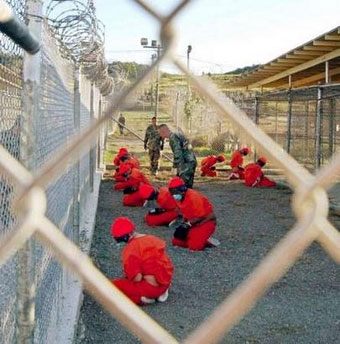
By Phil Hazlewood - LONDON
2006-01-11 09
middle-east-online.com/english/yemen/?id=15447
One of former Guantanamo detainees claims to have been abducted by CIA before ending up in Cuba.
Amnesty International released fresh claims Wednesday of the alleged torture and ill-treatment of terrorist suspects on the fourth anniversary of detainees being taken to Guantanamo Bay in Cuba.
The testimonies from three men echo similar claims made by released prisoners and include allegations from one of the men that he was abducted by the US Criminal Intelligence Agency (CIA) as part of its "extraordinary rendition" policy.
Abdulsalam al-Hela, a 34-year-old businessman from Sanaa, Yemen, allegedly "disappeared" after travelling to Egypt for a meeting with a construction firm in September 2002.
The father-of-two was shackled, blindfolded and gagged, put on a small, private plane and taken, possibly via Azerbaijan, to Afghanistan, where he was held "in secret, illegally and incommunicado" for two years, Amnesty said.
Amnesty said al-Hela suffered psychological torture at five prisons in or around Kabul, a number of them underground, before being transferred to Guantanamo Bay in September 2004.
The human rights group, with headquarters in London, said he wrote in a letter smuggled out of jail in Afghanistan: "The CIA conspired with the Egyptian Mukhabarrat (intelligence service), making false allegations and threats against me, so as to justify their crime of kidnapping me."
A number of countries have expressed concerns about the policy of extraordinary rendition to countries outside the legal process and the alleged existence of secret prisons in eastern Europe to interrogate suspects.
Washington has denied using or condoning torture but defended rendition as a "vital tool" in combating international terrorism.
Amnesty called for increased pressure to be put on the US government for the prisoners to be either released or given a fair trial and repeated its view that Guantanamo should be shut and an inquiry launched into the torture claims.
"In Guantanamo, around 500 men have been treated with complete and utter disdain of the type that nobody should be forced to endure," it said in a statement.
"It isn't surprising that after years of uncertainty about their fate, some of these men have expressed their intention to die rather than remain in Guantanamo indefinitely."
The most detailed testimony came from Jumah al-Dossari, a 32-year-old Bahraini national who was captured in Afghanistan in late 2001 and taken to Guantanamo in January 2002.
In a graphic account of his detention, given to Amnesty through his lawyer, he repeated claims made by a former detainee last year that US soldiers regularly desecrated copies of the Koran.
He also spoke of beatings, sexual assaults, threats to his family and having to endure lengthy periods in solitary confinement, plus disease, illness and infection being rife among those held at the camp.
Journalist Sami al Hajj, a 35-year-old Sudanese national working for Arabic satellite news channel Al-Jazeera, made similar allegations after being detained following an assignment covering the 2002 conflict in Afghanistan.
Amnesty said he has been interrogated constantly about possible links between his Qatar-based employers - which has angered Washington because of its reporting of the war in Iraq - and the Al-Qaeda network.